1. “Völkerrecht als Rechtsordnung”: Forschungsprogramm des MPIL
Viktor Bruns, Gründungsdirektor des Instituts, lancierte im Jahr 1929, also fünf Jahre nach Institutserrichtung, die Zeitschrift für ausländisches Recht und Völkerrecht (ZaöRV), die er mit einem langen Artikel über „Völkerrecht als Rechtsordnung“ einleitete. Dieser Aufsatz war als Auftakt einer Reihe geplant,[1] tatsächlich wurde aber nur ein Fortsetzungsaufsatz veröffentlicht.[2]
Anlässlich des fünfzigjährigen Bestehens des Instituts im Jahre 1974 widmete Direktor Hermann Mosler dem „Völkerrecht als Rechtsordnung“ wiederum einen umfangreichen Beitrag, der 1976 in der ZaöRV erschien. Ausweislich ihres Titels legen beide Beiträge dar, inwieweit das Völkerrecht nicht nur „Recht“ ist, sondern vielmehr eine „Rechtsordnung“ bildet. Wegen des in der Max-Planck-Gesellschaft geltenden Harnack Prinzips, also die Ausrichtung ganzer Institute auf die Visionen ihrer Direktoren, können diese Aufsätze durchaus als Forschungsprogramme nicht nur der Direktoren, sondern des MPIL gelten.
Laut Mosler ließ sich seinerzeit „nicht übersehen, daß die beiden Zeitpunkte – Mitte der zwanziger und Mitte der siebziger Jahre – günstige Ansätze für die Beurteilung für den Vergleich bieten. Zwischen diesen beiden Polen liegen die alsbald enttäuschten Hoffnungen auf die Wirksamkeit einer internationalen Ordnung ….“.[3] Dasselbe kann von der Mitte der 2020er Jahre gesagt werden: Hinter uns liegen die enttäuschten Hoffnungen auf die Wirksamkeit der „neuen Weltordnung“, die nach dem Berliner Mauerfall 1989 ausgerufen worden war.[4]
Der Moment ist also wieder ein günstiger, um anlässlich des 100. Institutsgeburtstages die beiden programmatischen Aufsätze der Direktoren Bruns und Mosler neu zu lesen (Teile 2 und 3) und Unterschiede und Gemeinsamkeiten herauszuarbeiten (Teil 4). In Teil 5 würdige ich den bleibenden Ertrag dieser Jubiläumsbeiträge und plädiere im Schlussteil 6 für ein aufgepepptes Programm von Völkerrecht als Rechtsordnung als Vorbedingung der Möglichkeit von wirksamer Völkerrechtskritik in einer Phase der Neu-Ordnung der Welt.
2. Bruns 1929
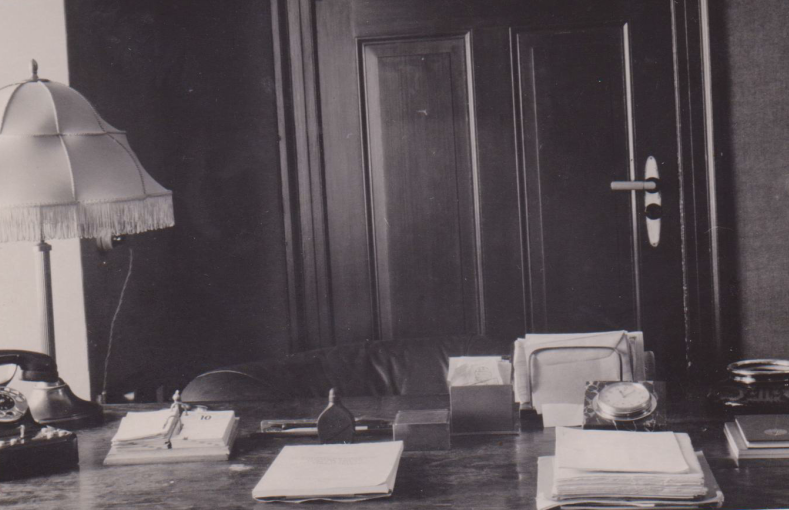
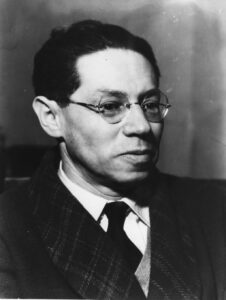
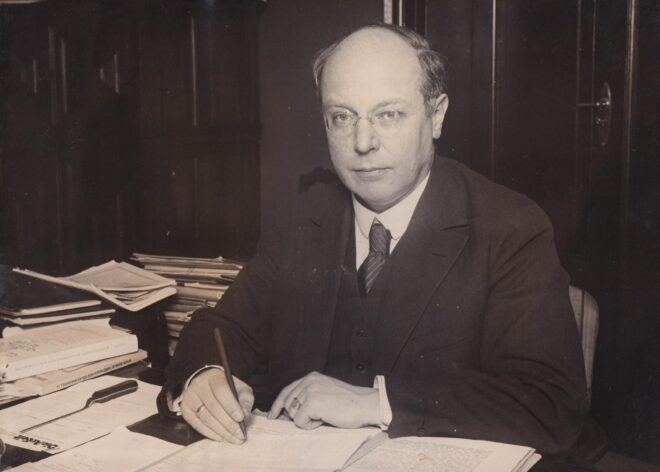
Hier verfasst? Schreibtisch von Viktor Bruns im Berliner Schloss, undatiert (Foto: Privatarchiv Rainer Noltenius)
Zum historischen Kontext von Bruns‘ Beiträgen von 1929 und 1933 gehören der verlorene Erste Weltkrieg, der von vielen Deutschen als unfair empfundene Vertrag von Versailles und die Blüte der internationalen und transnationalen Schiedsgerichtsbarkeit, die eine umfangreiche Rechtsprechung zur Bewältigung der Kriegsfolgen hervorbrachte, insbesondere durch Feststellung von Entschädigungs- und sonstigen Ansprüchen gegen den deutschen Staat.
Diese Schiedsgerichte haben den völkerrechtlichen „Rechtsstoff“ – so Bruns – „evident gemacht“.[5] Jedoch seien „die heutigen Systeme [und hiermit meinte Bruns die wissenschaftlichen Systeme] nicht ausreichend, um diesen „Rechtsstoff“ „zu erfassen“ und ein Gewebe daraus zu schaffen. Vor diesem Hintergrund suchte Bruns, „die wichtigste Aufgabe einer Wissenschaft zu erfüllen, nämlich eben jener Tätigkeit der Gerichte vorzuarbeiten und ihr die systematischen Zusammenhänge einer in sich geschlossenen Rechtsordnung aufzuzeigen“.[6] Bruns‘ Erkenntnisziele waren somit primär anwendungsorientiert. Seine zahlreichen Beispiele aus Verträgen und Rechtsprechung, insbesondere im Aufsatz II (1933) stellen diesen Anwendungsbezug auch her.
Bruns eröffnete den ersten Aufsatz mit seiner Kernthese: “Das Völkerrecht ist eine Rechtsordnung für die Gemeinschaft der Staaten, ein System von Rechtssätzen, die untereinander in einem Ordnungszusammenhang stehen.“[7] Eine Rechtsordnung ist durch ihre Systematik gekennzeichnet. Sie ist „nicht eine systemlose Zusammenfassung von einzelnen unter sich beziehungslosen Regeln und Einrichtungen“.[8]
Ausserdem – wichtig – ist sie „Ordnung in einem doppelten Sinne“: Sie schafft in der sozialen Wirklichkeit Ordnung, und zwar gerade durch ihre eigene (innere) Ordnung.[9] Anders gewendet: (Nur) aufgrund seiner inneren Ordnung kann – laut Bruns – das Recht, insbesondere das Völkerrecht, seine Aufgabe der „Ordnung“ der Welt erfüllen. Als „Wesen der Rechtsordnung“ sah Bruns das „Friedensgebot“ an.[10] Hierfür ist die Streitbelegung durch (schieds-)gerichtliche Instanzen zentral, ohne die es weder Ordnung noch überhaupt Recht geben kann.[11] Aus der Eigenschaft des Völkerrechts als Rechtsordnung folgte für Bruns, dass das Völkerrecht den Staaten positiv Kompetenzen zuweise und dass das staatliche „Persönlichkeits- oder Freiheitsrecht“ „mit Rücksicht auf die gleichgeordneten Genossen der Gemeinschaft“ nur „generell beschränkt“ sein könne, denn anders wäre „eine Rechtsordnung überhaupt nicht denkbar“.[12] Es kann somit, folgerte Bruns, keine allgemeine völkerrechtliche Handlungsfreiheit der Staaten geben.[13] Insgesamt verfolgte Bruns mit seinen Beiträgen kein geringeres Ziel als „für das Völkerrecht ein System und eine Methode zu finden“.[14]
3. Mosler 1976

Schreibtisch von Hermann Mosler im MPI 1972 (Foto: MPIL)
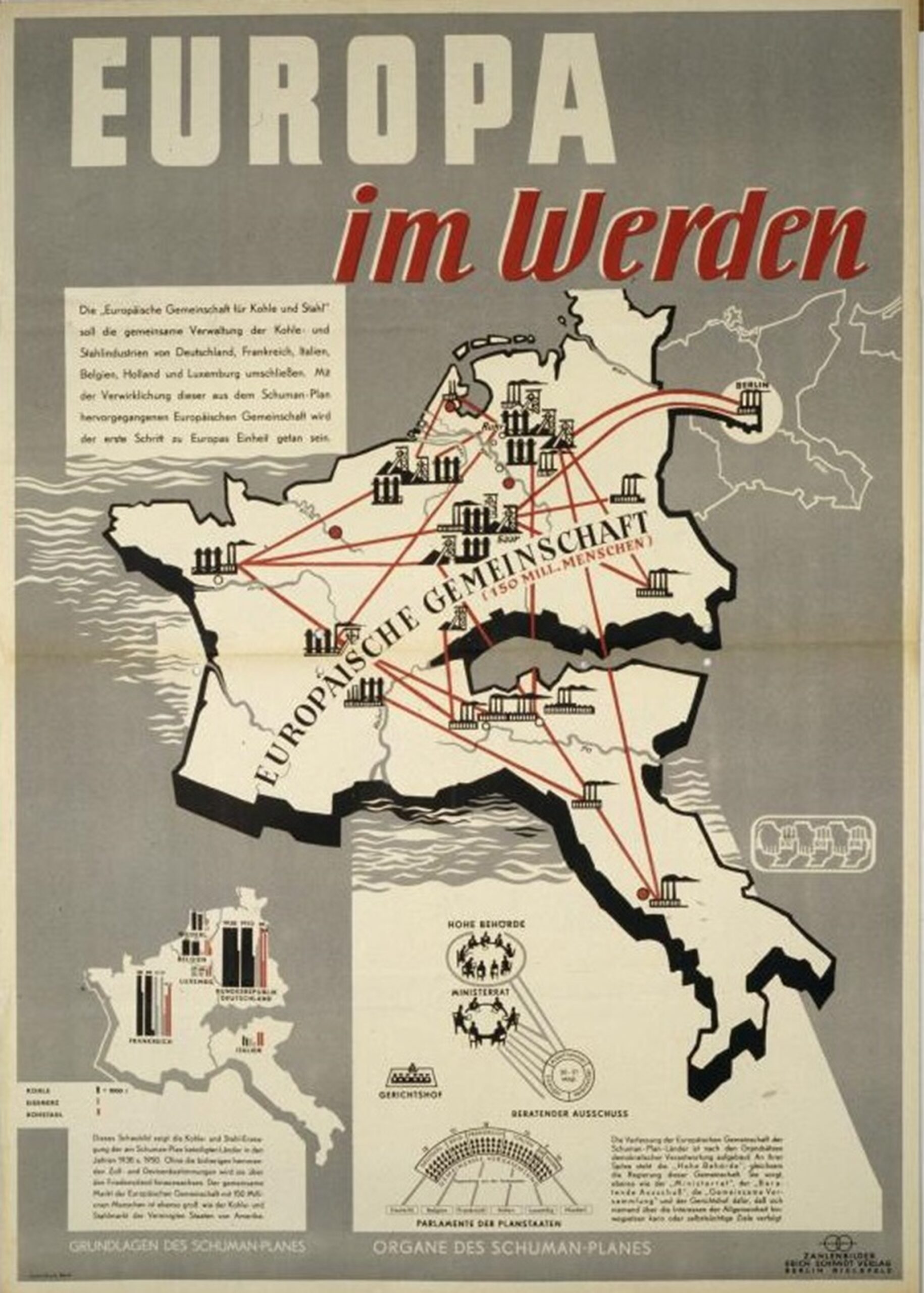
Im Jahr 1976 waren die Dekolonisierung und die damit einhergehende Aufnahme zahlreicher neuer Staaten des Globalen Südens in die Vereinten Nationen in vollem Gange. Vorausgegangen waren in Europa die Gründung der Europäischen Gemeinschaft für Kohle und Stahl (1951), zu der Mosler die deutsche Delegation beraten hatte, und dann der Europäischen Wirtschaftsgemeinschaft (1957). Die Ost-West-Blöcke hatten sich verfestigt und es herrschte der Kalte Krieg. In diesem Klima waren zwei getrennte UN-Menschenrechtpakte erarbeitet worden, die 1966 unterzeichnet wurden und die 1977 in Kraft treten sollten. Die Schlussakte von Helsinki (1975) umfasste einen sogenannten „Menschenrechtskorb“ mit humanitären Anliegen. Die UN Generalversammlung verabschiedete in den 1970er Jahren ihre grundlegenden quasi-kodifikatorischen Resolutionen, beginnend mit der Friendly Relations Declaration (1970) bis zur Definition of Aggression (1974).
Diese Ereignisse spiegeln sich in Moslers Charakterisierung der Völkerrechtsordnung. Er benannte und analysierte vier „kennzeichnende Element[e]“ „der internationalen Rechtsordnung“[15] bzw. der „modernen internationalen Gemeinschaft“[16]: Das erste Charakteristikum war „die Explosion der Mitgliederzahl der Vereinten Nationen“.[17] Das „zweite kennzeichnende Merkmal“ war „das organisatorische Element“[18] – im Gegensatz zum „unorganisierten Völkerrecht“[19] der Vergangenheit. Hier sprach Mosler den Bedeutungszuwachs internationaler Organisationen an und brachte viele Beispiele aus der Praxis der Vereinten Nationen und der Europäischen Gemeinschaft.
Die internationalen Organisationen dienen, so Mosler, der „Schaffung von Staaten durch Konvention“.[20] Durch die Beitritte zu den Organisationen, durch deren Aufnahmebeschlüsse, werden Territorien „mit ungesicherter eigener Lebensfähigkeit“[21] zu Staaten „befördert“[22]. Diese neuen Staaten des Globalen Südens unterscheiden sich „soziologisch“ von den alten Staaten des Nordens, die „notwendige Mitglieder der Völkerrechtsgemeinschaft“ waren. „Man könnte sie [die neuen Staaten] konventionelle, nicht aber soziologische oder originäre oder spontane Staaten nennen“.[23] Deren Entstehung und Aufnahme in die Organisationen „änderte auch den Charakter der internationalen Gesellschaft“.[24]
Drittens bemerkte Mosler die „Wiederauferstehung der alten Unterschiede zwischen großen und anderen Staaten“.[25] Damit spielte er auf die Vormachtstellung der P 5 im UN-Sicherheitsrat an. Das vierte Charakteristikum war eine dem Menschen zugewachsene „völkerrechtlich erhebliche Stellung“, „auch gegenüber der eigenen öffentlichen Gewalt“.[26] Mosler befand, dass „[d]ie Position der menschlichen Person“ die „in ihrem Kernbereich, je enger der Zusammenhang mit der Würde der Person ist, zum ordre public der Völkerrechtsordnung gehört“.[27]
Moslers Zugang zum Völkerrecht war praxisorientiert, und das heißt letztlich rechtsdogmatisch. Mosler lehnte beispielsweise eine „soziologische Rechtsbegründung“ ausdrücklich ab.[28] Die „Befolgung des rechtspraktischen Ansatzes“ war, wie Felix Lange herausgearbeitet hat, ein „bewusstes, politisches Programm“.[29] In einem Rückblick schreibt Mosler: „Weil unser Fach politisch bestimmte Objekte hat und weil es für politische Zwecke gebraucht und missbraucht wird, war nicht nur Leistung zu beweisen, sondern mussten auch Misstrauen und Abwehr überwunden werden“.[30]
Mosler hatte damit insbesondere den Missbrauch der nationalsozialistischen Völkerrechtstheorie im Sinn. Er hielt möglicherweise sämtliche Formen von Völkerrechtstheorie für missbrauchsanfällig. Seine (ganz überwiegend) dogmatisch geprägte und damit vermeintlich „unpolitische“ Methode sollte hiergegen schützen. Auf diesem Wege wollte Mosler Deutschland wieder in die Völkerrechtsgemeinschaft einführen. Seine Bemühungen hatten (in Kombination mit vielen anderen Faktoren) Erfolg: Die Bundesrepublik Deutschland wurde (gleichzeitig mit der DDR) als Mitglied in die Vereinten Nationen aufgenommen. Sie erhielt das Gütesiegel des „friedliebenden Staates“ (Art. 4 Abs. 1 UN Charta) ─ erst 1973, kurz vor dem 50-jährigen Institutsjubiläum und 24 Jahre nach Gründung der Bundesrepublik und Wiederbegründung des Instituts.
4. Kontinuitätslinien von Bruns zu Mosler
Der politische Kontext, der Entwicklungsstand des Völkerrechts und die Methoden der Völkerrechtswissenschaft waren im Jahr 1976 andere als noch 1929. Dennoch sollten die Unterschiede nicht überbetont werden, da vielfache Kontinuitätslinien bestanden. Das institutionelle Design der Vereinten Nationen von 1945 orientierte sich am Völkerbund, und auch die Politiken der neuen Organisation knüpften an die Völkerbundsarbeit an.[31] Das Gewaltverbot wurde zwar 1945 auf eine neue Rechtsgrundlage gestellt, war aber bereits vor den 1920er Jahren ausgebildet worden, wobei der Briand-Kellog Pakt von 1928 einen Meilenstein bildete.[32] Auch Wirtschaft, Soziales und Arbeit waren schon zu Bruns‘ Zeiten Anliegen des Völkerrechts, insbesondere des Völkerbundes und der Internationalen Arbeitsorganisation (ILO), und sie blieben es in der Ära Mosler.
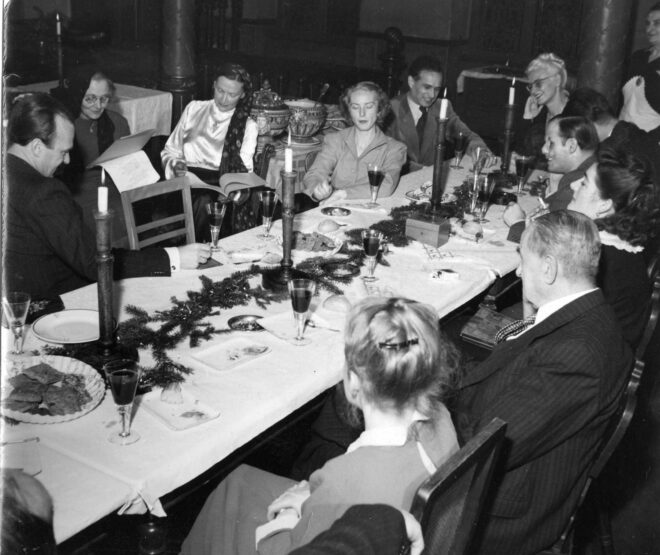
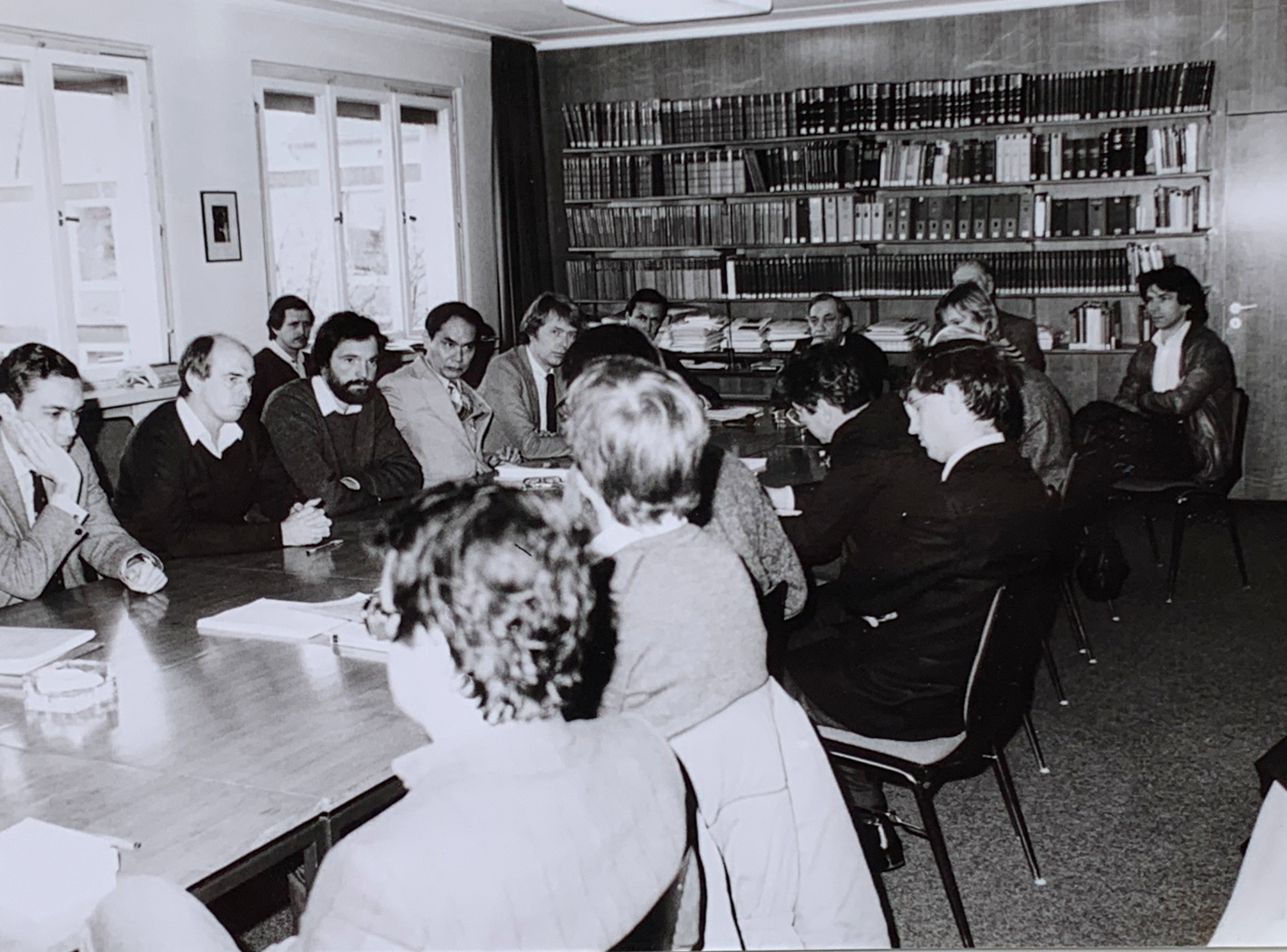
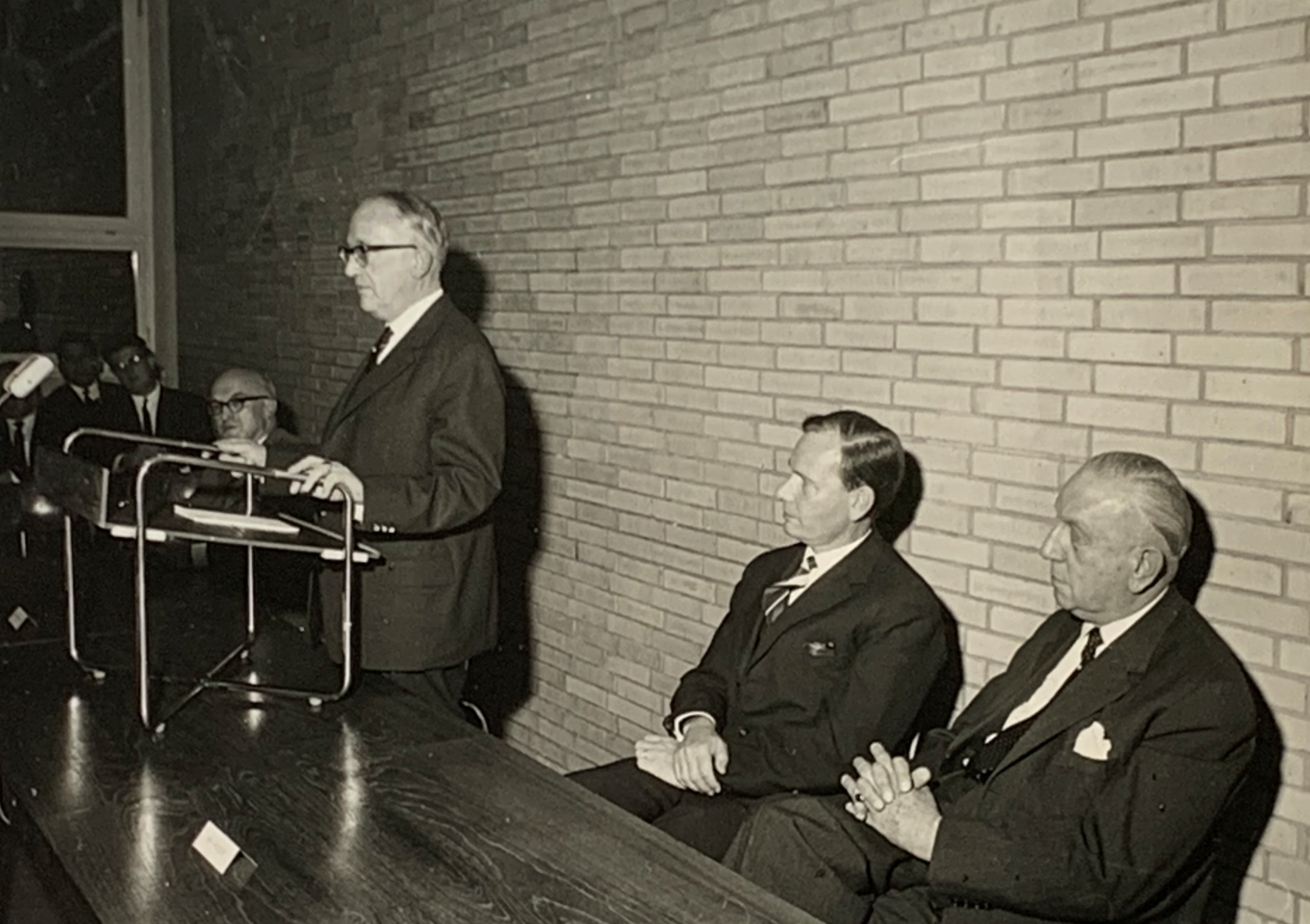
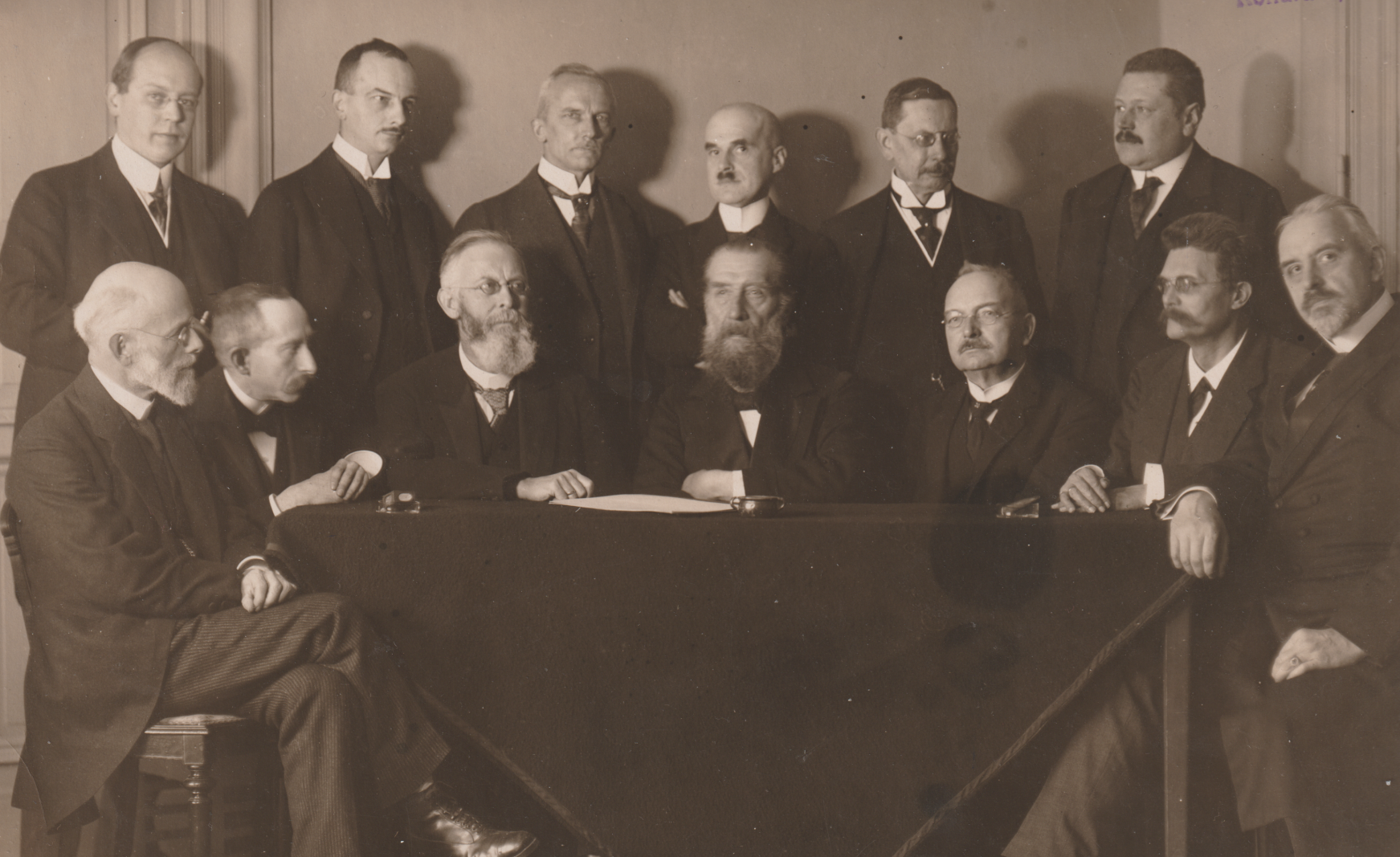
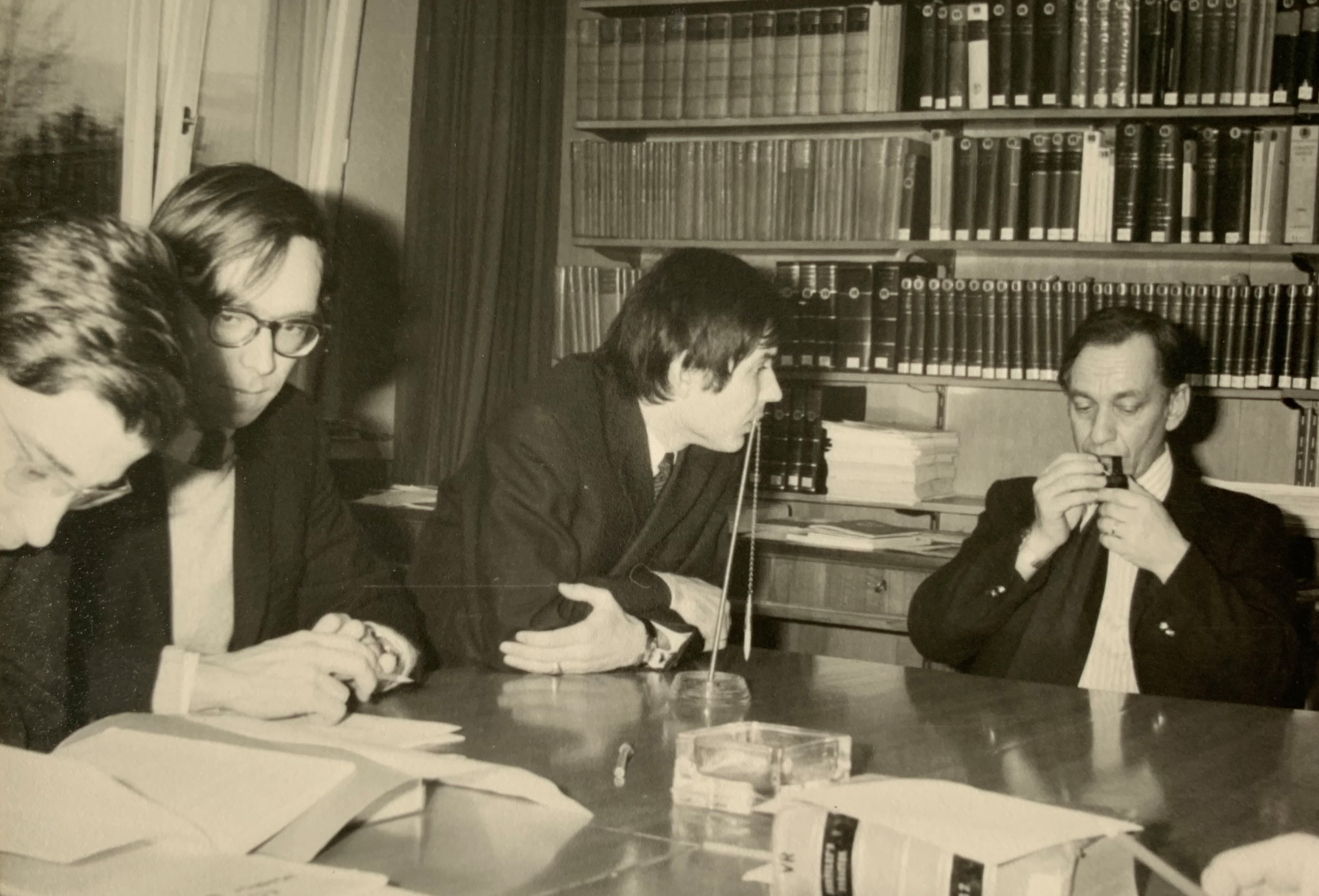
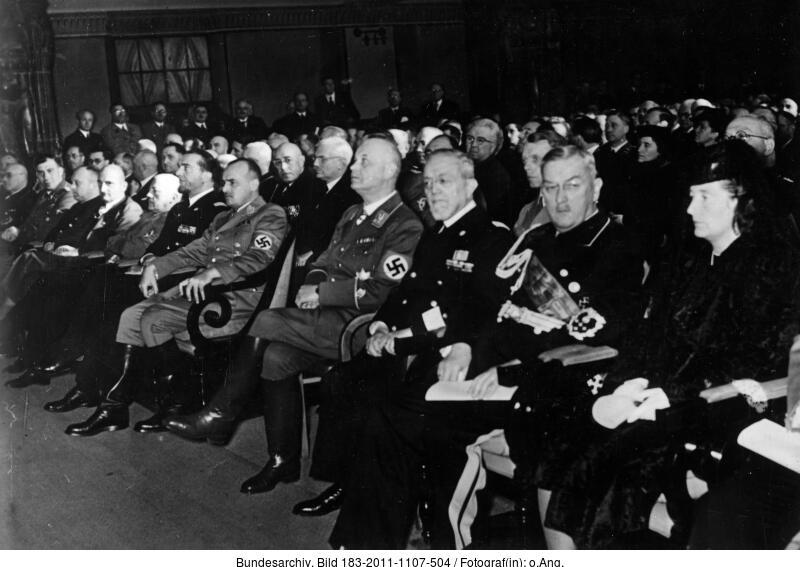
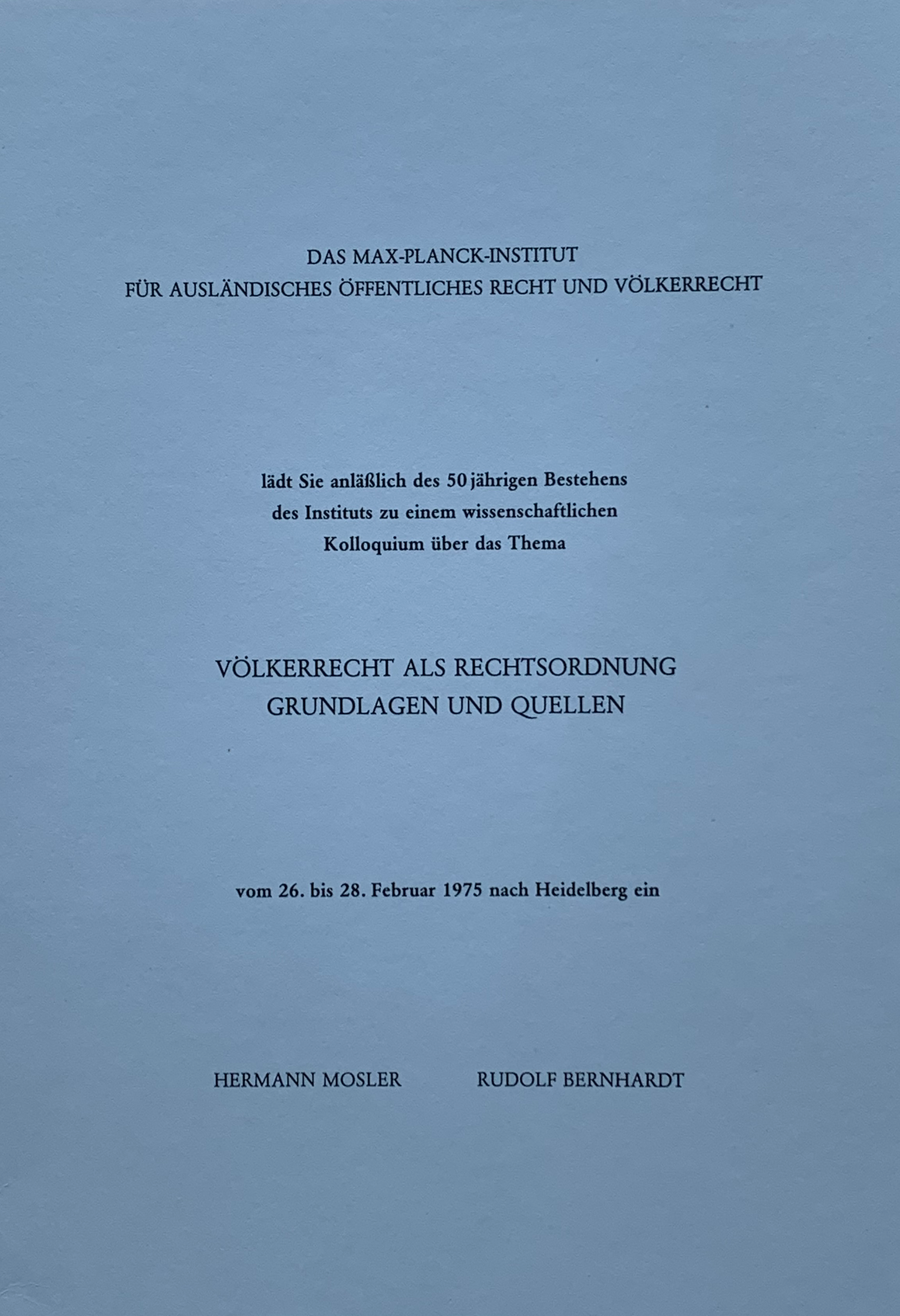
Betonung der Kontinuität. Jubiläumskolloquium “Völkerrecht als Rechtsordnung” 1975 (Foto: MPIL)
Die wirklich neuen Themen der 1970er Jahre waren die Dekolonisierung und die Bedrohung der natürlichen Lebensgrundlagen des Menschen, die auf völkerrechtlicher Ebene mit der Stockholmer Erklärung der UN-Generalversammlung von 1972 aufgegriffen worden war.[33] Das letztgenannte Thema jedoch erwähnte Mosler mit keinem Wort.
Auf den ersten Blick besteht ein starker Gegensatz zwischen der Bruns‘schen strikt zwischenstaatlichen Ordnung[34] und Moslers Einbeziehung von internationalen Organisationen und Individuen. Jedoch weist auch Mosler den neuen Akteuren klar den Status von zweitklassigen Völkerrechtssubjekten zu. Die Organisationen sind nur „jeweils ein Homunkulus der Staaten“,[35] von ersteren erzeugt, getragen, und beseitigbar; sie besitzen keine „Existenz aus sich selbst“ und sind „nicht der Rechtsordnung vorgegeben“[36], sind nicht „primäre oder ursprüngliche oder notwendige Rechtsubjekte“ wie die (europäischen) Staaten.[37] Auch die veränderte Position des Individuums berührte nach Mosler „die spezifische Strukturfrage der Völkerrechtsordnung … nicht“.[38] Diese blieb „eine im wesentlichen auf den Staaten aufbauende Rechtsordnung“.[39]
Mosler schätzte Bruns‘ Darlegung der Lückenlosigkeit des Völkerrechts als eine „in sich geschlossene Rechtsordnung“[40] und folgte ihr. Lückenlosigkeit oder „Geschlossenheit“ bedeutete für Bruns, dass die Regeln und Grundsätze des Völkerrechts „vollständig“ sind und somit die staatliche Handlungsfreiheit konstituieren und damit auch begrenzen.[41] Mosler legte diese Vollständigkeit bzw. Lückenlosigkeit der Völkerrechtsordnung zugrunde.[42] Er nahm – wie Bruns[43] – an, dass „die Grenzen der staatlichen Kompetenz durch das Völkerrecht festegelegt würden.[44] Beide Direktoren lehnten dementsprechend das Lotus-Prinzip des Ständigen Internationalen Gerichtshofs, die Vermutung einer allgemeinen Handlungsfreiheit der Staaten, ab.[45]
Das Forschungsprogramm beider Direktoren war praxisorientiert. Dem entsprach am besten die rechtsdogmatische Methode. Einige Völkerrechts- und Völkerrechtswissenschaftsverständnisse wurden von den Direktoren entweder nicht thematisiert oder ausdrücklich zurückgewiesen. Beide Direktoren lehnten einen Rechtspositivismus kelsenianischer Prägung ab, wobei Bruns keine erkennbare alternative Rechtstheorie anbot.[46] Bruns argumentierte sehr rechts-logisch und rein rechts-immanent, so dass der jeweilige Gedankengang vollkommen von den juristischen Prämissen abhing. Er wies zahlreiche Überlegungen als sozusagen juristisch unmöglich zurück, da sie nicht „denkbar“ oder nicht „denkmöglich“ seien, wohingegen die von ihm angeführten Argumente „apriorisch“ oder dem „Wesen“ (des Völkerrechts, der Ordnung usw.) gemäß und somit korrekt seien.
Mosler bekannte sich demgegenüber ausdrücklich zu einer naturrechtlichen Grundlegung des Völkerrechts.[47] Mosler suchte also den „Geltungsgrund“ des Völkerrechts[48] und arbeitete die charakteristischen Elemente der Ordnung heraus, insbesondere „Verfassungselemente der Völkerrechtsgemeinschaft“.[49]
Diese Unterschiedlichkeit der Zugänge zum Völkerrecht wird von einer Gemeinsamkeit überwölbt: Beide Direktoren betrachteten das Völkerrecht vorrangig instrumentell. Dieses Recht war ein Werkzeug (oder eine Waffe) und sollte im Interesse Deutschlands optimal auch auf der außenpolitischen Bühne genutzt werden können. Diesem Ziel diente die völkerrechtswissenschaftliche Arbeit am MPIL. Mosler benannte klar den historischen Hintergrund der Institutsgründung: Es ging um den “Kampf gegen den als ungerecht empfundenen Vertrag von Versailles“. „Die rechtlichen Mittel, die das Vertragswerk selbst an die Hand gab, sollten ausgeschöpft werden.“ „Das Institut verdankt seine Entstehung weitgehend dem Bedürfnis, die Auseinandersetzung mit soliden völkerrechtlichen Argumenten auf der Basis einer umfassenden Dokumentation zu führen.“ Dennoch „sei das Institut kein Hilfsinstrument der Reichsregierung, sondern ein Institut der Grundlagenforschung“ gewesen, zunächst mit der Hauptaufgabe des Aufbaus einer Materialsammlung.[50]
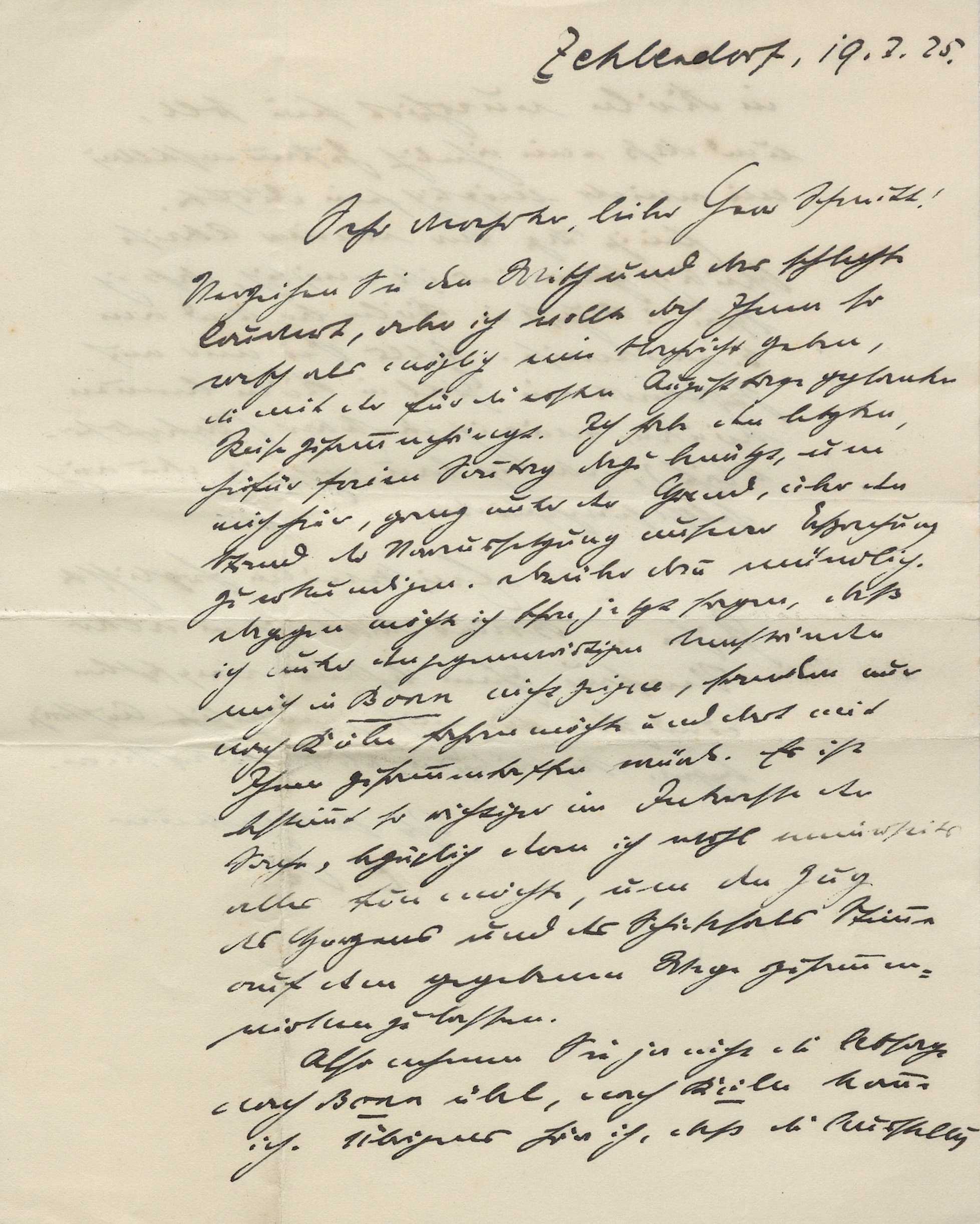
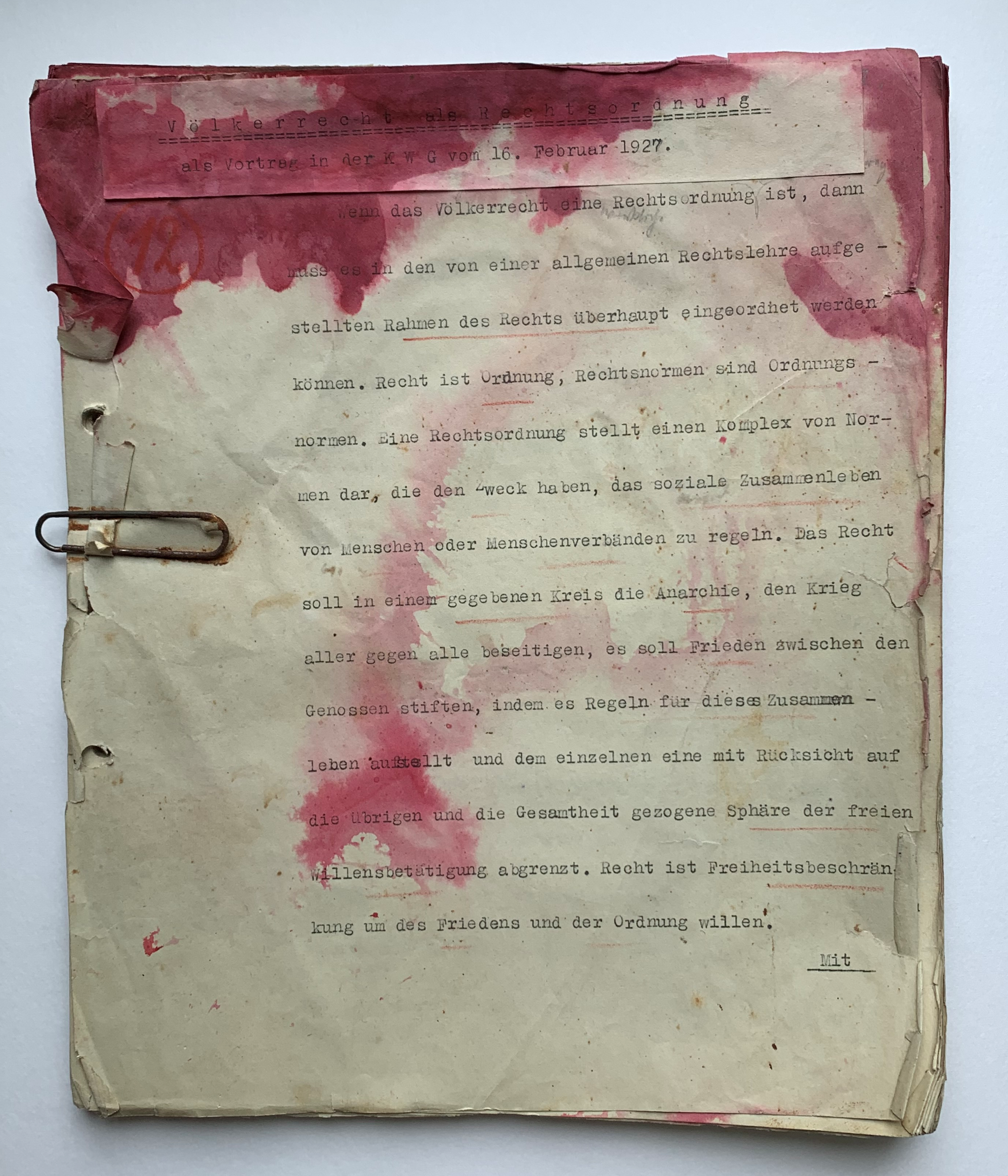
In Bruns‘ Aufsatz wird dieser Sammel- und Systematisierungsauftrag explizit gemacht, nicht aber der Einsatz des Völkerrechts als Waffe für Deutschland. Die (rein) deutsche Perspektive wird jedoch überdeutlich im Vorwort der neuen ZaöRV. Hier zählt Bruns zu den “Hauptproblemen der Gegenwart: Das Reparationsproblem, die Auslegung der Friedensverträge, das Minderheitenproblem“.[51] Diese drei Themen waren, global gesehen, nicht unbedingt die wichtigsten zeitgenössischen Völkerrechtsfragen, aber sie waren tatsächlich die wichtigsten Fragen für Deutschland. Dazu passt das dem Aufsatz von 1929 zugrundliegende Vortragsmanuskript „Völkerrecht als Rechtsordnung“.[52] Es endet mit den Worten: „Ich glaube, wir Deutschen haben von einem Sieg des Rechts alles zu hoffen und nichts zu fürchten.“
Mosler vertrat ebenfalls deutsche Interessen. Im seinem bereits erwähnten Rückblick nannte er die “Wiedergewinnung einer Position im internationalen Austausch“ als das „Hauptziel“ des Instituts in der Nachkriegszeit.[53]
Im Ergebnis war das Forschungsprogramm beider Direktoren (und damit auch dasjenige des Instituts) von mehr oder minder intensivem epistemischem Nationalismus geleitet. Dies hängt nicht zuletzt damit zusammen, dass beide Direktoren Deutschland (bzw. die Bundesrepublik) in einer parallelen Situation vorfanden: Nach einem verlorenen Weltkrieg, als geschwächter Staat, ja als Paria-Staat, der seinen Platz in der Gemeinschaft zivilisierter Staaten erst wieder erringen musste, unter anderem mit völkerrechtlichen Argumenten – lawfare für Deutschland.
5. Rückblick auf Erkenntnisse von Bruns und Mosler
a) Viktor Bruns
Während Bruns seinen Aufsatz vorbereitete, wurden anderswo ideengeschichtliche Fundamente gelegt, deren Bedeutung für das heutige Völkerrecht und die Völkerrechtswissenschaft damals kaum zu erahnen war. Die Muslimbrüderschaft, deren Ableger Hamas heute als globale Terrororganisation mit Sanktionen belegt wird,[54] ist 1928 gegründet worden. Im selben Jahr publizierte Margret Mead Coming of Age in Samoa, das zum Kultbuch in späteren Diskursen um Kulturrelativismus und Rechtspluralismus avancieren sollte.
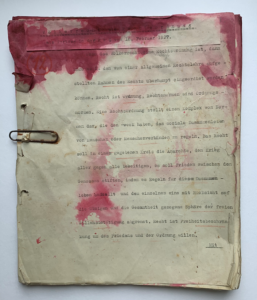
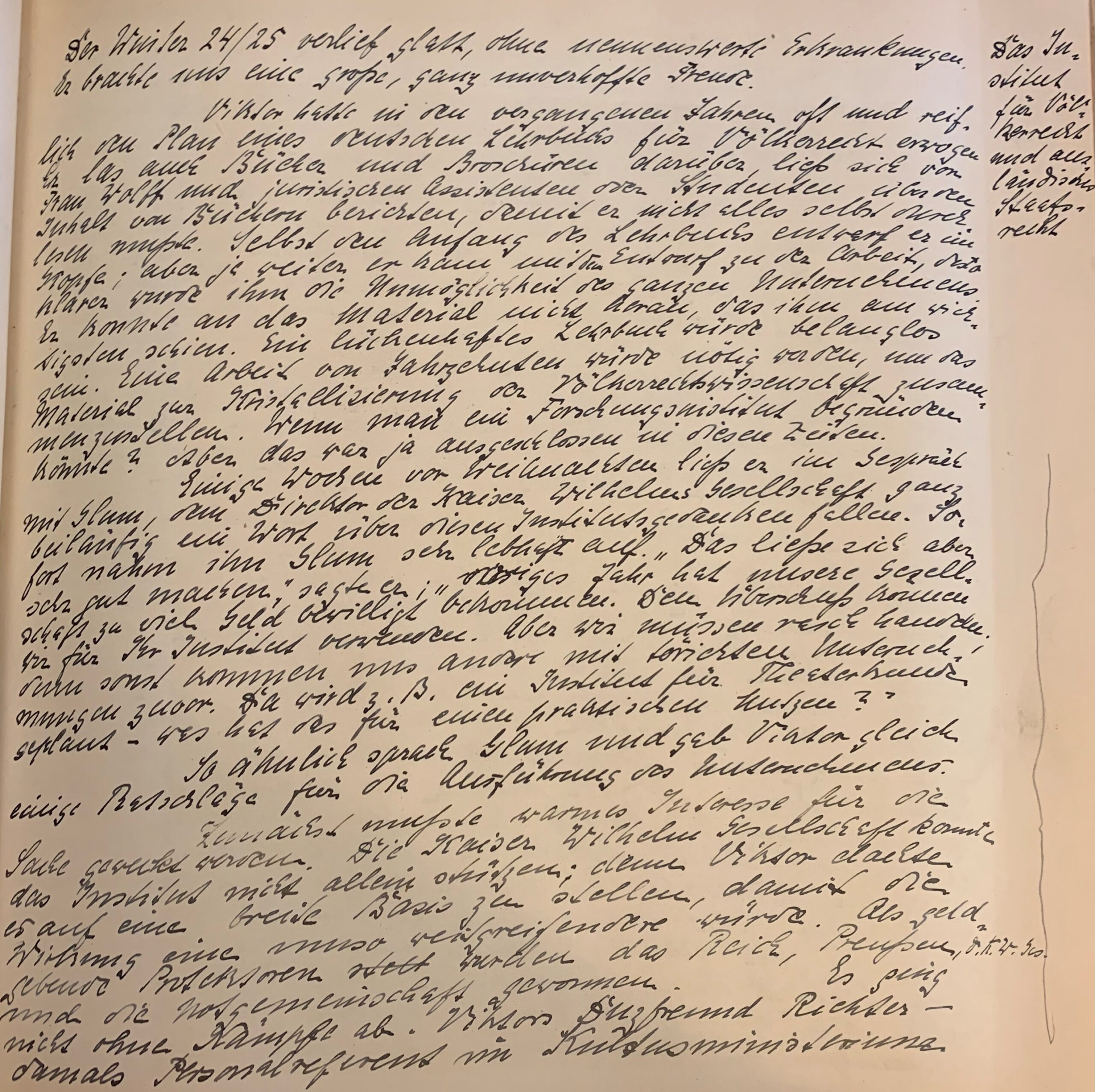
Vortragsmanuskript “Völkerrecht als Rechtsordnung” von Viktor Bruns 1927 (Foto: MPIL)
Viktor Bruns dürfte durch familiäre und gesellschaftliche Kontakte über das ganze Spektrum wissenschaftlicher Innovationen seiner Zeit, auch und gerade in den Geistes- und Sozialwissenschaften informiert gewesen sein.[55] Offenbar entschied er sich bewusst für eine streng rechtsdogmatische Herangehensweise, unter Verzicht auf transdisziplinäre Kontextualisierungen oder Methoden. Als „ein Hauptverdienst der Bruns’schen Arbeit“ würdigte jedenfalls Mosler den von Bruns „durch rationale Argumentation und Staatenpraxis“ begründeten Nachweis der Lückenlosigkeit des Völkerrechtsordnung.[56] Bruns vertrat hier – wieder in den Worten Moslers – einen „für die damalige Zeit fortschrittliche[n] Gedanke[n]“.[57] Mit diesem stellte sich Bruns gegen „die zeitgenössischen Verfechter des staatlichen Souveränitätsdogmas“.[58]
Tatsächlich folgt heute die (deutsche) Literatur tendenziell der von Bruns vehement vertretenen und aus dem Ordnungs-Charakter „abgeleiteten“ Ansicht, dass die Staaten jeweils spezielle Handlungsermächtigungen benötigen.[59] Demgegenüber ging der IGH in seinem Kosovo-Gutachten wieder Lotus-mäßig davon aus, dass alles erlaubt sei, was nicht spezifisch vom Völkerrecht verboten ist.[60]
Bruns erwähnte zahlreiche Völkerrechtsthemen, die im Jahr 1929 angelegt wurden und die bis heute von zentraler Bedeutung sind, gar nicht. Das Gewaltverbot kommt nicht vor, obwohl der Briand-Kellog-Pakt 1929 in Kraft trat. Das humanitäre Völkerrecht wurde nicht genannt, obwohl die Rotkreuzbewegung im Jahr 1929 formalisiert wurde und zwei Genfer Konventionen im selben Jahr unterzeichnet wurden. Menschenrechte waren kein Thema, obwohl Bruns die Vorbereitungen einer “Déclaration des droits internationaux de l‘ homme” kennen musste, die am 12. Oktober 1929 vom Institut de Droit International verabschiedet wurde.[61]
Auch der Völkerbund kam bei Bruns praktisch nicht vor, außer im Kontext langatmiger Erörterungen zur domaine réservé. Dementsprechend fehlt bei Bruns jegliche Reflexion zur möglicherweise neuartigen Qualität dieser Organisation und ihrer Arbeit.[63] Da Bruns also den Genfer Geist[64] gar nicht mit trug, trifft ihn der spätere Vorwurf des naiven Idealismus nicht.[65] Insgesamt dürfte Bruns bleibendes Verdienst die von ihm angeregte und angeleitete Sammeltätigkeit und damit verbundene Rechtssystematisierungsleistung des Instituts sein.
b) Hermann Mosler

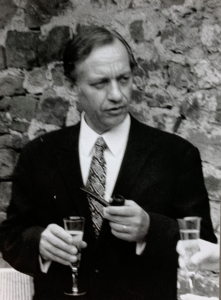
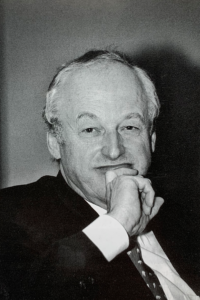
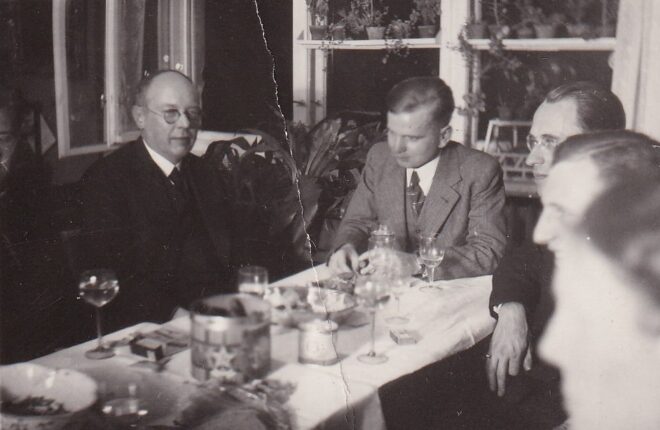
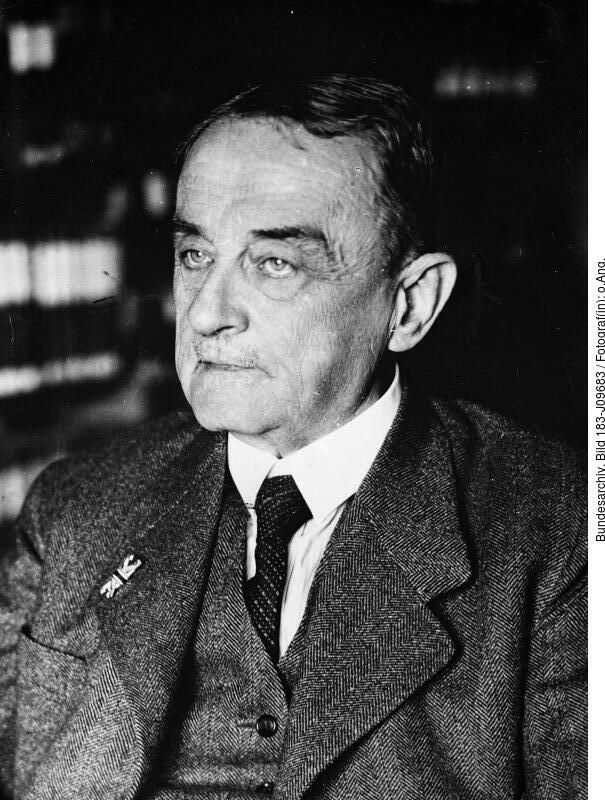
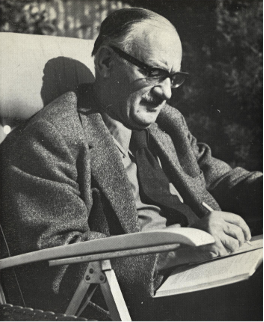
Hermann Mosler 1975 (Foto: MPIL)
Mosler war aus meiner Sicht innovativer und visionärer. Er hat die „Erweiterung des Kreises der Völkerrechtssubjekte“ frühzeitig erkannt und rechtsdogmatisch eingeordnet.[66] Mit seiner allgemeinen Haager Vorlesung zu diesem Thema[67] erreichte er auch ein internationales Publikum.
Mosler qualifizierte das Selbstbestimmungsrecht progressiv als „peremptory norm“.[68] Dies könnte damit zusammenhängen, dass dieses Recht in der völkerrechtlichen Diskussion zum Status der der Bundesrepublik Deutschland und für die „Deutsche Frage“ zentral war. Der IGH konnte sich zur Qualifikation des Selbstbestimmungsrechts als Ius cogens (bei Fremdbesetzung) erst 48 Jahre später in seinem Gutachten zu Palästina durchringen.
Demgegenüber sprach Mosler den Resolutionen der UN-Generalversammlung keine völkerrechtserzeugende Kraft zu. Eher sah er „die bisher nicht vermiedene Gefahr, daß durch politisch motivierte Mehrheitskombinationen ein nicht repräsentatives Bild der Rechtsüberzeugung vermittelt wird“.[70] Damit blieb er wesentlich zurückhaltender als (von ihm nicht zitierte) Kollegen, die diesen Resolutionen bereits Jahre zuvor eine erhebliche normative Relevanz beigemessen hatten.[71]
Schliesslich war Mosler meilenweit von einer postkolonialen Weltsicht entfernt, die Kollegen aus dem globalen Süden damals vertraten. Der letztlich gescheiterte Versuch des globalen Südens, eine neue Weltwirtschaftsordnung (NIEO) durchzusetzen, ging an Mosler – jedenfalls ausweislich seiner hier untersuchten Programmschrift – fast völlig vorbei: Mosler erwähnte nicht die einschlägigen Generalversammlungsresolutionen,[72] sondern lediglich die Charta über die wirtschaftlichen Rechte und Pflichten als „das bekannteste Beispiel“ der aktuellen Generalversammlungsresolutionen, welche „Tendenzen zur Weiterentwicklung des Völkerrechts zum Ausdruck (…) bringen“.[73] So überrascht es kaum, dass Mosler jegliche Kritik an einer “neoliberalen“ Völkerrechtsordnung fremd blieb, die bereits von französischen Kollegen formuliert worden war.[74]

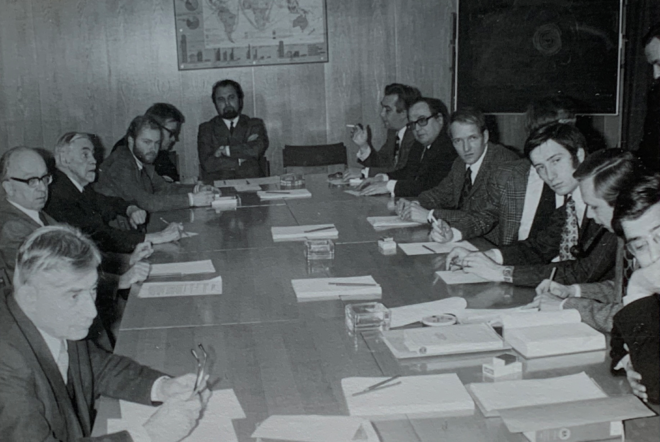
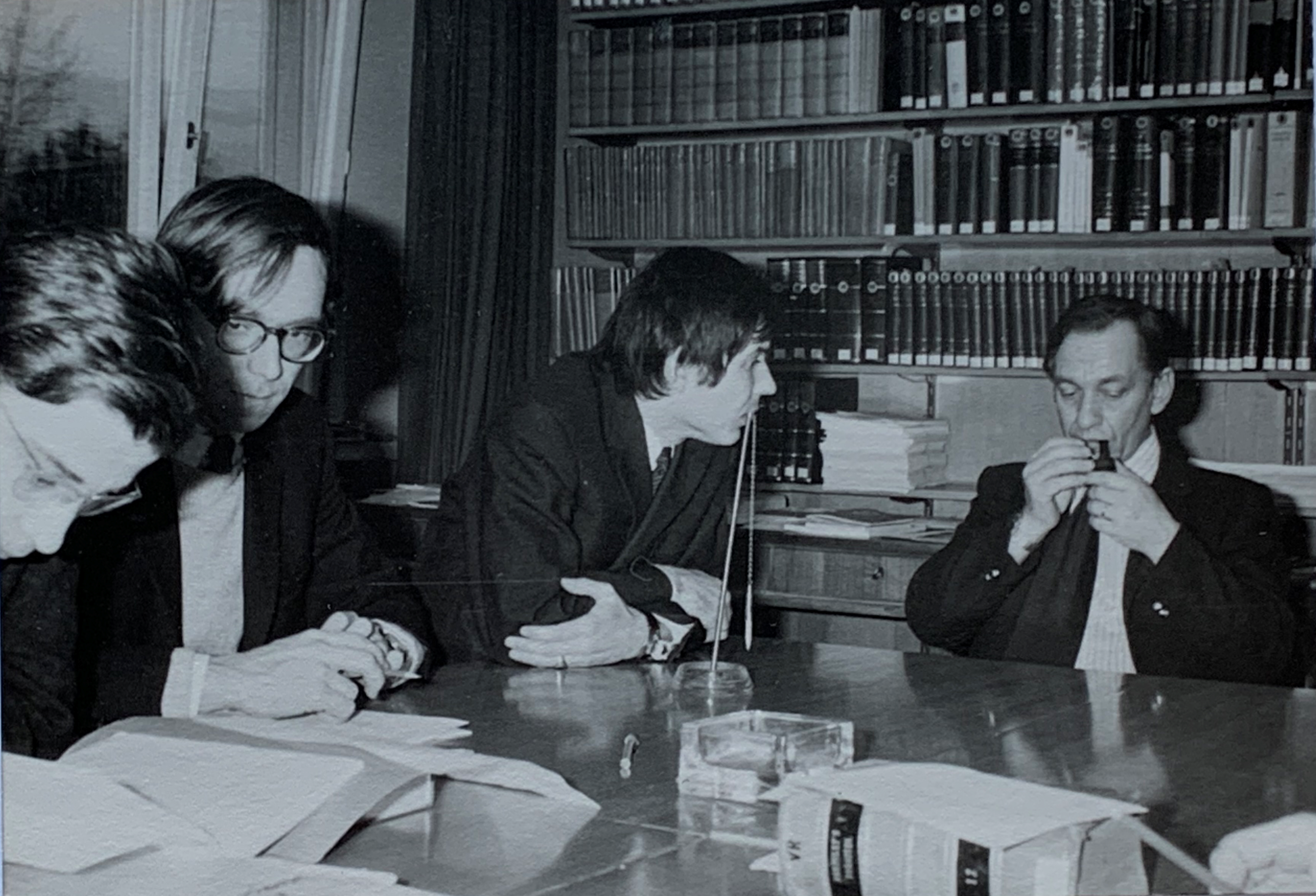
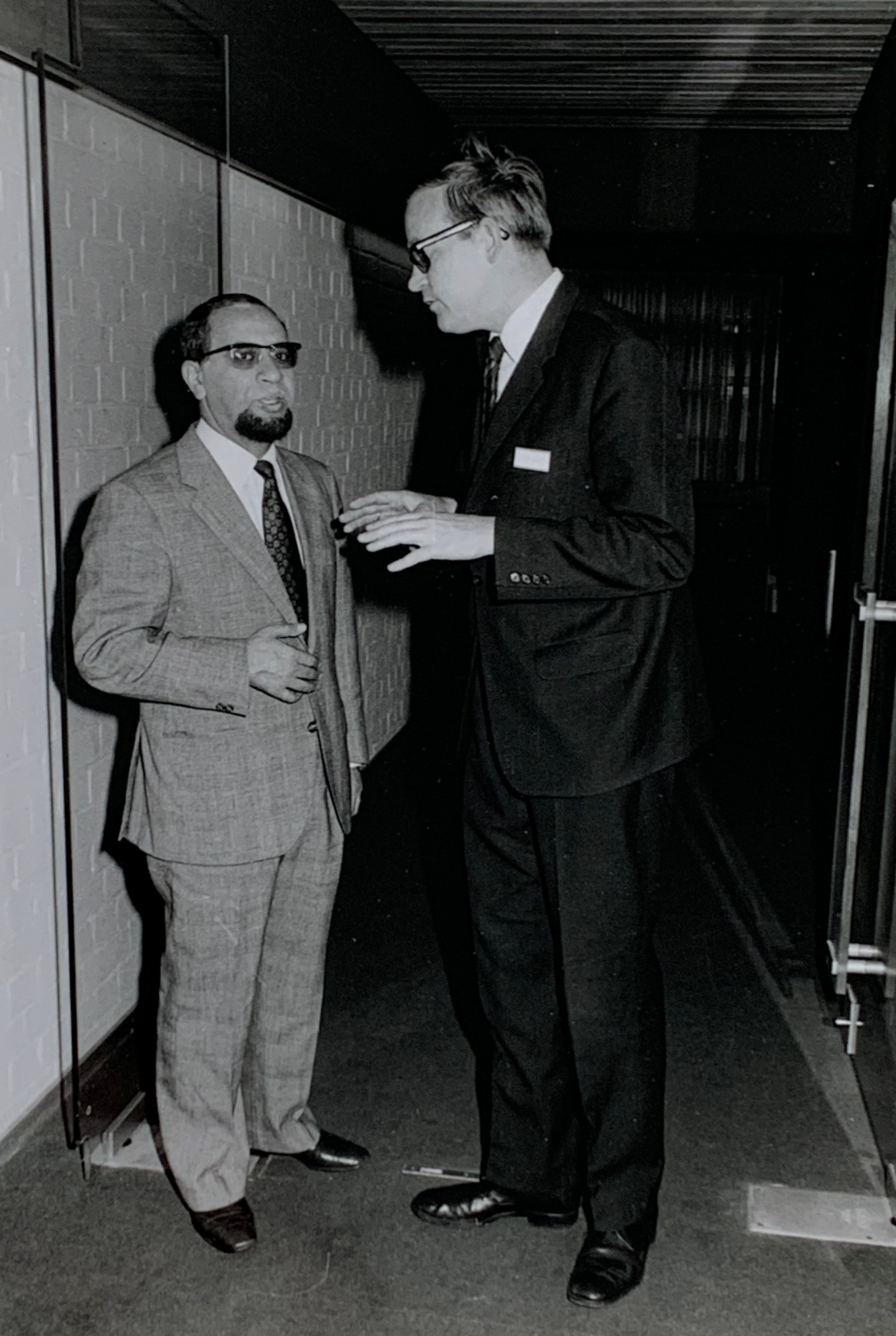
Mohammed Bedjaoui und Georg Ress 1972 auf dem Institutskolloquium “Judicial Settlement” (Foto: MPIL)
Mosler äußerte Vorbehalte gegenüber den neuen Staaten des globalen Südens, den „Territorialverbänden mit ungesicherter eigener Lebensfähigkeit“,[75] die „das Bild der überkommenen Staatengemeinschaft“ „stören“.[76] Anti-kolonialistische Völkerrechtler waren zu dieser Zeit als Gastforscher am MPIL präsent. Vielleicht bereitete Mohamed Bedjaoui hier sogar seine Haager Vorlesung vor, in der er die bestehende Völkerrechtsordnung als eurozentrisch, neokolonial, imperialistisch und oligarchisch kritisierte.[77] Diese Kritik hielt Mosler offenbar nicht für erwähnenswert.
Die Befassung der Völkerrechtswissenschaft des neuen Millenniums mit dem Kolonialismus, die These seiner konstitutiven Bedeutung für das Völkerrecht als Rechtsordnung, die Bewältigung und Kritik der kolonialen Kontinuitäten in den Third-World Approaches to International Law (TWAIL), die Renaissance der Ideen der NIEO und das Aufkommen von Reparationsforderungen wegen Sklaverei und Kolonialismus – all dies konnte Mosler nicht vorhersehen. Der Eurozentrismus der Direktoren und der von ihnen geleiteten Institute entsprach dem damals und bis heute herrschenden Wissenschaftsstil.
6. Völkerrecht als Rechtsordnung 2024
Ist – über die eben geschilderten Einzelerträge hinaus – Bruns‘ und Moslers völkerrechtswissenschaftlicher Zugriff heute noch zeitgemäß? Oder ist die Frage nach dem Völkerrecht als Rechtsordnung obsolet?
a) Weltordnung im Umbruch
Seit Moslers Zeiten sind gut fünfzig Staaten und 4 Milliarden Menschen zur Völkerrechtsordnung hinzugestoßen, die den legitimen Anspruch der Mitgestaltung und der stärkeren Berücksichtigung ihrer Bedürfnisse, Interessen und Werte erheben. Hinzukommen tausende internationale Organisationen, zivilgesellschaftliche Akteure und transnationale Unternehmen sowie kriminelle und terroristische Netzwerke. Im Jahr 2024 liegt das politische Programm der von China und Russland angeführten anti-liberalen Allianz einer „Neuen Weltordnung“ offen zutage.[78] Dieses Programm jener Akteure, die vom Völkerrechts-taker zum Völkerrechts-shaper mutierten, zielt auf Ordnung ab, und zwar auf eine neue.
Ist parallel hierzu eine völkerrechtswissenschaftliche Suche nach Ordnung überhaupt sinnvoll? Diese Frage stellt sich vor dem Hintergrund eines tiefgreifenden Legitimitätsverlustes der geltenden Völkerrechtsordnung, der in veränderten Ideen, Interessen und Machtkonstellationen begründet liegt. Die Schlagworte der „post-westlichen“, „post-liberalen“ und post-Amerikanischen Ordnung kennzeichnen diese ideellen und materiellen Verschiebungen.[79]
b) Bruns und Mosler als praxisbegleitende und praxisermöglichende Völkerrechtswissenschaftler
In diesem Kontext des tiefgreifenden Umbruchs und der Neuorientierung besteht ein großer Bedarf an kritischen (irritierenden) völkerrechtswissenschaftlichen Untersuchungen, vielleicht mehr als an konformistischen (ermöglichenden) Beiträgen.[80] Demgegenüber weisen die Charakteristika der wissenschaftlichen Betrachtung von Bruns und Mosler auf eine Neigung zur zweitgenannten, konformistischen, praxis-begleitenden und -ermöglichenden Form von Völkerrechtswissenschaft hin: Erstens muss nach Bruns und Mosler „systemkonform“ argumentiert werden. Die argumentativen Bemühungen um die Geordnetheit des Völkerrechts sind rechts-„interne“ Betrachtungen. Sie nahmen bei Bruns die Form des „Nachweises“ der Lückenlosigkeit und des Aufzeigens („notwendiger“) allgemeiner Rechtsgrundsätze an.[81] Mosler verfolgte dasselbe Ziel mit Verweisen auf „Verfassungselemente“, auf zwingendes Völkerrecht[82] und mit einer dogmatischen Fundierung der Völkerrechtspersönlichkeit.[83] Bruns und Mosler sahen also als Aufgabe der Völkerrechtswissenschaftler*innen, die juristische innere Ordnung, die Rechtssystematik, durch Auslegung (Erklärung der Bedeutung des Normgehalts), durch Freilegung der den Einzelnormen zugrunde liegenden Rechtsprinzipien, durch das Aufzeigen „logischer“ Widersprüche, durch Lückenfüllung, also mit Hilfe des gesamten dogmatischen Werkzeugkastens, offenzulegen, zu bewahren und zu erhalten und dadurch jedenfalls ansatzweise erst herzustellen. Das zweite Charakteristikum ist Bruns‘ und Moslers‘ deutliche Anwendungsorientiertheit.
Beide Charakteristika, die wissenschaftliche Wahrung bzw. Herstellung von „Ordnung“ und „System“ und die Praxisorientierung scheinen ─ auf den ersten Blick ─ die Formulierung von Kritik (also die erstgenannte Dimension von Völkerrechtswissenschaft) zu erschweren. Zurecht bemängelt Sué González Hauck: „Die Vorstellungen von System, Ordnung und Kohärenz trugen wesentlich dazu bei, die Versuche der Dritten Welt, das Völkerrecht neu zu gestalten, als politisch zu kennzeichnen und ihnen vorgeblich neutrale und juristische Argumente entgegenzusetzen, die zufällig die westliche Dominanz bewahrten“.[84]
Die monierte konservierende und status-quo Privilegien-sichernde Tendenz des völkerrechtswissenschaftlichen Zugriffs im Stil von Bruns und Mosler kann mit einigen methodischen Ergänzungen abgemildert werden. Mit diesen Ergänzungen kann das Programm die aktuellen Bedürfnisse nach einer wirksamen, konstruktiven und sogar transformativen wissenschaftlichen Völkerrechtskritik befriedigen, wie sogleich darzulegen ist.
c) Überwindung und Vermittlung: Ordnung des Rechts als Bedingung der Möglichkeit wirksamer Rechtskritik
Ausgangspunkt der Überlegung ist, dass jegliche Kritik am Völkerrecht (also etwa eine realistische, die konstitutionalistische, die postkoloniale, die marxistische, die ökologische oder neomaterialistische) zunächst von aussen an dieses Recht herangetragen wird. Die Verantwortung der Völkerrechtswissenschaft liegt darin, das Völkerrecht nicht zum bloßen „Spielball“ von Kritikbewegungen werden zu lassen. Es ist Aufgabe der Wissenschaftler*innen, Kritik so zu formulieren, dass sie „Transformationen aus dem Inneren des Rechts heraus anstößt, um den Widerspruch der rechtlichen Ordnung zu den Erfordernissen [globaler] sozial-ökonomischer Gerechtigkeit zu benennen und die Gewalt des Rechts hierdurch abzumildern“.[85]
An dieser Stelle kann die (von Bruns und Mosler geforderte) wissenschaftliche Herstellung von Rechtsordnung sinnvoll eine externe mit einer internen Kritik verbinden und damit die gegenwärtig notwendige Völkerrechtskritik schlagkräftig machen. Eine solche Verbindung (Vermittlung oder „Dialektik“) ist leistungsstärker als eine rein externe oder eine rein interne Rechtskritik. Eine rein externe Kritik am Völkerecht kann keine rechtsändernde Wirkung entfalten, weil sie das Recht gar nicht erreicht, wenn sie nicht in juristische Argumente überführt wird. Ausserdem sind extern gesetzte Maßstäbe letztlich austauschbar und erscheinen willkürlich. Eine rein interne Kritik wiederum hat keinen Biss, weil sie ihrerseits gesellschaftlich und historisch kontingent ist, innerhalb eines unhinterfragten Wertehorizonts verharrt („blinde Flecken“ hat) und tendenziell konservierende Züge aufweist. Am wirksamsten ist die Rechtskritik also, wenn sie zugleich intern und extern argumentiert.[86]
Ein rechts-interner wissenschaftlicher Zugriff auf das Völkerrecht verbindet mit geordnetem Recht die Erwartung einer tatsächlichen „Ordnung“ der Welt. Zwar ist umstritten, ob und wieviel Völkerrecht überhaupt zur Stabilisierung und Befriedung der internationalen Beziehungen beiträgt. Generationen politikwissenschaftlicher Vertreter einer „realistischen“, also primär machtpolitisch orientierten, Betrachtungsweise der internationalen Beziehungen bezweifeln dies.[87] Dem gegenüber stand und steht die „Frieden durch Recht“-Bewegung, die Ende des 19. Jahrhunderts aufkam und die Haager Friedenskonferenzen, die Gründung der Haager Akademie für Völkerrecht und den Völkerbund trug.[88] Die Bemühungen um geordnetes und dadurch ordnendes Recht sind alles andere als passé. Sie kehren wieder in der Fragmentierungsdebatte des frühen Millenniums und in der aktuellen Abarbeitung aller (traditionellen) Rechtsquellen in der International Law Commission (ILC). Insbesondere die Suche nach allgemeinen Prinzipien ist ein Evergreen: Die Draft conclusions der ILC zu general principles (2024) weisen den allgemeinen Rechtsgrundsätzen ausdrücklich die Funktion der Erzeugung von Kohärenz des Rechts zu.[89]
Hiergegen ist der extern-kritische Einwand zu erheben: Eine derartige „Ordnung“ des Völkerrechts im Sinne der genannten Kohärenz bietet keine Garantie für die Fairness dieser Ordnung. Im Gegenteil, könnte man sagen: Die Wahrung des status quo dient den privilegierten Mitgliedern der „Rechtsgemeinschaft“– und dies sind aktuell, vereinfachend gesagt, die Staaten des Globalen Nordens und die Großmächte.[90]
Auf diese berechtigte externe Kritik versuche ich mit einer Vermittlung der externen und der internen Betrachtungsweise zu antworten: Erstens nützt Stabilität auch den kleinen, armen und schwachen Staaten (zumindest) insofern, als sie das nach historischer Erfahrung mit Umbrüchen oft einhergehende Chaos, Gewalt und Leid vermeiden. Deshalb stellt beispielsweise der Uti possidetis-Grundsatz eine Rechtsvermutung für die Unverrückbarkeit von Staatsgrenzen auf, egal wie willkürlich und gewaltsam diese zustande gekommen sind.[91]
Zweitens dürfte die Ordnung des Rechts vor allem wichtig sein für eine gewisse Form von Legitimität, die sich aus Schlüssigkeit (Widerspruchsfreiheit, auch in Bezug auf Wertungen) speist. Eine solche, eher formale Fairness kann unter Umständen die Akzeptanz durch die Rechtsadressaten erhöhen, und dies kann dann wiederum zur besseren compliance und damit zur Wirksamkeit des Rechts beitragen. Trotz der ihr innewohnenden konservativen Tendenz ist also der tiefere Grund der Suche nach Rechtsordnung, dass Inkohärenz im Recht einem Grundpostulat der Gerechtigkeit zuwiderläuft, wobei Gerechtigkeit – in Moslers Worten – “mit dem Begriff der Rechtsordnung notwendigerweise verbunden ist“.[92] Genau deshalb muss der aktuelle Vorwurf der „double standards“ ernst genommen werden. Dieser betrifft zwar in erster Linie die Rechtsanwendung, aber auch die Rechtserzeugung und -auslegung, an der die Völkerrechtswissenschaft besonders beteiligt ist. Wenn im Völkerrechtsprozess tatsächlich immer wieder mit zweierlei Maß zulasten der schwachen Mitglieder der Rechtsgemeinschaft gemessen wird, wird die Völkerrechtsordnung insgesamt unglaubwürdig und ungerecht. Es ist Aufgabe der Wissenschaft, den von Kritikern erhobenen Vorwurf der selektiven Völkerrechtsdurchsetzung durch westliche Staaten genau zu prüfen, die Situationen zu vergleichen und ggf. zu unterscheiden. Nur so kann ermittelt werden, wann der Vorwurf gerechtfertigt ist und wann er zwar opportunistisch und strategisch erhoben wird, aber letztlich unbegründet ist.[93] Die Suche nach dem „System“ kann hier also eine kritische Funktion erfüllen.
Auch die Praxisorientierung, die Bruns und Mosler (aus jeweils unterschiedlichen Motiven) verfolgten, kann zeitgemäß eingesetzt werden. Denn nicht nur eine genaue Kenntnis des positiven Rechts, sondern weitergehend eine Kenntnis der Rechtspraxis ist eine Vorbedingung von wirksamer Rechtskritik. Mit ähnlichen Erwägungen hat kürzlich Naz Khatoon Modirzadeh die Praxisferne der im Entlarvungs-Gestus verharrenden Third World Approaches kritisiert. Modirzadeh fordert eine konkrete Mitwirkung von TWAIL-Juristen in der internationalen Rechtspraxis, um tatsächlich zum Umbau des Völkerrechts im Interesse der Bevölkerung des globalen Südens beizutragen.[94]
Mit der eben beschriebenen Stärkung einer extern-kritischen Perspektive kann das wissenschaftliche Programm von „Völkerrecht als Rechtsordnung“ fit gemacht werden für 2024, ohne den Anwendungsbezug und die dogmatisch-interne Perspektive aufgeben zu müssen. Und wenn das Leben auf unserem Planeten nicht vorher sein Ende findet, bleibt die Ordnung des Rechts als Beitrag zur Ordnung durch Recht eine Aufgabe des MPIL für die nächsten 100 Jahre.
***
[1] Viktor Bruns, ‘Völkerrecht als Rechtsordnung I’, ZaöRV 1 (1929) 1-56 (8).
[2] Viktor Bruns, ‘Völkerrecht als Rechtsordnung II’, ZaöRV 3 (1933) 445-487.
[3] Hermann Mosler, ‘Völkerrecht als Rechtsordnung’, ZaöRV 36 (1976), 6-49 (7-8).
[4] George H.W. Bush, ‘Address Before a Joint Session of Congress on the Persian Gulf Crisis and the Federal Budget Deficit’, 11 September 1990, in: Public Papers of the Presidents of the United States: George H. W. Bush (1990, Book II), 1218-1222.
[5] Bruns 1929 (Fn. 1), 2.
[6] Bruns 1929 (Fn. 1), 2.
[7] Bruns 1929 (Fn. 1), 1.
[8] Bruns 1929 (Fn. 1), 10.
[9] Bruns 1929 (Fn. 1), 10.
[10] Bruns 1929 (Fn. 1), 26.
[11] Mosler 1976 (Fn. 3), 28.
[12] Bruns 1929 (Fn. 1), 54.
[13] Bruns 1929 (Fn. 1), 11, 22, 33 und passim.
[14] Bruns 1929 (Fn. 1), 8.
[15] Mosler 1976 (Fn. 3), 29.
[16] Mosler 1976 (Fn. 3), 28.
[17] Mosler 1976 (Fn. 3), 17, auch 19 u 23.
[18] Mosler 1976 (Fn. 3), 28.
[19] Mosler 1976 (Fn. 3), 23.
[20] Mosler 1976 (Fn. 3), 18.
[21] Mosler 1976 (Fn. 3), 23.
[22] Mosler 1976 (Fn. 3), 17.
[23] Mosler 1976 (Fn. 3), 19.
[24] Mosler 1976 (Fn. 3), 27.
[25] Mosler 1976 (Fn. 3), 29.
[26] Mosler 1976 (Fn. 3), 31.
[27] Mosler 1976 (Fn. 3), 31.
[28] Mosler 1976 (Fn. 3), 8.
[29] Felix Lange, Praxisorientierung und Gemeinschaftskonzeption: Hermann Mosler als Wegbereiter der westdeutschen Völkerrechtswissenschaft nach 1945 (Springer 2017), 204.
[30] Hermann Mosler, Rückblick und Ausblick anläßlich des Eintritts von Karl Doehring und Jochen A. Frowein in die Institutsleitung und nach der Emeritierung von Hermann Mosler vom 27.2.1981, 36 ff., unveröffentlicht, zitiert in Lange (Fn. 29), 204 (Hervorhebung durch die Verf.).
[31] Susan Pedersen, ‘Back to the League of Nations’, The American Historical Review 112 (2007), 1091‑1117.
[32] Agatha Verdebout, Rewriting Histories of the Use of Force: The Narrative of ‘Indifference’ (CUP 2021).
[33] Declaration of the United Nations Conference on the Human Environment (UN Doc. A/CONF. 48/14/Rev. 1 of 16 Sept. 1972).
[34] Bruns 1929 (Fn. 1), 1 und passim.
[35] Mosler 1976 (Fn. 3), 24.
[36] Mosler 1976 (Fn. 3), 17.
[37] Mosler 1976 (Fn. 3), 23.
[38] Mosler 1976 (Fn. 3), 30.
[39] Mosler 1976 (Fn. 3), 31.
[40] Bruns 1929 (Fn. 1), 2, auch 31.
[41] Das Thema der „Geschlossenheit“ der Völkerrechtsordnung war vor dem Hintergrund der proliferierenden Schiedssrechtsprechung extrem praxisrelevant. Die Frage war u.a., ob die Schiedsgerichte mittels der Anwendung allgemeiner Prinzipien vorhanden „Lücken“ im positiven Recht schließen durften. Das grundlegende Werk hierzu, das vor Bruns‘ Aufsatz erschienen war, war Hersch Lauterpacht, Private Law Analogues (Longmans 1927 (reprint 1970)), 302, 305.
[42] Mosler 1976 (Fn. 3), 40.
[43] Bruns 1929 (Fn. 1), 9-11.
[44] Mosler 1976 (Fn. 3), 38 (Hervorhebung durch die Verf.).
[45] Bruns 1929 (Fn. 1), 12, 13, 22, 33, 54; Mosler 1976 (Fn. 3), 40-41.
[46] Bruns 1929 (Fn. 1), 7.
[47] Mosler 1976 (Fn. 3), 31, 32, 35.
[48] Mosler 1976 (Fn. 3), 47.
[49] Mosler 1976 (Fn. 3), 31.
[50] Mosler 1976 (Fn. 3), 14.
[51] Bruns 1929 (Fn. 1), Vorwort 1929, IV.
[52] Bruns 1927, Archiv MPIL, bei Philipp Glahé.
[53] Mosler, Rückblick und Ausblick (Fn. 30).
[54] Für die EU: Gemeinsamer Standpunkt 2003/651/GASP v. 12. September 2003, ABl. 2003, L 229, S. 42; Beschluss 2003/646/EG v. 12. Sept. 2023, ABl. 2003, L 229, S. 22.
[55] Ich danke Alexandra Kemmerer für diesen Hinweis.
[56] Mosler 1976 (Fn. 3), 12-13.
[57] Mosler 1976 (Fn. 3), 12.
[58] Mosler 1976 (Fn. 3), 13.
[59] Ulrich Fastenrath, Lücken im Völkerrecht (Duncker und Humblot 1991), 245.
[60] IGH, Accordance with International Law of the Unilateral Declaration of Independence in Respect of Kosovo, Gutachten v. 22. Juli 2010, ICJ Reports 2010, 403 ff (Rn. 56).
[61] Annuaire IDI 35 (1929), 298-300.
[62] vgl. Art. 15 Abs. 8 Völkerbundsatzung v. 28 Juni 1919 (108 LNTS 188); Bruns 1929 (Fn. 1), 40-50.
[63] vgl. demgegenüber Paul Guggenheim, Der Völkerbund: Systematische Darstellung seiner Gestaltung in der politischen und rechtlichen Wirklichkeit (B. G. Teubner 1932), 273-274 zur neuen „Völkerbundsmethode“.
[64] Joseph Kunz, ‘The Swing of the Pendulum: from Overestimation to Underestimation of International Law’ AJIL 44 (1950), 135-140 (136-37); s. auch Robert de Traz, L’esprit de Genève (Bernard Grasset 1929).
[65] Edward H. Carr, The Twenty Years‘ Crisis, 1919-1939: An Introduction to the Study of International Relations (2. Aufl., MacMillan 2001 (orig. 1946)), 29-31; Wilhelm Grewe, der sein Hauptwerk mit Hilfe der Bibliothek des Kaiser Wilhelm Instituts verfasst hatte, geißelte die „normativistische Hypertrophie dieses Völkerrechts“ der Zwischenkriegszeit, die im Strudel des zweiten Weltkriegs versank (Wilhelm G. Grewe, Epochen der Völkerrechtsgeschichte (2. Aufl., Nomos 1988), 717.
[66] Hermann Mosler, ‘Die Erweiterung des Kreises der Völkerrechtssubjekte’, ZaöRV 22 (1962), 1-48.
[67] Hermann Mosler, ‘The international society as a legal community’, in: The Hague Academy of International Law Collected Courses/Recueil des Cours Volume 140 (III/1973), 1-320.
[68] Mosler 1976 (Fn. 3), 37.
[69] IGH, Legal Consequences arising from the Policies and Practices of Israel in the Occupied Palestinian Territory, including East Jerusalem, Gutachten v. 19. Juli 2024, Rn. 233, für den Kontext der Besatzung. https://www.icj-cij.org/sites/default/files/case-related/186/186-20240719-adv-01-00-en.pdf
[70] Mosler 1976 (Fn. 3), 36.
[71] Rosalyn Higgins, The Development of International Law through the Political Organs of the United Nations (Oxford University Press 1963); Richard Falk, The Status of Law in International Society (Princeton UP 1970), 177: “from consent to consensus”.
[72] UN, GV Resolution 3201 (S-VI), 1. Mai 1974: Declaration on the Establishment of a New International Economic Order, sowie UN, GV Resolution 3202 (S-VI), 1 Mai 1974: Programme of Action.
[73] Mosler 1976 (Fn. 3), 23 zu UN, GV Resolution 3281, 12. Dezember 1974.
[74] Dominique Carreau et al, ‘Chronique du droit international économique‘, Annuaire Français de droit international 21 (1975), 648-700 (648-50).
[75] Mosler 1976 (Fn. 3), 23.
[76] Mosler 1976 (Fn. 3), 19.
[77] Mohammed Bedjaoui, ‘Non-alignment et droit international‘, Collected Courses of the Hague Academy of International Law 151 (1976), 337-456 (378-384 und passim).
[78] Zheping Huang, ‘Chinese President Xi Jin Ping has vowed to lead the “new world order”’, QUARTZ, 22 February 2017. https://qz.com/916382/chinese-president-xi-jinping-has-vowed-to-lead-the-new-world-order, zuletzt besucht 16. September 2024. Siehe auch: Joint Statement by the Foreign Ministers of China and Russia on Certain Aspects of Global Governance in Modern Conditions of 23 March 2021, https://www.mid.ru/ru/foreign_policy/news/1418041/?lang=en; Joint Statement of the Russian Federation and the People’s Republic of China on the International Relations Entering a New Era and the Global Sustainable Development of 4 February 2022, http://www.en.kremlin.ru/supplement/5770; Joint statement between the People’s Republic of China and the Russian Federation on deepening the comprehensive strategic partnership of coordination for a new era on the occasion of the 75th anniversary of the establishment of diplomatic relations between the two countries of 16 May 2024, https://www.chinanews.com.cn/gn/2024/05-16/10217948.shtml (auf Chinesisch), http://kremlin.ru/supplement/6132 (auf Russisch).
[79] Oliver Stuenkel, Post-Western World: How Emerging Powers are Remaking Global Order (CUP 2016); G. John Ikenberry, ‘The End of Liberal International Order?’, International Affairs 94 (2018), 7-23; Alexander Cooley and Daniel Nexon, Exit from Hegemony: the Unraveling of the American Global Order (OUP 2020).
[80] Diese Dichotomie ist natürlich eine starke Vereinfachung. Viele rechtswissenschaftliche Beiträge weisen beide Dimensionen auf. Auch besagt meine Zuspitzung keinesfalls, dass aktuell kein Bedarf an praxisbegleitender Wissenschaft besteht.
[81] Bruns 1929 (Fn. 1), 27 und passim.
[82] Mosler 1976 (Fn. 3), 31 und passim.
[83] Mosler 1976 (Fn. 3), 21-23.
[84] Sué Gonzáles Hauck, ‘Systemerhaltung durch Systematisierung: Lehrbücher, allgemeine Kurse und Kodifikationen im Völkerrecht als politische Projekte’, Archiv des Völkerrechts 62 (2024), 3-29 (26). Ich folge dieser Beobachtung darin, dass Völkerrechtswissenschaft nicht vorgeben sollte, „neutral“ oder „unpolitisch“ zu sein, zumal sie es an vielen Stellen gar nicht sein kann.
[85] Andreas Fischer-Lescano, ’Verteilungsfragen im Weltgesundheitssystem’ in: Anne Peters, Eva-Maria Kieninger, Stephan Hobe (Hrsg.), Koloniale Kontinuitäten im internationalen Recht: Berichte der DGIR 52 (CF Müller 2024), 177-213 (209), in Anlehnung an Rahel Jaeggi, Kritik von Lebensformen (Suhrkamp 2014), 60.
[86] Zur Notwendigkeit einer Verbindung von rein interner (immanenter) und externer (transzendenter) Rechtskritik Tatjana Sheplyakova, ‘Prozeduralität des Rechts: Zu den Bedingungen immanenter Rechtskritik’, Kritische Justiz 54 (2021), 155-164 (155-56); Janne Mende, Der Universalismus der Menschenrechte UTB 2021), 186-193.
[87] Jack Goldsmith and Eric A. Posner, The Limits of International Law Fifteen Years Later, Chicago Journal of International Law 22 (2021), 112-127; Carlo Masala, Weltunordnung (3. Aufl., Beck 2022).
[88] Siehe nur aus der Präambel der Satzung des Völkerbundes vom 19. Juni 1922: „In order to (…) achieve international peace (…) by the firm establishment of the understandings of international law as the actual rule of conduct among Governments (…)”. Aus der Literatur Marcus M. Payk, Frieden durch Recht?: Der Aufstieg des modernen Völkerrechts und der Friedensschluss nach dem Ersten Weltkrieg (De Gruyter Oldenbourg 2018); Sarah Jäger und Wolfgang S. Heinz (Hrsg.), Frieden durch Recht – Rechtstraditionen und Verortungen (Springer VS 2020).
[89] ILC, ‘General principles of law, Draft conclusions’, ILC 74th Session, UN Doc. A/CN.4/L.982, 12 May 2023 (adopted on first reading); ‘Report on the work of the seventy-fourth session’, ILC 74th Session, UN Doc. A/78/10, 2023, Rn. 30-41, Conclusion 10 Abs. 2: “General principles of law contribute to the coherence of the international legal system.”
[90] Siehe Fn. 84.
[91] Anne Peters, ‘The Principle of “Uti Possidetis Juris”: How Relevant is it for Issues of Secession? ’ in: Christian Walter, Antje von Ungern-Sternberg, und Kavus Abushov (Hrsg.), Self-Determination and Secession in International Law (OUP 2014), 95-137.
[92] Mosler 1976 (Fn. 3), 32.
[93] Anne Peters, ‘The Russian Invasion of Ukraine: An Anti-Constitutional Moment in International Law?’ Posnan Journal of Law, Economics, and Sociology/Ruch Prawniczy, Ekonomiczny i Socjologiczny 86 (2024), 5-36 (23-27).
[94] Naz Khatoon Modirzadeh, ‘“Let Us All Agree to Die a Little”: TWAIL’s Unfulfilled Promise’, Harvard International Law Journal 65 (2023), 79-131 (126, 131).
1. ‘International Law as a Legal Order’: The MPIL’s Research Agenda
Viktor Bruns was not only the Institute’s founding director but also launched the Institute’s journal Zeitschrift für ausländisches öffentliches Recht und Völkerrecht (ZaöRV, English title: Heidelberg Journal of International Law, HJIL) in 1929, five years after the Institute took up its work. The first ever contribution was Viktor Bruns’ article entitled ‘International Law as a Legal Order’ (‘Völkerrecht als Rechtsordnung’). It was originally intended as the first of a series,[1] but ultimately only one follow-up article was ever published.[2]
On the occasion of the Institute’s 50th anniversary, director Hermann Mosler once again dedicated an essay to ‘International Law as a Legal Order’ which was published in the ZaöRV in 1976. As their titles suggests, both contributions explore the extent to which international law is not merely ‘law’, but rather constitutes a ‘legal order’. Given the adherence of the Max Planck Society to the Harnack principle, which aligns entire institutes with the visions of their directors, these articles can be seen as research programmes not only of the directors themselves, but of the MPIL as a whole.
According to Mosler, when he wrote his article, it could ‘not be overlooked, that both points in time—the mid-1920s and the mid-1970s – offered favourable starting points for stock-taking and comparison. Between these poles lie the soon-to-be disappointed hopes for a strong international order […]’.[3] The same can be said of the mid-2020s: Behind us lie the dashed hopes for a ‘New World Order’ proclaimed after the fall of the Berlin Wall in 1989.[4]
The Institute’s centenary is a good occasion to revisit the anniversary contributions by directors Bruns and Mosler. Parts 2 and 3 re-examine their articles, while part 4 analyses their similarities and differences. In part 5, I assess the lasting significance of both commemorative contributions. In part 6, I will present a renewed programme of conceptualizing international law as a legal order, and will argue that this approach helps to understand deeply and to articulate a critique of international law that is needed in our current period of global re-ordering.
2. Bruns 1929
The place where the essay was written? Viktor Bruns’ desk at Berlin Palace, undated [5]
The historical context of Bruns’ contributions in 1929 and 1933 was marked by Germany’s defeat in the first world war and the Treaty of Versailles—perceived as unjust by many Germans—and the flourishing of international and transnational arbitration, which produced extensive case law to address the war’s consequences, particularly in determining compensation claims against the German state.
These arbitral courts made the international law ‘material’ and ‘tangible’, according to Bruns.[6] Yet, ‘today’s systems’ (by which Bruns meant scholarly systems) were insufficient to ‘capture this legal material’ and weave it into a fabric of law. Accordingly, Bruns tried to ‘fulfil the most important task of scholarship, which is to be ahead of the courts’ work and reveal to them [to the courts] the law’s systemic interconnections in a complete legal order’.[7] Bruns’ scholarly interest was thus primarily practice-oriented. This is underlined by the many examples he took from treaties and court rulings, especially in the second article of 1933.
Bruns opened his first article with his central thesis: ‘International law is a legal order for the community of nations, a system of legal rules that are interconnected to form an order [Ordnungszusammenhang].’[8] A legal order is characterized by its systematic structure. It is not an ‘unstructured compilation of rules and institutions unrelated to each other’.[9]
Moreover, and importantly, it is an ‘order in a twofold sense’: it (supposedly) creates order in social reality precisely through its own (internal) order.[10] Put differently, Bruns argued that the existence of this inner structure is indispensable for enabling the law—particularly international law—to fulfil its task of ‘ordering’ the world. Bruns saw the ‘imperative of peace’ as ‘the essence of the legal order’.[11] In order to bring about and guarantee peace, dispute resolution through (arbitral) courts was central—without it there could be neither order nor law at all.[12]Because international law has this quality of a legal order, Bruns deduced that it positively assigns competences to states and that the states’ ‘right to personality and freedom’ must be ‘generally limited’. That right is intrinsically bounded because it needs to respect the rights of ‘the other members of the community which are equal in rank’. Otherwise ‘legal order would not be conceivable’.[13] Bruns concluded that states could not (as a matter of legal logic) enjoy a general freedom of action, and drew this conclusion from his concept of legal order.[14] Overall, Bruns’ goal was no less than ‘to find a system and method for international law’.[15]
3. Mosler 1976
Hermann Mosler’s desk at the MPIL (Photo: MPIL)
In 1976, decolonization was in full swing, with many new states of the Global South joining the United Nations as new members. This followed the founding of the European Coal and Steel Community (ECSC) in 1951—for which Mosler had advised the German delegation—and later the European Economic Community (EEC) in 1957. The Eastern and Western blocks had consolidated themselves, and the Cold War had begun. In this climate, two separate UN covenants on human rights had been drafted and signed in 1966 and were set to enter into force in 1977. The Helsinki Final Act of 1975 included a so-called human rights ‘basket’ addressing humanitarian concerns. Throughout the 1970s, the UN General Assembly adopted important resolutions that function as quasi-codifications of international law, ranging from the Friendly Relations Declaration (1970) to the Definition of Aggression (1974).
These events are mirrored in Mosler’s characterization of international law as a legal order. He identified and analysed the ‘four defining element[s]’ ‘of the international legal order’[16] or the ‘modern international community’[17]: the first characteristic was the ‘explosion in the number of UN members’.[18] The ‘second significant feature’ was ‘the organizational element’[19] — contrasting with the ‘unorganized international law’[20] of the past. Under this heading, Mosler mentioned the increasing relevance of international organizations and provided numerous examples from the practice of the United Nations and the European Community.
International organizations, according to Mosler, serve the purpose of ‘creating states through convention’ (by treaty).[21] Through accession to these organizations, through the admission decisions of the organizations, new territories ‘with uncertain viability’[22] were ‘promoted’[23] to statehood. These new states of the Global South differed in ‘sociological’ terms from the old states of the Global North. Only the former had been ‘necessary members of the international law community’: ‘One could call them [the new states] conventional, but not sociological, or original, or spontaneous, states’.[24] In other words, the new states were treaty-made but not organically grown. Their emergence and their admission to the international organizations ‘changed the character of international society’.[25]
Thirdly, Mosler noted the ‘revival of old differences between great powers and other states’.[26] With that, he alluded to the privileged position of the P5 in the United Nations Security Council. The fourth characteristic was the ‘status of international legal relevance’ gained by human individuals ‘even vis-à-vis their own home state’s public authority’.[27] Mosler held that ‘the core’ of ‘the legal status of the human person’ was guaranteed as ‘part of the ordre public of the international legal order’, and all the more so, the closer the protected status was ‘connected to human dignity’.[28] (Here Mosler probably had the most fundamental human rights in mind).
Mosler’s approach to international law was practice-oriented, which first of all means doctrinal. For example, he explicitly rejected any ‘sociological foundation’ of law.[29] ‘Pursuing a practice-oriented approach’ was, as Felix Lange has made clear, ‘a conscious, political programme’.[30] Looking back, Mosler wrote: ‘because our discipline deals with certain political issues and because it is used and abused for political ends, one not only had to perform but also had to overcome distrust and rejection.’[31]
What Mosler had in mind was primarily the abuse of international law by National Socialist theories. Maybe he perceived any theory of international law to be prone to abuse. His predominantly doctrinal and therefore supposedly ‘apolitical’ approach was meant to safeguard against such abuse. With his approach, Mosler intended to reintroduce Germany into the international legal community. His strategy was successful: the Federal Republic of Germany was admitted to the United Nations (at the same time as the German Democratic Republic). Germany received this stamp of approval as a ‘peace-loving state’ (Art. 4 (1) UN Charter) in 1973, shortly prior to the 50-year anniversary of the Institute and 24 years after the foundation of the Federal Republic and the re-foundation of our Institute under the name of Max Planck.
4. Continuities from Bruns to Mosler
The political context, the state of development of international law, and the methods of international legal scholarship in 1976 were different from those of 1929. However, those differences should not be overstated, given the numerous lines of continuity. The institutional design of the United Nations was modelled on the League of Nations.[32] The prohibition of the use of force, while placed on a new legal foundation in 1945, had already been conceptualized as early as the1920s, with the Briand-Kellogg Pact of 1928 as a milestone.[33] Economic, social, and labour issues had already been concerns of international law, especially of the League of Nations and the International Labour Organization (ILO), in Bruns’ days.
Emphasizing continuity: The Institute’s anniversary colloquium on “International Law as a Legal Order”, 1975 (Photo: MPIL)
They remained salient in Mosler’s era. The truly novel issues of the 1970s were decolonization and the protection of the natural environment. The latter theme reached international law with the Stockholm declaration of the United Nations General Assembly in 1972.[34] Mosler, however, did not mention this topic with a single word.
At first glance, Bruns’ vision of a strictly inter-state legal order[35] and Mosler’s conception of a legal order which also encompasses international organizations and individuals seem to stand in stark contrast. However, Mosler still classified the new actors as second-class persons of international law. International organizations were, he argued merely ‘homunculi of states’[36]—created, sustained and potentially dissolvable by states. The organizations did not possess an ‘independent existence in themselves’ and were ‘not prior givens to the legal order’[37], they were not ‘primary or original or necessary legal persons’ like the (European) states.[38] Similarly, the novel and legally significant position of the individual human being did ‘not affect the specific structure of the international legal order’.[39] This order remained ‘fundamentally a legal order based on states’.[40]
Mosler appreciated Bruns’ conceptualization of a coherent system of international law as a ‘legal order complete in itself’[41] and adopted this view. For Bruns, ‘gaplessness’ or ‘closure’ meant that the rules and principles of international law were ‘complete’ and thereby both constituted and placed legal bounds on states’ freedom of action.[42] Mosler embraced this idea of completeness.[43] Like Bruns,[44] he theorized that it is international law which defines the states’ powers and their limits.[45] Both directors thereby rejected the Lotus principle of the Permanent Court of International Justice (PCIJ), which presumed a general freedom of action for states unless prohibited by international law.[46]
Both directors also shared a practice-oriented research agenda, best served by a doctrinal approach. Competing or complementary approaches to international law scholarship were either ignored by the directors or outrightly rejected. Both directors opposed a Kelsenian version of legal positivism, though Bruns did not offer any alternative theory of law.[47] Bruns’ thinking was based on legal logic and was self-referential, with his arguments entirely dependent on their own legal premises. He dismissed several lines of reasoning as legally ‘unthinkable’ or inconceivable in legal terms, while his own thoughts were supposedly ‘a priori’ or ‘in accordance with the ‘essence’ (Wesen) of international law, or of order and the like, and thus correct.
In contrast, Mosler, explicitly grounded international law in natural law.[48] He searched for the ‘basis of validity [Geltungsgrund]’ of international law[49] and identified ‘constitutional elements of the international law community’.[50]
Despite their differences, both directors saw international law primarily as an instrument. It was considered a tool (or a weapon) to be used to advance German interests on the international political stage. The research conducted at the MPIL served this goal. Mosler explicitly acknowledged that the Institute’s foundation was motivated by ‘the struggle against the Treaty of Versailles, which was perceived as unjust’. ‘The legal means provided for in the treaty itself were to be exhausted.’ ‘The Institute owes its existence largely to the need to take part in the struggle with solid international legal arguments based on an extensive documentation.’ Yet, according to Mosler, ‘the Institute was not an auxiliary instrument of the Reich-government, but an Institute committed to basic research’, tasked first of all with collecting the necessary materials.[51]
Bruns’ article made explicit the Institute’s task of collecting and systematizing the material but avoided overtly presenting international law as a weapon for Germany. Yet, the purely German perspective is painfully obvious in the foreword of the newly founded journal. Here, Bruns identified as the ‘main contemporary problems’ the reparations issue, the interpretation of peace treaties, [and] the problem of [German] minorities’.[52] Globally, these were not necessarily the most important problems of the international law of the time, but they were in fact the most pressing questions Germany was faced with. Bruns’ manuscript of a lecture entitled ‘International Law as a Legal Order’ (‘Völkerrecht als Rechtsordnung’), on which Bruns’ article was based, reveals this posture plainly.[53] The manuscript concludes with the words: ‘I think us Germans have everything to hope for from a victory of law, and nothing to fear.’
Mosler stood up for German interests as well. Reflecting on the post-war period, he identified the Institute ‘main goal’ as ‘regaining a position in the international discourse’.[54]
Ultimately, the research programmes of both directors (and thus that of the Institute) was shaped by an intense epistemic nationalism. This was largely due to the parallel circumstances both directors faced: a German state defeated in a world war, weakened as a state, even regarded as a pariah among nations, struggling to regain its place in the community of civilized nations. In this context they sought to use international law as a weapon—lawfare for Germany.
5. Bruns’ and Mosler’s Achievements
a) Viktor Bruns
While Bruns was drafting his article, new trends in other fields emerged which would later become highly significant for international law and scholarship. The Muslim Brotherhood, whose offshoot Hamas is today designated as a global terrorist organization,[55] was founded in 1928. In the same year, Margret Mead published Coming of Age in Samoa, a work that would later become important in debates on cultural relativism and legal pluralism.
Lecture manuscript “International Law as a Legal Order” by Viktor Bruns, 1927 (Photo: MPIL)
Bruns, given his academic and social connections, was likely aware of the spectrum of contemporary intellectual trends in the humanities and social sciences.[56] Yet, he deliberately opted for a strictly doctrinal approach, eschewing inter- or transdisciplinary contextualization or methods. This was also what Mosler appreciated. He regarded Bruns’ argument for the coherence of the international legal order constituted ‘through rational argumentation and state practice’ as ‘one of the main achievements of Bruns’ work’.[57] Mosler saw this as a ‘progressive idea for the time’.[58] With this idea, Bruns had positioned himself against ‘the contemporary proponents of the doctrine of absolute state sovereignty’.[59]
Even today, some voices in the (German) literature tend to follow Bruns’ position, ‘derived’ from the nature of international law as a legal order, that the states are competent to act on the international plane or with extraterritorial repercussions only when international law allows this.[60] By contrast, in its Kosovo-opinion, the ICJ reverted to the Lotus-style presumption that states are free to act, also with extraterritorial effects, if not specifically prohibited by international law.[61]
Bruns did not address key international law issues that were emerging in 1929 and remain central today: the prohibition of the use of force was absent in his article, despite the Briand-Kellogg Pact coming into force that year. He did not mention international humanitarian law, although the Red Cross movement was formalized in 1929, and two Geneva Conventions were signed in the same year. Bruns did not even discuss human rights despite certainly having been aware of the Institut de Droit International’s ongoing work on a ‘Declaration of the International Rights of Man’, published on 12 October 1929.[62]
Bruns made hardly any mention of the League of Nations either, except in the context of a lengthy discussion of the domaine réservé.[63] His article lacks any reflection on the potentially innovative character of this young international organization and its work.[64] Bruns was not committed to the ‘Geneva spirit’.[65] Thus any later critique of interwar international law scholarship as naively idealistic does not apply to him.[66] It seems fair to conclude that his lasting achievement lies in his initiative to collect the international law materials, and to engage the entire Institute in ordering and rationalizing this material, and with it the entire field.
b) Hermann Mosler
Hermann Mosler, 1975 [67]
Mosler was more innovative and more of a visionary. He was one of the first scholars to register the ‘extension of the circle of international legal persons’ and was able to analyse this development in doctrinal terms.[68] He reached an international audience with his lecture on this topic in The Hague.[69]
Mosler progressively qualified the right to self-determination as a ‘peremptory norm’.[70] This might have to do with the fact that this principle was central to the legal discussion on the international legal status of the Federal Republic of Germany and the ‘German question’. Only 48 years later, the ICJ qualified the right to self-determination as ius cogens in its Advisory Opinion on Palestine.[71]
In contrast, Mosler did not ascribe any jurisgenerative quality to resolutions of the UN General Assembly. Rather, he perceived the ‘danger that politically motivated majorities may convey an unrepresentative picture of the opinio iuris’.[72] He thus remained considerably more cautious than colleagues (whom he avoided to even quote), who had already attributed some normative relevance to these resolutions years earlier.[73]
Finally, Mosler was miles away from the post-colonial world view that colleagues from the Global South were advocating for at the time. The ultimately failed attempt by the Global South to establish a New International Economic Order (NIEO) went completely uncommented, at least the 1976 article. Mosler did not mention the relevant General Assembly resolutions,[74] but only the Charter on Economic Rights and Duties as ‘the best-known example’ of the contemporary General Assembly resolutions which ‘express tendencies towards a further development of international law’.[75] It is therefore hardly surprising that Mosler remained unfamiliar with any criticism of a ‘neoliberal’ international legal order which had already been voiced by French colleagues.[76]
Mohammed Bedjaoui and Georg Ress at the MPIL’s colloquium on “Judicial Settlement”, 1972 [77]
Mosler expressed reservations about the new states of the Global South, which he considered to be ‘territorial entities with unsecured viability’[78] that ‘disrupt’ ‘the picture of the extant community of states’.[79] Anti-colonialist international law experts were present at the MPIL as visiting scholars at this time. Perhaps Mohamed Bedjaoui even prepared his Hague Lecture here, in which he criticized the existing international legal order as Eurocentric, neo-colonial, imperialist, and oligarchic.[80] Mosler apparently did not consider this critique worth mentioning.
He could not see the current preoccupation of international legal scholars with colonialism coming, nor anticipate the thesis that colonialism has been constitutive for international law as a legal order. It was probably impossible to foresee that the colonial legacies in international law would be exposed, that the ideas of the NIEO would be rehabilitated, and that calls for reparations for slavery and colonialism would emerge in the new millennium. The Eurocentrism of the directors and the Institute they headed was in the academic mainstream of their times.
6. International Law as a Legal Order 2025
Beyond their individual achievements, is Bruns’ and Mosler’s approach to international law still relevant today? Or has the overarching question whether international law is a legal order become obsolete?
a) A World Order in Flux
Since Mosler’s time, over fifty states and four billion people have joined the international legal order, demanding a greater role in shaping it and a stronger consideration of their needs, interests, and values. On top, thousands of international organizations, civil society actors, transnational corporations and criminal and terrorist networks have emerged as influential players. In 2025, the political programme of a China and Russia-led anti-liberal alliance for a ‘New World Order’ is openly articulated.[81] These actors have transitioned from mere takers of international law to shapers of it. They aim to establish order, and this shall be a new one, different from what we have been used to.
The buzzwords of a ‘post Western’, ‘post-liberal’, and post-American order encapsulate this shift.[82] Is a parallel search for order in international legal scholarship still meaningful? This question arises in the context of a profound legitimacy crisis of the current international legal order, driven by new ideas and changing interests, and unstable power structures.
b) Bruns and Mosler as Practice-Oriented Lawyers
In this era of upheaval and realignment, there is a pressing need for critical (disruptive), approaches to international law, perhaps more than for conformist (enabling) contributions.[83] However, Bruns’ and Mosler’s scholarship exhibited a tendency towards the latter, conformist, practice-accompanying and -enabling type of international law scholarship. Firstly, according to Bruns and Mosler, arguments had to be system-conforming in order to be accepted as valid. Their efforts to establish the orderliness of international law were exercises that were situated inside the law as an intellectual edifice. For Bruns, this exercise took the form of ‘proving’ the absence of legal gaps and identifying (‘necessary’) general legal principles.[84] Mosler pursued the same goal by referring to ‘constitutional elements’, to ius cogens[85] and with the creation of a doctrinal foundation of international legal personality.[86] Both saw the task of international law scholars as working with the international legal system, by way of interpretation (analysing the meaning of norms), exposing the legal principles underlying the specific rules, pointing out ‘logical’ contradictions, and filling gaps. All this was to be done with the help of the entire doctrinal toolbox, in order to identify, uphold and safeguard the international legal order. To some extent these scholarly moves even co-created such order. The second shared characteristic is both Bruns’ and Mosler’s focus on legal practice.
Both peculiarities, the scholarly efforts to uphold an ‘order’ or a ‘system’, combined with a strong orientation towards legal practice seem—at first glance—to make the articulation of critique (i.e. the first dimension of scholarship mentioned above) more difficult. Rightly, Sué González Hauck observes: ‘The notions of system, order, and coherence significantly contributed to relegating the Third World’s attempts to reshape international law to the political realm, and allowed to counter those attempts with ostensibly neutral and legal arguments, that just so happened to preserve Western dominance’.[87]
In response to this valid comment, I suggest that the conservatism and status-quo preserving tendency of Bruns’ and Mosler’s approach to international law can be mitigated by slightly modifying and complementing their research programme. I will show that, when supplemented by further reflection, their original research programme can be upstepped to satisfy contemporary needs for an effective, constructive, and even transformative scholarly critique of international law.
c) Ordering the Law as a Precondition for Effective Legal Critique
The starting point of my argument is that any critique of international law (be it realist, constitutionalist, Marxist, ecological, neo-materialist, or any other) originates from outside the legal system. It is a task of scholars to ensure that international law does not become a mere plaything of these critical movements. Put differently, legal scholars should reformulate the critique in a way that ‘stimulates transformations from within the legal system in order to expose the contradictions between the legal order as it is and the demands of [global] socio-economic justice and thereby to mitigate the violence of the law’.[88]
At this juncture, the scholarly establishment of legal order, as advocated by Bruns and Mosler, can serve as a bridge between the external and the internal critique, and thus render the critique of international law (a critique that we need in current times) more powerful. Such a combination (mediation or ‘dialectic’) of the two modes of critique has more force than either a critique articulated solely from an external standpoint or a critique formulated entirely from within the legal system. To explain: On the one side, any critique of international law from the outside (based on paradigms that might range from rational choice to post-colonialism or whatsoever) cannot lead to changes of the law unless it is integrated into the law itself, and this can be done only by translating the political positions into legal arguments. Moreover, any critique of the law relying only on some external benchmark of morality or political ideology will be to some extent random. On the other hand, a purely internal critique (working inside of the doctrinal parameters), has no teeth because it is itself socially and historically contingent, remains within an unquestioned horizon of values (has ‘blind spots’) and tends to preserve the status quo. It is inherently conservative because it must treat certain legal parameters as a given, indeed as dogma. Because both approaches have shortcomings, they can be usefully combined to complement each other and fill the gaps. Critique of the law can become more powerful when it argues both from within international law and from the outside.[89]
Bruns’ (and in a mitigated form also Mosler’s) approaches were confined to the internal realm of the law and therefore had little bite, as explained above. Another blind spot of especially Bruns’ scholarly approach was that—by remaining internal to the legal system—it implicitly presupposed that the ordering of the law would contribute to order in the real world, too. Yet, it is debatable whether, to what extent and how international law is conducive to the stabilization and pacification of international relations. Generations of political scientists working in a ‘realist’ paradigm that focuses on power politics in international relations have doubted that law is a force of order at all.[90] The opposing positions that reject such power focused realist paradigms are exemplified by the ‘Peace Through Law’ Movement, which emerged at the end of the 19th century and motivated the Hague Peace Conferences, the founding of the Hague Academy of International Law, and the establishment of the League of Nations.[91] The efforts to build an international law which, by power of its own orderliness, is able to create order in international relations, are by no means a thing of the past. They shine up in the debate on the fragmentation of international law at the beginning of this millennium and in the International Law Commission’s (ILC) ongoing work on all (traditional) sources of law. Especially the search for general principles is an evergreen, and the ILC Draft Conclusions on General Principles (2024) explicitly assign to these principles the function of fostering legal coherence.[92]
Against such attempts of generating order through law, objections from an external perspective have been raised not without merit: Any ‘ordering’ of international law in the service of coherence does not guarantee the fairness of this order. Quite to the contrary, one could say that the preservation of the status quo serves the privileged members of the ‘legal community’—which are currently, in oversimplified terms, the states of the Global North and the Great Powers.[93]
In response to this well-founded critique from the outside of the law, I would like to offer a perspective on a middle ground which mediates between the external and the internal perspectives: First, legal stability can be said to also benefiting the small, poor and weak states (at least) to the extent that such stability avoids the chaos, violence, and suffering that often accompany legal upheavals, as historical experience teaches us. This is why the principle of uti possidetis, for example, establishes a legal presumption for the immovability of state borders, regardless of how arbitrarily and violently these borders had been created.[94]
Secondly, the orderliness of law is likely to generate a weak form of legitimacy which flows from consistency (the absence of internal contradictions, including on values). This rather formal virtue can maybe persuade those subjected to the law to accept it as fair, and this in turn can contribute to better compliance and thus to an overall greater effectiveness of the law. The conservatism inherent in the search for legal order notwithstanding, a deeper reason for this search for order is that any incoherence in the legal system runs counter to a basic postulate of justice, namely the (formal) justice that lies in avoiding internal contradictions. As Mosler put it: justice ‘is necessarily linked to the concept of a legal order’.[95] It is exactly owed to this link between order and justice that the current accusations of ‘double standards’ (however well founded or not they may be) resonate so much.
Third, an orientation towards legal practice, as pursued by Bruns and Mosler, makes sense even for a reason that Bruns and Mosler might not have had in mind. This reason is that, in order to live up to the critical aspiration to not only interpret the world but to change it, and to help improving the fate of concrete human beings, any critique of the law must be informed, complemented, and challenged by a (critical) practice.[96] For all this, a solid knowledge of the positive law, as applied, is indispensable.[97]Along this line, critical and TWAIL approaches have recently been blamed for their detachedness from practice. More involvement of critical and TWAIL lawyers in the practice of international law seems warranted in order to actually contribute to the law’s alignment with the interests of the populations of the Global South.[98]
In the midst of these debates, and facing the current turmoil in world politics and international law, the academic programme of ‘International Law as a Legal Order’ is almost fit for 2025. It would need to be strengthened by an external-critical perspective, as described, without having to give up neither its practice-orientation nor its doctrinal-internal perspective. This means that unless life on our planet does not end before, the ordering of law as a contribution to achieving order through law is a valid task of the MPIL for the next 100 years.
***
This article was first published in: Max Planck Law Perspectives (8 August 2025), DOI: 10.17176/20250808-142451-0.
[1] Viktor Bruns, Völkerrecht als Rechtsordnung I, HJIL 1 (1929), 1–56, 8.
[2] Viktor Bruns, Völkerrecht als Rechtsordnung II, HJIL 3 (1933), 445–487.
[3] Hermann Mosler, Völkerrecht als Rechtsordnung, HJIL 36 (1976), 6–49, 7–8.
[4] George H.W. Bush, Address Before a Joint Session of Congress on the Persian Gulf Crisis and the Federal Budget Deficit, 11 September 1990, Public Papers of the Presidents of the United States: George H.W. Bush, Book II (Office of the Federal Register, National Archives and Records Administration 1990), 1218–1222.
[5] Photo: Private Archive of Rainer Noltenius
[6] Bruns (fn. 1), 2. All translations from German are mine, often quite liberal.
[7] Bruns (fn. 1), 2.
[8] Bruns (fn. 1), 1.
[9] Bruns (fn. 1), 10.
[10] Bruns (fn. 1), 10.
[11] Bruns (fn. 1), 26.
[12] Bruns (fn. 1), 28.
[13] Bruns (fn. 1), 54.
[14] Bruns (fn. 1), 11, 22, 33, and passim.
[15] Bruns (fn. 1), 8.
[16] Mosler (fn. 3), 29.
[17] Mosler (fn. 3), 28.
[18] Mosler (fn. 3), 17, and 19, 23.
[19] Mosler (fn. 3), 28.
[20] Mosler (fn. 3), 23.
[21] Mosler (fn. 3), 18.
[22] Mosler (fn. 3), 23.
[23] Mosler (fn. 3), 17.
[24] Mosler (fn. 3), 19.
[25] Mosler (fn. 3), 27.
[26] Mosler (fn. 3), 29.
[27] Mosler (fn. 3), 31.
[28] Mosler (fn. 3), 31
[29] Mosler (fn. 3), 8.
[30] Felix Lange, Praxisorientierung und Gemeinschaftskonzeption: Hermann Mosler als Wegbereiter der westdeutschen Völkerrechtswissenschaft nach 1945, Berlin: Springer 2017, 204.
[31] Hermann Mosler, Rückblick und Ausblick anläßlich des Eintritts von Karl Doehring und Jochen A. Frowein in in die Institutsleitung und nach der Emeritierung von Hermann Mosler, 27 September 1981, unpublished, 36 ff., quoted after Lange (fn. 30), 204 (emphasis added).
[32] Susan Pedersen, Back to the League of Nations, The American Historical Review 112 (2007), 1091–1117.
[33] Agatha Verdebout, Rewriting Histories of the Use of Force: The Narrative of ‘Indifference’, Cambridge: Cambridge University Press 2021.
[34] Declaration of the United Nations Conference on the Human Environment, A/ CONF/48/14, Rev. 1 of 16 September 1972.
[35] Bruns (fn. 1), 1 and passim.
[36] Mosler (fn. 3), 24.
[37] Mosler (fn. 3), 17.
[38] Mosler (fn. 3), 23.
[39] Mosler (fn. 3), 30.
[40] Mosler (fn. 3), 31.
[41] Bruns (fn. 1), 2, 31.
[42] The issue of the ‘completeness’ of the international legal order was extremely relevant in practice against the background of the proliferating arbitration jurisprudence. The question was, among other things, whether arbitral tribunals were allowed to close existing ‘gaps’ in positive law by applying general principles. The fundamental work on this subject, published before Bruns’ essay, was: Hersch Lauterpacht, Private Law Sources and Analogies of International Law, first published in 1927, reprinted: Hamden: Archon Books 1970, 302, 305.
[43] Mosler (fn. 3), 40.
[44] Bruns (fn. 1), 9–11.
[45] Mosler (fn. 3), 38, emphasis added.
[46] Bruns (fn. 1), 12, 13, 22, 33, 54; Mosler (fn. 3), 40–41.
[47] Bruns (fn. 1), 7.
[48] Mosler (fn. 3), 31, 32, 35.
[49] Mosler (fn. 3), 47.
[50] Mosler (fn. 3), 31.
[51] Mosler (fn. 3), 14.
[52] Bruns (fn. 1), Foreword.
[53] Viktor Bruns, Völkerrecht als Rechtsordnung, 1927, unpublished manuscript, MPIL Archive.
[54] Mosler, Rückblick und Ausblick (fn. 31).
[55] From the EU side: Council Common Position 2003/651/CFSP of 12 September 2003, 42; Council Decision 2003/646/EG of 12 September 2023.
[56] I thank Alexandra Kemmerer for this observation.
[57] Mosler (fn. 3), 12–13.
[58] Mosler (fn. 3), 12.
[59] Mosler (fn. 3), 13.
[60] Ulrich Fastenrath, Lücken im Völkerrecht, Berlin: Duncker & Humblot 1991, 245.
[61] ICJ, Accordance with International Law of the Unilateral Declaration of Independence in Respect of Kosovo, Advisory Opinion of 22 July 2010, ICJ Reports 2010, 403 (para. 56).
[62] Institut de Droit International, Annuaire 35 (1929), 298–300.
[63] Cf. Covenant of the League of Nations of 19 June 1922 (108 LNTS 188), Art. 15, VIII; Bruns (fn. 1), 40–50.
[64] Cf., in contrast: Paul Guggenheim, Der Völkerbund: Systematische Darstellung seiner Gestaltung in der politischen und rechtlichen Wirklichkeit, Leipzig: B. G. Teubner 1932, 273–274 on the new ‘League of Nations method’.
[65] Joseph Kunz, The Swing of the Pendulum: from Overestimation to Underestimation of International Law, AJIL 44 (1950), 135–140, 136–137; see also: Robert de Traz, L’esprit de Genève, Paris: Bernard Grasset 1929.
[66] Edward H. Carr, The Twenty Years‘ Crisis, 1919–1939: An Introduction to the Study of International Relations, first published in 1946, 2nd edn, London: MacMillan 2001, 29–31; Wilhelm Grewe, who wrote his main work utilising the Kaiser Wilhelm Institute’s library, sharply attacked the ‘normativistic hypertrophy of international law’ in the inter-war period, which was eventually lost in the swirl of the second world war: Wilhelm G. Grewe, Epochen der Völkerrechtsgeschichte, 2nd edn Baden-Baden: Nomos 1988, 717.
[67] Photo: MPIL.
[68] Hermann Mosler, Die Erweiterung des Kreises der Völkerrechtssubjekte, HJIL 22 (1962), 1–48.
[69] Hermann Mosler, The International Society as a Legal Community, The Hague Academy of International Law, Collected Courses/Recueil des Cours Vol. 140 (III/1973), 1–320.
[70] Mosler (fn. 3), 37.
[71] ICJ, Legal Consequences arising from the Policies and Practices of Israel in the Occupied Palestinian Territory, including East Jerusalem, Advisory Opinion of 19 July 2024, para. 233, in the context of occupation.
[72] Mosler (fn. 3), 36.
[73] Rosalyn Higgins, The Development of International Law through the Political Organs of the United Nations, Oxford: Oxford University Press 1963; Richard Falk, The Status of Law in International Society, Princeton: Princeton University Press 1970, 177: ‘from consent to consensus’.
[74] UNGA Res 3201 (S-VI) of 1 May 1974, A/RES/3201; UNGA Res 3202 (S-VI) of 1 May 1974, A/RES/3202.
[75] Mosler (fn. 3), 23, on: UNGA Res 3281 (XXIX) of 12 December 1974.
[76] Dominique Carreau et al., Chronique du droit international économique, Annuaire Français de droit international 21 (1975), 648–700, 648–50.
[77] Photo: MPIL.
[78] Mosler (fn. 3), 23.
[79] Mosler (fn. 3), 19.
[80] Mohammed Bedjaoui, Non-alignment et droit international, The Hague Academy of International Law, Collected Courses/Recueil des Cours Vol. 151 (1976), 337–456, 378–384, and passim.
[81] Zheping Huang, Chinese President Xi Jin Ping has vowed to lead the “new world order”, QUARTZ, 22 February 2017; The Ministry of Foreign Affairs of the Russian Federation, Joint Statement by the Foreign Ministers of China and Russia on Certain Aspects of Global Governance in Modern Conditions, unofficial translation, 23 March 2021; President of Russia, Joint Statement of the Russian Federation and the People’s Republic of China on the International Relations Entering a New Era and the Global Sustainable Development, 4 February 2022; Joint statement between the People’s Republic of China and the Russian Federation on deepening the comprehensive strategic partnership of coordination for a new era on the occasion of the 75th anniversary of the establishment of diplomatic relations between the two countries, 16 May 2024, currently available in Chinese and Russian.
[82] Oliver Stuenkel, Post-Western World: How Emerging Powers are Remaking Global Order, Cambridge: Cambridge University Press 2016; G. John Ikenberry, The End of Liberal International Order?, International Affairs 94 (2018), 7–23; Alexander Cooley/Daniel Nexon, Exit from Hegemony: the Unraveling of the American Global Order, Oxford: Oxford University Press 2020.
[83] This dichotomy is, of course, simplistic. Many contributions to legal scholarship have both dimensions.
[84] Bruns (fn. 1), 27 and passim.
[85] Mosler (fn. 3), 31 and passim.
[86] Mosler (fn. 3), 21–23 and passim.
[87] Sué Gonzáles Hauck, Systemerhaltung durch Systematisierung: Lehrbücher, Allgemeine Kurse und Kodifikation im Völkerrecht als politische Projekte, Archiv des Völkerrechts 62 (2024), 3–29, 26 (my liberal translation). I agree with these observations on the point that international legal scholarship should make no claim to being ‘neutral’ or ‘apolitical’, because the political implications of legal arguments can hardly be avoided.
[88] Andreas Fischer-Lescano, Verteilungsfragen im Weltgesundheitssystem, in: Anne Peters/Eva-Maria Kieninger/Stephan Hobe (eds), Koloniale Kontinuitäten im internationalen Recht, Berichte der DGIR Vol. 52, Heidelberg: CF Müller 2024, 177–213, 209, referencing: Rahel Jaeggi, Kritik von Lebensformen, Berlin: Suhrkamp 2014, 60.
[89] On the need to combine a purely internal (immanent) and an external (transcendental) critique of the law: Tatjana Sheplyakova, Prozeduralität des Rechts: Zu den Bedingungen immanenter Rechtskritik, Kritische Justiz 54 (2021), 155–164, at 155–156; Janne Mende, Der Universalismus der Menschenrechte, München: UTB 202, 186–193.
[90] Jack Goldsmith/Eric A. Posner, The Limits of International Law Fifteen Years Later, Chicago Journal of International Law 22 (2021), 112–127; Carlo Masala, Weltunordnung. Die globalen Krisen und die Illusionen des Westens, 3rd edn, Munich: C.H. Beck 2022.
[91] See: Covenant of the League of Nations of 19 June 1922 (108 LNTS 188), Preamble: ‘In order to […] achieve international peace […] by the firm establishment of the understandings of international law as the actual rule of conduct among Governments […]’; from the literature: Marcus M. Payk, Frieden durch Recht? Der Aufstieg des modernen Völkerrechts und der Friedensschluss nach dem Ersten Weltkrieg, Berlin: De Gruyter 2018; Sarah Jäger/Wolfgang S. Heinz (eds), Frieden durch Recht: Rechtstraditionen und Verortungen, Berlin: Springer 2020.
[92] ILC, General Principles of Law, Draft Conclusions, UN Doc. A/CN.4/L.982; ILC, Report on the work of the seventy-fourth session, UN Doc. A/78/10, 2023, para. 30–41, Conclusion 10 sec. 2: ‘General principles of law contribute to the coherence of the international legal system’.
[93] Cf. fn. 87
[94] Anne Peters, The Principle of “Uti Possidetis Juris”: How Relevant is it for Issues of Secession?, in: Christian Walter/Antje von Ungern-Sternberg/Kavus Abushov (eds), Self-Determination and Secession in International Law, Oxford: Oxford University Press 2014, 95–137.
[95] Mosler (fn. 3), 32.
[96] Bernard E. Harcourt, Die Kritik und Praxis der Rechte, Kritische Justiz 54 (2021), 182–189, 183–184, 189.
[97] It is a different question whether a ‘practice theory’ is needed to reach this objective.
[98] Michelle Staggs Kesall, Disordering International law, EJIL 33 (2022), 729–759, 731 asking for a ‘return to practice’; Naz Khatoon Modirzadeh, “Let Us All Agree to Die a Little”: TWAIL’s Unfulfilled Promise, Harv. Int’l. L.J. 65 (2023), 79–131, 126, 131.