Jahr: 2024

Das Berliner Jahr. Carlo Schmid als Referent am Institut für ausländisches öffentliches Recht und Völkerrecht 1927/28

One Year in Berlin. Carlo Schmid as Research Fellow at the Institute for Comparative Public Law and International Law 1927/28

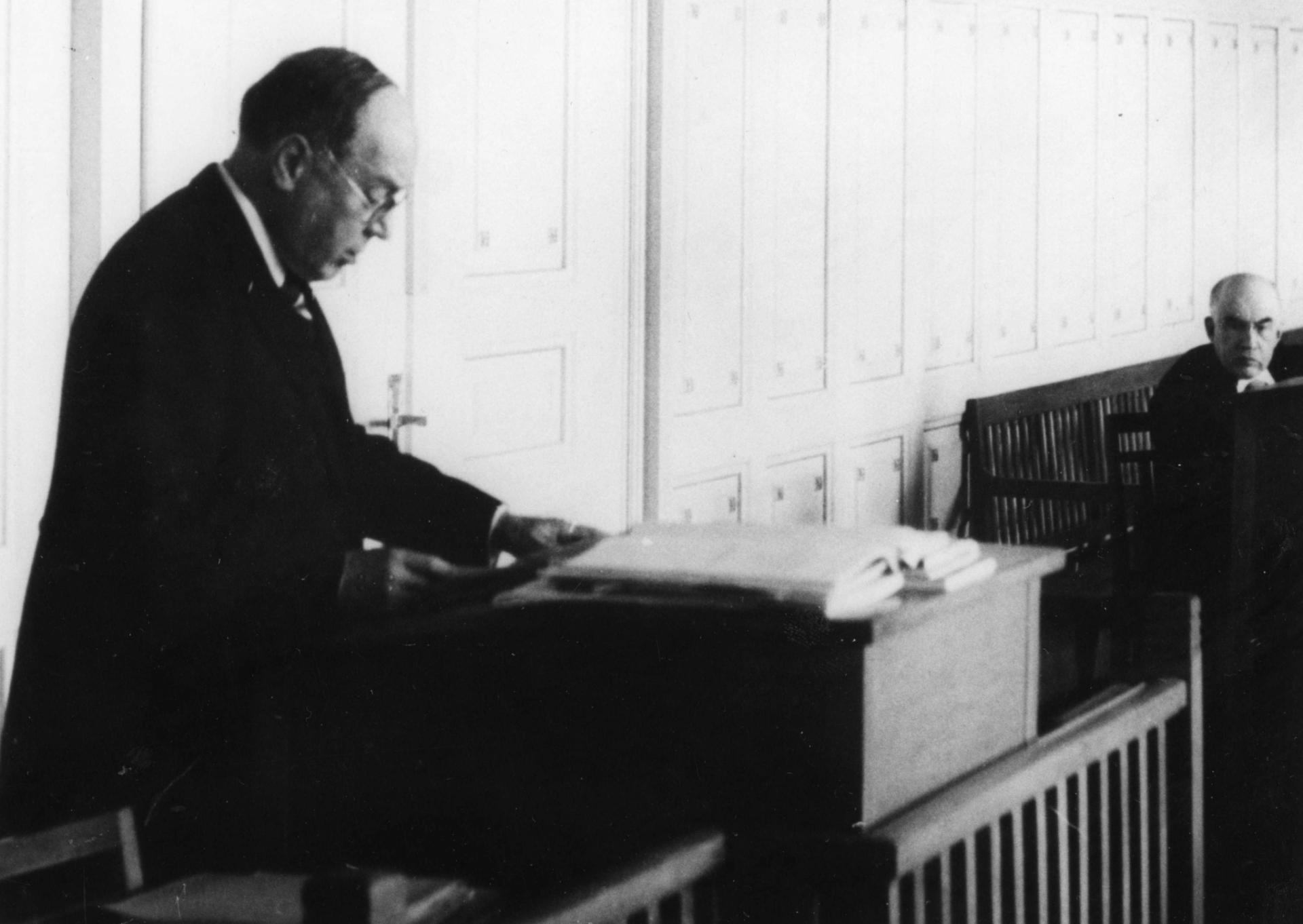
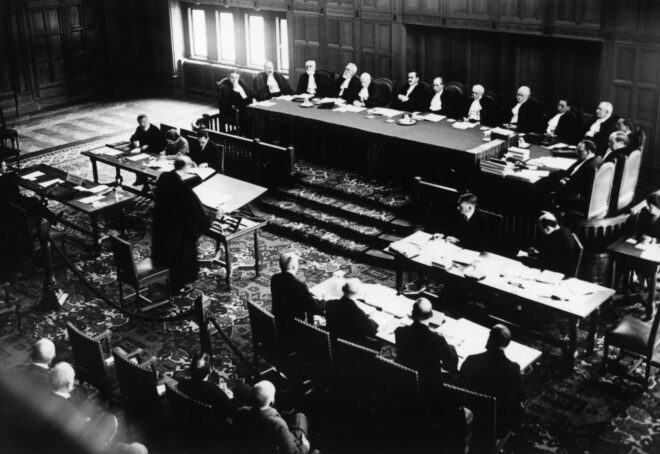
Session of the Permanent Court of International Justice in The Hague (ca. 1928). Viktor Bruns second from the right at the bench (AdsD, 6/FOTA003421)

Deutsch

Am Ende dauerte das Intermezzo kaum ein Jahr. Im September 1927 war der junge Amtsrichter Karl Schmid (1898-1979) vom beschaulichen Tübingen in die ruhelose Reichshauptstadt gewechselt und hatte eine Referentenstelle am Institut für ausländisches öffentliches Recht und Völkerrecht übernommen; im Spätsommer 1928 kehrte er zurück und nahm eine universitäre Karriere auf. Für die spätere Bekanntheit des sich nach dem Zweiten Weltkrieg nur noch Carlo Schmid nennenden Politikers war diese Episode sicherlich nicht entscheidend. Schmid sollte nicht als Jurist der Weimarer Republik reüssieren, sondern als Staatsmann, Gründervater der Bundesrepublik und unbequemer Vordenker der SPD, in die er nach 1945 eingetreten war.[1] Selbst innerhalb der Max‑Planck‑Gesellschaft, der Schmid seit 1951 als Senator angehörte, war diese Vorgeschichte um 1970 längst in Vergessenheit geraten.[2] Insofern stellt sich die Frage: Lassen sich überhaupt Spuren seines Wirkens am heutigen Max-Planck-Institut entdecken? Und welcher Stellenwert kommt den Erfahrungen am Berliner Institut, über die Schmid in seinen 1979 veröffentlichten Erinnerungen[3] in einer gleichermaßen distanzierten wie eigentümlich geglätteten Weise berichtete, für seinen weiteren Werdegang zu?

Ein „französischer Schwabe“. Herkunft und Ausbildung
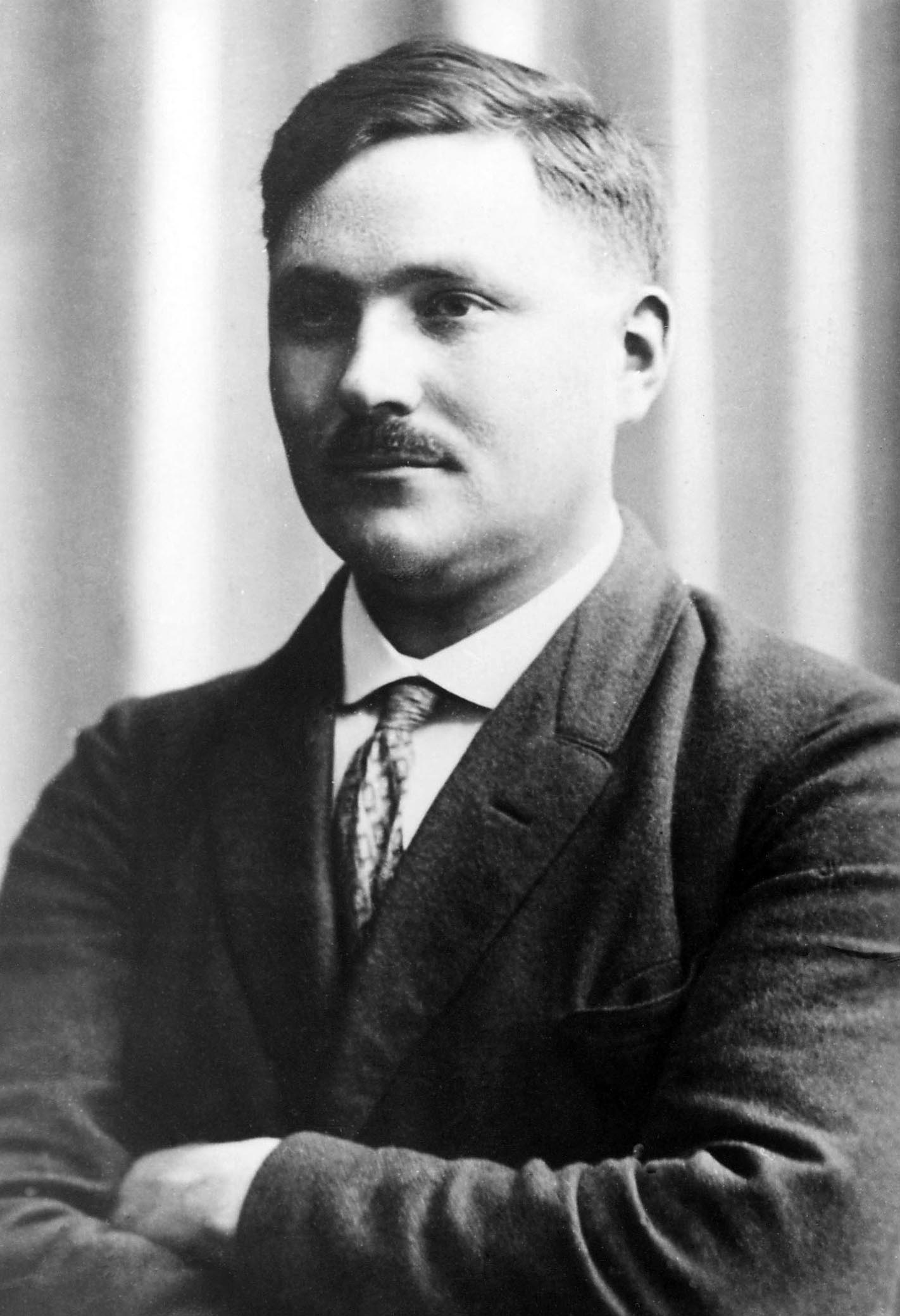
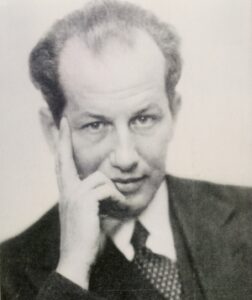
Carlo Schmid nach seiner Promotion 1923[4]

Zur Herkunft müssen einige biographische Stichworte genügen: Carlo Schmid wurde am 3. Dezember 1898 in ein deutsch‑französisches Elternhaus geboren. Kurz nach seiner Geburt siedelte die Familie von Südfrankreich wieder in die württembergische Heimat des Vaters zurück, wo er ein humanistisches Gymnasium durchlief und im Juni 1914 in Stuttgart das Abitur ablegte. Von der Jugendbewegung und dem Wandervogel geprägt und patriotisch wohl ausgesprochen begeistert, meldete er sich zu Beginn des Weltkriegs unverzüglich zum Kriegsdienst. Als Soldat diente Schmid vier Jahre dem Kaiserreich als seinem wortwörtlichen Vaterland, teilweise im Osten, zum Leidwesen seiner französischen Mutter aber vorrangig an der Westfront.[5] Erst nach dem Waffenstillstand von November 1918 schied er, inzwischen mehrfach ausgezeichnet, aus dem Militär aus und nahm ein Studium der Rechts‑ und Staatswissenschaften in Tübingen auf. Nach Abschluss (1921/1924), Promotion (1923) und einer kurzen Etappe als Rechtsanwalt trat Schmid in den württembergischen Justizdienst ein und wurde Anfang 1927 als Richter am Amtsgericht Tübingen eingesetzt.

Beschaulich. Schmids Wirkungsstätte, Tübingen in den 1920ern[6]

Folgt man den Darstellungen seiner Autobiographie, so fand Schmid weder im Richteramt noch in der Tübinger Honoratiorengesellschaft intellektuelle Befriedigung. Während seine von Hugo Sinzheimer betreute Dissertation über die „Rechtsnatur der Betriebsvertretungen nach dem Betriebsrätegesetz“ sich noch ganz dem aufblühenden Weimarer Arbeitsrecht verschrieben hatte, wandte er sich ab Mitte der 1920er Jahre im Selbststudium völkerrechtlichen Klassikern wie Hugo Grotius und Immanuel Kant zu.[7] Nahezu zeitgleich zu seinem Antritt als Amtsrichter, im Januar 1927, bot ihm Heinrich Pohl, der Direktor des völkerrechtlichen Seminars der Universität Tübingen, eine Stelle als Hilfsassistent an, sodass Schmid seine wissenschaftliche Interessen neben dem Justizdienst in einem akademisch formalisierten Rahmen verfolgen konnte. Pohl, ein Schüler von Philipp Zorn, zählte in der Zwischenkriegszeit nicht nur zu den anerkanntesten Verfassungs- und Völkerrechtlern Deutschlands, sondern war mehrfach als entschiedener Kritiker des Versailler Vertrags hervorgetreten.[8] Mit dem Auswärtigen Amt (AA) stand Pohl seit längerer Zeit im Austausch, auch wenn seine im Auftrag der Reichsregierung erstellten Gutachten, etwa zu amerikanischen Schadenersatzforderungen aus dem U-Boot-Krieg, aufgrund von handwerklichen Mängeln und eines „reichlich temperamentvollen Ton[s]“[9] nicht selten ungenutzt in den Schubladen der Wilhelmstrasse verschwanden. Ebenso blieb ein über mehrere Jahre vom AA großzügig gefördertes Forschungsvorhaben von Pohl, welches die Rechtslage in den nach dem Versailler Vertrag besetzten Reichsgebieten untersuchen sollte, unvollendet.[10]

Im Kampf gegen Versailles. Schmid kommt an das Institut

Gleichwohl war es diese Verbindung von Völkerrechtswissenschaft und Außenpolitik, welche den weiteren Werdegang von Carlo Schmid bestimmen sollte. Heinrich Pohl bahnte ihm nicht nur den Weg zu einer akademischen Karriere in Tübingen, sondern vermittelte augenscheinlich auch den Kontakt zum Institut für ausländisches öffentliches Recht und Völkerrecht nach Berlin. Diese mit Mitteln der Reichsregierung ab 1924/25 eingerichtete Forschungseinrichtung in Trägerschaft der Kaiser‑Wilhelm‑Gesellschaft diente vorrangig dazu, die Völkerrechtswissenschaft in Deutschland zu stärken, international konkurrenzfähig zu machen und systematisch zur strategischen Unterstützung der deutschen Diplomatie heranzuziehen, allzumal in den Konflikten um die Auslegung und Umsetzung des Versailler Vertrags.[11] In seinen Erinnerungen vermied Schmid zwar jegliche Erwähnung des nationalkonservativen Pohl und erklärte seinen Wechsel nach Berlin nur vage damit, dass Viktor Bruns, der Gründungsdirektor des Instituts, junge Mitarbeiter bevorzugt unter den Examensbesten Württembergs rekrutiert habe.[12] Es ist jedoch kaum vorstellbar, dass Bruns ohne Empfehlung oder Hinweis von Pohl auf den jungen Tübinger Richter zugegangen wäre. Die Vorstellung, dass der „Kampf gegen Versailles“ auch und gerade mit den Mitteln des Völkerrechts auszufechten sei, teilten Bruns und Pohl jedenfalls unbestritten, und auch Schmid machte sich dieses Anliegen mit großer Leidenschaft zu eigen.[13]
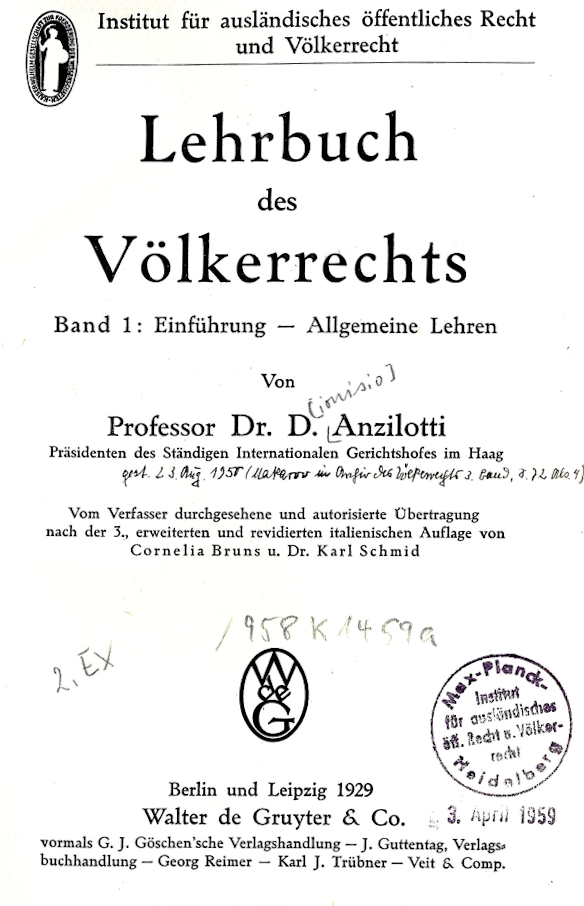
Eine Arbeitsfrucht am Institut: die Anzilotti-Übersetzung

Nähere Hinweise auf Carlo Schmids Tätigkeiten am Institut, das in den Räumlichkeiten des alten Berliner Schlosses an der Spreeinsel untergebracht war, finden sich nur wenige. Unterlagen oder Schriftwechsel von seiner Hand sind in den Archivbeständen der Max‑Planck‑Gesellschaft nicht überliefert.[14] Soweit sich rekonstruieren lässt, befasste sich Schmid nach seiner Ankunft im September 1927 vornehmlich mit Reparations- und Restitutionsfragen aus dem Versailler Vertrag, wobei sich diese spröde Materie immerhin in zwei einschlägigen Fachaufsätzen niederschlug.[15] Mit Cornelia Bruns, der Bibliothekarin des Instituts, übersetzte er daneben das bekannte Lehrbuch von Dionisio Anzilotti aus dem Italienischen.[16] Größere Bedeutung kam seiner Beteiligung an den deutsch‑polnischen und deutsch‑tschechoslowakischen Schiedsverhandlungen zu, an denen er als Assistent von Erich Kaufmann beziehungsweise Viktor Bruns teilnahm.[17] Diese, nach den Grundsätzen des Versailler Vertrages eingerichteten, gemischten Schiedsgerichte verhandelten vorrangig eigentumsrechtliche, als unpolitisch geltende Streitfragen, die sich zwischen den beteiligten Nationen durch die Umsetzung des Friedensschlusses von 1919 ergaben.[18]

Schmid muss diese Tätigkeit, für die er bereits durch seine französischen Sprachkenntnisse prädestiniert war, ernüchtert haben. Zwar erlebte er die Reisen zu den Sitzungsorten der Schiedsgerichte nach Paris, Genf und Venedig oder zum Ständigen Internationalen Gerichtshof in Den Haag als Erweiterung seines Horizonts und, mit Blick auf zahlreiche Museumsbesuche, als großen kulturellen Gewinn.[19] Wenig erquicklich erschienen ihm jedoch die eigentlichen Verhandlungen mit ihrem Tauziehen zwischen den Streitparteien, bei denen die „juristische[n] Argumente, die man seinen politischen Erklärungen beifügte, nicht viel mehr waren als der Faltenwurf, mit dem sich handfeste Interessen drapierten (…).“[20] Freilich: Diese Kritik an einer politischen Instrumentalisierung des Rechts war nicht weit entfernt von der Skepsis, mit der viele deutsche Staats- und Völkerrechtler in den 1920er Jahren auf den vorgeblich lebensfernen Dogmatismus formaler, rein positivistischer Vertrags- und Rechtsregeln blickten.[21] Im Kreis der Mitbegründer und Führungsköpfe des Instituts waren „antipositivistische“ Denker stark vertreten: sowohl bei Heinrich Triepel wie bei Rudolf Smend, bei Hermann Heller wie bei Erich Kaufmann handelte es sich, wenngleich aus unterschiedlichen Gründen, um teils entschiedene Kritiker eines politisch abstinenten, formalistischen Rechtsdenkens. Ebenso wäre an Carl Schmitt zu denken, der zwar erst nach 1933 eine engere Bindung an das Institut einging, aber schon in seinen Weimarer Schriften ausgiebig über eine Verschleierung politischer Machtfragen durch juristische Formeln nachgedacht hatte und von dem Carlo Schmid seinerzeit wohl mehr fasziniert war, als er es später eingestehen mochte.[22]

Rückkehr nach Tübingen, Habilitation und nationale Polemik

Ohnehin scheint Carlo Schmid in dieser Zeit geschwankt zu haben, ob er die juristische Kärrnerarbeit am Institut zugunsten eines Engagements in der Politik oder einer akademischen Karriere aufgeben solle; ausschlaggebend für letzteres waren vermutlich die Belastungen durch die Pendeltätigkeit zwischen Berlin und Tübingen sowie der familiäre Unwille – und vielleicht auch das eigene Unbehagen – sich dauerhaft in der Reichshauptstadt niederzulassen.[23] Im August 1928 meldete sich Schmid beim Amtsgericht Tübingen zurück, ab Herbst nahm er seine Lehrtätigkeit an der Universität bei Heinrich Pohl wieder auf, der im Übrigen wenig später einen seiner Doktoranden, Berthold Schenk von Stauffenberg, als neuen Referenten an das Institut vermittelte.[24] Trotzdem hatte Carlo Schmid nicht sämtliche Verbindungen zum Institut gekappt. Nicht nur unterstütze er im Nebenamt weiterhin Erich Kaufmann als Sekretär am deutsch‑polnischen Schiedsgericht, sondern er konzipierte auch seine Habilitationsschrift auf dem Feld der internationalen Gerichtsbarkeit mit einem expliziten Blick auf den praktischen Nutzwert für Diplomatie und Außenpolitik. Gleichsam als Quintessenz seiner praktischen Erfahrungen am Völkerrechts-Institut entstand so ein Manuskript, welches die bisherige Spruchpraxis des Ständigen Internationalen Gerichtshofs in Den Haag systematisch analysierte und aus den Entscheidungen allgemeine Rechtssätze zu abstrahieren versuchte, welche als Argumentationshilfe in internationalen Verhandlungen dienen konnten.[25] Die bereits im Frühjahr 1929 vorgelegte, knapp 300‑seitige Fleißarbeit wurde von der Rechts‑ und Wirtschaftswissenschaftlichen Fakultät der Universität Tübingen als Habilitationsschrift angenommen und positiv begutachtet; abgeschlossen wurde das Verfahren im November mit einer Antrittsvorlesung Schmids über völkerrechtliche Haftungsfragen gegenüber fremden Staatsangehörigen.[26]

Warum Carlo Schmid in dem auf Herbst 1931 datierten Vorwort zur Druckfassung der Habilitation auf jeden Hinweis auf Heinrich Pohl – der immerhin ein überschwängliches Erstgutachten zur Arbeit verfasst hatte[27] – verzichtete, sich jedoch ausdrücklich bei Viktor Bruns bedankte, lässt sich vorderhand kaum eindeutig klären. Während das Verhältnis zu Pohl, der inzwischen einen Ruf nach Breslau angenommen hatte, vermutlich von Beginn an schwierig gewesen war, hatte Schmid an einem versöhnlichen Ausgleich mit Bruns schon deshalb ein Interesse, weil es zwischen den beiden Männern im Vorjahr zum Eklat gekommen war. Den Anlass hatte ein anonymer Artikel Schmids in einer christlich-nationalen Gewerkschaftszeitung gegeben, der die Neuordnung der deutschen Reparationspflichten im Zuge des „Young-Plans“ aus juristischer Sicht betrachtet und insbesondere den im Januar 1930 auf einer Regierungskonferenz in Den Haag ausgehandelten Kompromiss, welche Sanktionen bei einer Verletzung der vorgesehenen Zahlungspflichten möglich sein sollten, scharf kritisiert hatte. Während nach aktuellen völkerrechtlichen Regeln die Sanktionsrechte „der Rechtsverletzung adäquat sein mussten“, so Schmid, würden die Gläubigerstaaten mit dem Haager Kompromiss das Recht erhalten, in Deutschland „zu tun, was ihnen beliebt“[28]. Das war zwar eine polemische Übertreibung, entsprach aber dem Tenor der nationalistischen Kampagnen, welche sich seit dem vorangegangenen Herbst gegen den Young‑Plan richteten, und spiegelte zugleich den Argwohn einer Staats- und Völkerrechtslehre, welche die vertragspositivistische Übermächtigung und Entpolitisierung der deutschen Souveränität fürchtete.
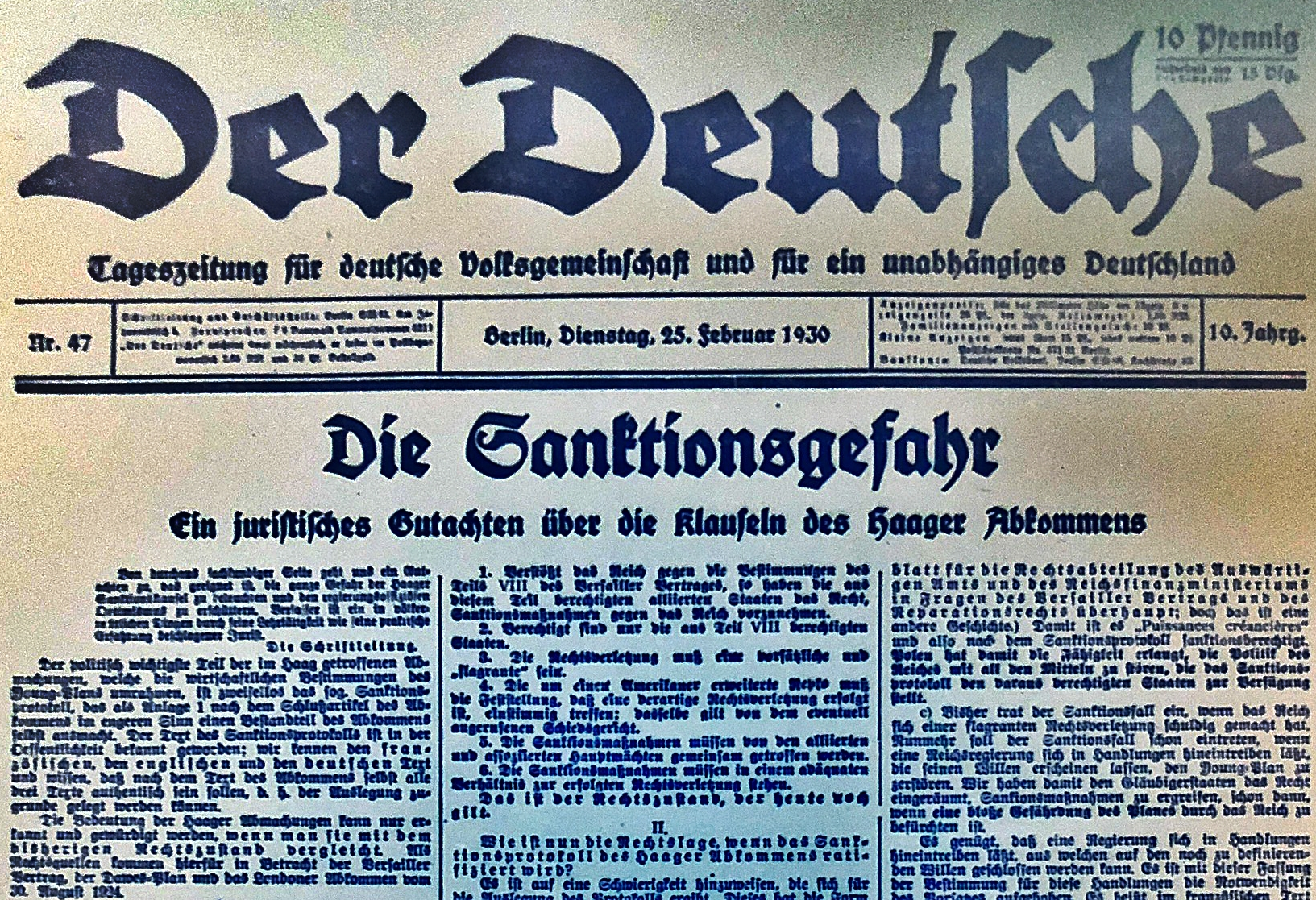
Stein des Anstoßes: Schmids Artikel zur „Sanktionsgefahr“

In der Folge dieses Zeitungsartikels, der selbst innerhalb der Reichsregierung für Aufsehen sorgte, sah sich Viktor Bruns gezwungen, Schmid von jeder weiteren Beteiligung am deutsch‑polnischen Schiedsgericht zu entbinden. Zwar lässt sich kaum mehr klären, wie publik Schmids Autorenschaft in der Berliner Regierungspolitik tatsächlich war. Innerhalb des Instituts war sie jedoch bekannt. Angesichts der Tatsache, dass die deutsche Außenpolitik vom Institut eine loyale Unterstützung und unpolitische Rechtsberatung erwartete, war aus Sicht von Bruns eine demonstrative Trennung selbst bei einem so randständigen Mitarbeiter wie Schmid unvermeidlich.[29] Ein dauerhaftes Zerwürfnis entstand daraus jedoch nicht. Weder Bruns, der in der Sache durchaus einer ähnlichen Auffassung zugeneigt haben mag, noch Schmid gingen mit bleibendem Groll auseinander, wovon neben den freundlichen Dankesworten in Schmids Habilitationsschrift noch einige Briefwechsel bis 1941 zeugen.[30]

Nach 1945: Von der Wissenschaft in die Politik
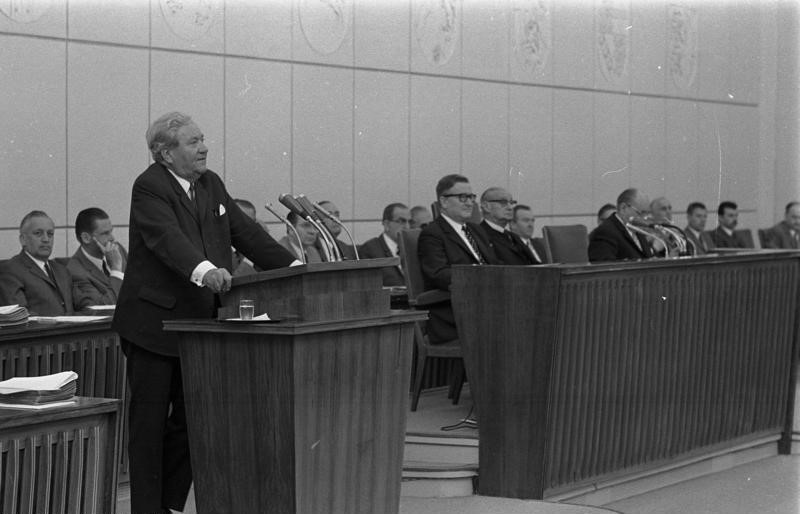
Carlo Schmid spricht vor dem Bundesrat (1969)[31]

Was lässt sich als Fazit zu Carlo Schmids Zeit am Institut für ausländisches öffentliches Recht und Völkerrecht festhalten? Für eine wissenschaftshistorische Betrachtung ist die Tätigkeit Schmids in Berlin wenig ergiebig. An nachgeordneter Stelle eingesetzt, war er immer eher Mitläufer und Beobachter der am Institut betriebenen Verknüpfung völkerrechtlicher Theorie und Praxis. Tritt man indes einen Schritt zurück und nimmt eine biographische Perspektive ein, fallen zwei Aspekte ins Auge: Erstens war die Zeit als juristischer Referent am Institut für Schmid eine Phase der Politisierung. Darin liegt nur scheinbar ein paradoxer Befund. Die Erfahrung, dass die völkerrechtlichen Schiedsverfahren in der Umsetzung des Versailler Vertrages die machtpolitischen Glutkerne des Friedensschlusses nicht ansatzweise ersticken konnten, bedeutete eine realpolitische Schulung, deren Essenz Schmid in seinen Erinnerungen auf die bündige Formel brachte: „Jurisprudenz ist kein Ersatz für Politik (…)“[32]. Nach Tübingen kehrte er als Nationalist zurück, der das „Versailler Diktat“ vielleicht erbitterter als zuvor bekämpfte und Kontakte bis weit in das rechtsintellektuelle Milieu pflegte.[33]

Zweitens: Nach 1945 ergaben sich neue Perspektiven. Trotz einer nationalen Grundhaltung hatte sich Carlo Schmid jeder tieferen Verstrickung in den Nationalsozialismus entziehen können, sodass er nach Kriegsende als unbelasteter Newcomer und Hoffnungsträger galt. Obwohl er im Jahr 1946 kurzfristig sogar als möglicher Direktor eines in die Westzonen verlagerten Instituts für ausländisches öffentliches Recht und Völkerrecht gehandelte wurde,[34] optierte er nun für eine politische Karriere, die erst in Württemberg und der französischen Besatzungszone, dann in der frühen Bundesrepublik auf geradezu atemberaubend steile Weise nach oben verlief.[35] Ein genauerer Blick zeigt, dass er dabei durchaus auf den Erfahrungen seines Berliner Intermezzos aufbaute und das Bemühen um eine völkerrechtliche Bestimmung der deutschen Rechtslage und um eine juristische Bindung der Siegermächte auf eine neue Stufe hob. Nicht nur focht Schmid seit einem fulminanten Auftritt auf der Münchener Ministerpräsidentenkonferenz im Juni 1947 für eine Formalisierung und Verrechtlichung der Beziehungen zu den alliierten Siegermächten im Rahmen eines Besatzungsstatuts (worüber er sich seit dem Frühjahr 1947 mit Erich Kaufmann ausgetauscht hatte).[36] Auch bei der Beratung des Grundgesetzes auf Herrenchiemsee und im Parlamentarischen Rat 1948/49 setzte er sich nachdrücklich dafür ein, dass im Text ein explizites Bekenntnis zum Völkerrecht, zur friedlichen Streitbelegung durch Schiedsgerichte und zur freiwilligen Abtretung staatlicher Hoheitsrechte verankert wurde. Dass darin ein Echo der Gründungsideen und Leitgedanken des Völkerrechts-Instituts nachhallte, ist offensichtlich. Die Berufung auf das Recht, so formulierte es Schmid im Parlamentarischen Rat im September 1948, sei „die einzige Waffe, die dem Schwachen und Entmachteten zu Gebote steht (…).“[37] Zu keinem anderen Zweck war das Institut für ausländisches öffentliches Recht und Völkerrecht in Berlin gegründet worden.

[1] Dazu umfassend: Petra Weber, Carlo Schmid 1896-1979. Eine Biographie, Frankfurt am Main: Suhrkamp 1998.

[2] Vgl.: Brief von Ulrike Ringmann an Erika Bollmann, datiert 29. Mai 1970, APMG, II. Abt., Rep. 67, Nr. 1272.

[3] Vgl.: Carlo Schmid, Erinnerungen, Bern: Scherz 1979; dazu: Petra Weber, Erziehungsroman statt Memoiren: Carlo Schmids „Erinnerungen“, in: Magnus Brechtken (Hrsg.), Life Writing and Political Memoir. Lebenszeugnisse und Politische Memoiren, Göttingen: V&R unipress 2012, 259–278; mit Blick auf solche Vorerfahrungen nach 1945, siehe auch: Sabine Kurtenacker, Der Einfluss politischer Erfahrungen auf den Verfassungskonvent von Herrenchiemsee. Entwicklung und Bedeutung der Staats- und Verfassungsvorstellungen von Carlo Schmid, Hermann Brill, Anton Pfeiffer und Adolf Süsterhenn, München: Herbert Utz 2017.

[4] AdsD, 6/FOTA003426

[5] Vgl.: Weber, Carlo Schmid (Fn. 1), 36.

[6] Verlag von Heinrich Sting, Public Domain.

[7] Vgl.: Schmid (Fn. 3), 119-120.

[8] Vgl.: Heinrich Pohl, Die belgischen Annexionen im Versailler Vertrage, Stuttgart: Kohlhammer 1927; Heinrich Pohl, Neues Völkerrecht auf Grund des Versailler Vertrages, Berlin: Ferdinand Dümmler 1927.

[9] [Georg] Martius, Aktenvermerk v. 30.05.1923, PA AA, R 54330.

[10] Vorgang mit Korrespondenzen und weiteren Unterlagen, PA AA, R 54330.

[11] Vgl.: Ingo Hueck, Die deutsche Völkerrechtswissenschaft im Nationalsozialismus. Das Berliner Kaiser-Wilhelm-Institut für ausländisches öffentliches Recht und Völkerrecht, das Hamburger Institut für Auswärtige Politik und das Kieler Institut für Internationales Recht, in: Doris Kaufmann (Hrsg.), Geschichte der Kaiser-Wilhelm-Gesellschaft im Nationalsozialismus, Bd. 2, Göttingen: Wallstein 2000, 490–527 (490-491; 499-504); Michael Stolleis, Geschichte des öffentlichen Rechts in Deutschland, Bd. 3: Staats- und Verwaltungsrechtswissenschaft in Republik und Diktatur, 1914–1945, München: C.H. Beck 1999, 89.

[12] Vgl.: Schmid (Fn. 3), 121.

[13] Vgl.: Weber, Carlo Schmid (Fn. 1), 59-67.

[14] So auch Kurtenacker (Fn. 3), 43, Fn. 234.

[15] Vgl.: Karl [Carlo] Schmid/Ernst Schmitz, Der Paragraph 4 der Anlage zu Sektion IV des Teils X des Versailler Vertrags, ZaöRV 1 (1929), 251–320; Karl [Carlo] Schmid/Ernst Schmitz, Zur Dogmatik der Sektion V des Teiles X des Versailler Vertrags, ZaöRV 2 (1931), 17–85.

[16] Vgl.: Dionisio Anzilotti, Lehrbuch des Völkerrechts. Band 1: Einführung – Allgemeine Lehren, Autor. Übers. Cornelia Bruns / Dr. Karl [Carlo] Schmid, Berlin: De Gruyter 1929.

[17] Zu Kaufmanns Tätigkeit in diesem Zusammenhang, vgl.: Frank Degenhardt, Zwischen Machtstaat und Völkerbund. Erich Kaufmann (1880-1972), Baden-Baden: Nomos 2008, 107-109.

[18] Vgl.: Jakob Zollmann, Nationality, Property, and the Mixed Arbitral Tribunals, 1914 to c. 1930, in: Hélène Ruiz Fabri/Michel Erpelding (Hrsg.), Mixed Arbitral Tribunals, 1919-1939. An Experiment in the International Adjudication of Private Rights, Baden-Baden: Nomos 2023, 113–157 [Angaben zu den genannten Schiedsgerichten, aber ohne Erwähnung von Schmid im Anhang: 556-557, 574]; Jakob Zollmann, Reparations, Claims for Damages, and the Delivery of Justice. Germany and the Mixed Arbitral Tribunals (1919-1933), in: David Deroussin (Hrsg.), La Grande Guerre et son droit, Issy-les-Moulineaux: LGDJ 2018, 379–394.

[19] Vgl.: Schmid (Fn. 3), 125-131.

[20] Schmid (Fn. 3), 129.

[21] Vgl.: Manfred Gangl (Hrsg.), Die Weimarer Staatsrechtsdebatte. Diskurs- und Rezeptionsstrategien, Baden-Baden: Nomos 2011; Stolleis (Fn. 10), 158-186.

[22] Vgl.: Schmid (Fn. 3), 139-141; auch nach 1945 hatte sich eine merkliche Ehrerbietung gehalten, vgl: Brief von Carlo Schmid an Carl Schmitt, datiert 16. Mai 1947, AdsD, NL Carlo Schmid, 609.

[23] Vgl.: Weber, Carlo Schmid (Fn. 1), 75.

[24] Vgl.: Alexander Meyer, Berthold Schenk Graf von Stauffenberg (1905–1944). Völkerrecht im Widerstand, Tübinger Schriften zum internationalen und europäischen Recht, Bd. 57, Berlin: Duncker & Humblot 2001, 42-53; Am Institut scheint Stauffenberg wesentlich die Aufgabengebiete von Schmid übernommen zu haben.

[25] Vgl.: Karl [Carlo] Schmid, Die Rechtsprechung des Ständigen Internationalen Gerichtshofs in Rechtssätzen dargestellt, Stuttgart: Ferdinand Enke 1932.

[26] Vgl.: Weber, Carlo Schmid (Fn. 1), 70.

[27] Vgl.: Weber, Carlo Schmid (Fn. 1), 70.

[28] Die Sanktionsgefahr. Ein juristisches Gutachten über die Klauseln des Haager Abkommens, in: Der Deutsche. Tageszeitung für deutsche Volksgemeinschaft und ein unabhängiges Deutschland, 25. Februar 1930, 2; Zum Kontext der Sanktionsdebatte siehe etwa: Franz Knipping, Deutschland, Frankreich und das Ende der Locarno-Ära 1928–1931. Studien zur internationalen Politik in der Anfangsphase der Weltwirtschaftskrise, München: De Gruyter 1987, 112-119; weitere Hintergründe bei: Philipp Heyde, Das Ende der Reparationen. Deutschland, Frankreich und der Youngplan 1929-1932, Paderborn: Schöningh 1998.

[29] Mit immer noch leicht gekränktem Unterton, vgl. dazu: Schmid (Fn. 3), 142.

[30] Vgl.: Weber, Carlo Schmid (Fn. 1), 72, 133.

[31] BArch, B 145 Bild-F029089-0006 / Schaack, Lothar / CC-BY-SA 3.0

[32] Schmid (Fn. 3), 130.

[33] Vgl.: Weber, Erziehungsroman (Fn. 3), 266; Weber, Carlo Schmid (Fn. 1), 75-76.

[34] Vgl.: Felix Lange, Carl Bilfingers Entnazifizierung und die Entscheidung für Heidelberg: Die Gründungsgeschichte des völkerrechtlichen Max-Planck-Instituts nach dem Zweiten Weltkrieg, ZaöRV 74 (2014), 697-731 (710-712, 715-716).

[35] Vgl.: Hellmuth Auerbach, Die politischen Anfänge Carlo Schmids. Kooperation und Konfrontation mit der französischen Besatzungsmacht 1945-1948, VfZ 36 (1988), 595–648.

[36] Vgl. Karl [Carlo] Schmid, Die Neuregelung des Besatzungsrechtes, Jahrbuch für internationales und ausländisches öffentliches Recht 1(1947), 123–128; siehe auch: Brief von Carlo Schmid an Erich Kaufmann, datiert 05. März 1947, AdsD, NL Carlo Schmid, 601.

[37] Zweite Sitzung des Ausschusses für Grundsatzfragen 16. September 1948, in: Deutscher Bundestag/Bundesarchiv (Hrsg.), Der Parlamentarische Rat, 1948-1949. Akten und Protokolle, Bd. 5: Ausschuß für Grundsatzfragen, Boppard am Rhein: Oldenbourg Wissenschaftsverlag 1993, 8.

Suggested Citation:

Marcus M. Payk: Das Berliner Jahr: Carlo Schmid als Referent am Institut für ausländisches öffentliches Recht und Völkerrecht 1927/28, MPIL100.de, DOI: 10.17176/20240214-102625-0

Lizenz: CC BY-NC-SA 4.0 DEED


English

In the end, the intermezzo barely lasted a year. In September 1927, the young district judge Karl Schmid (1898-1979) had moved from placid Tübingen to Berlin, the restless capital of the German Empire, to become a research fellow at the Institute for Comparative Public Law and International Law; he returned in the late summer of 1928 and took up a university career. This episode was certainly not decisive for the later fame of the politician, who, after the Second World War, went exclusively by Carlo Schmid. Schmid was to make a name not as a legal scholar in the Weimar Republic, but as a statesman, a founding father of the Federal Republic and provocative thought leader of the SPD (Social Democratic Party of Germany), which he joined after 1945.[1] Even within the Max Planck Society, which Schmid joined as a senator in 1951, this backstory had long been forgotten by 1970.[2] Therefore, the question arises: can any traces of his work at the be discovered at today’s Max Planck Institute? And what significance do the experiences at the Berlin Institute, on which Schmid reports in his autobiography Erinnerungen (“Memories”)[3], published in 1979, in a reserved and strangely smoothed-out manner, have for his future career?

A “French Swabian”. Early Life and Education
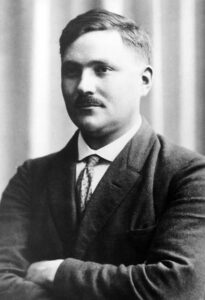
Carlo Schmid after his doctorate in 1923[4]

Regarding his early life, a few biographical keywords must suffice: Carlo Schmid was born into a German‑French family on 3 December 1898. Shortly after his birth, the family moved from the South of France back to his father’s home in Württemberg, where Schmid received secondary education, and graduated high school in Stuttgart in June 1914. Influenced by the German Youth Movement (Jugendbewegung) and the Wandervogel (two popular groups at the time, emphasizing the experience of nature and a spirit of community) and rather patriotic, he immediately enlisted for military service at the beginning of the First World War. As a soldier, Schmid served the German Empire, his – literal – fatherland, for four years, partly in the East, but mainly on the Western Front, much to the chagrin of his French mother.[5] It was only after the armistice in November 1918, that he left the military, having been decorated several times in the meantime, and began studying law and constitutional theory (Staatswissenschaften) in Tübingen. After graduating (1921/1924), obtaining his doctorate (1923) and a brief stint as a lawyer, Schmid joined the judicial service of Württemberg and was appointed as a judge at the Tübingen district court in early 1927.

Placid. Schmid’s place of work, Tübingen in the 1920s[6]

According to his autobiography, Schmid found no intellectual satisfaction either in his position as a judge or in Tübingen’s distinguished social circles. While his dissertation on the “Legal Nature of Workers’ Councils under the Workers’ Councils Act”, supervised by Hugo Sinzheimer, was still devoted to the flourishing Weimar labour law, from the mid-1920s onwards, he turned to the self-study of classics of international law such as Hugo Grotius and Immanuel Kant.[7] Almost simultaneously to Schmid taking up his position as a district judge, in January 1927, Heinrich Pohl, the director of the international law seminar at the University of Tübingen, offered him a position as an assistant, so that Schmid was able to pursue his academic interests in a formalised setting alongside his work in the judicial service. Pohl, a student of Philipp Zorn, was not only one of the most renowned constitutional and international law scholars in Germany in the interwar period, but had also repeatedly come forward as a staunch critic of the Treaty of Versailles.[8] He had also been in dialogue with the Foreign Office for some time, even though his legal expert opinions commissioned by the government, on American claims for damages from the submarine war for example, often disappeared in the drawers of the office, unused, due to methodological shortcomings and a “rather spirited tone”[9] . Similarly, a research project by Pohl, intended to investigate the legal situation in the territories of the Reich occupied under the Treaty of Versailles and generously funded by the Foreign Office for several years, remained unfinished.[10]

Fighting Versailles. Schmid Joins the Institute

 Nevertheless, it was this combination of international law and foreign policy that was to determine Carlo Schmid’s future career. Heinrich Pohl not only paved the way for him to pursue an academic career in Tübingen, but apparently also put him in touch with the Institute for Comparative Public Law and International Law in Berlin. This research institution under management of the Kaiser-Wilhelm‑Gesellschaft (Kaiser Wilhelm Society) was established in 1924/25 with funds from the German government and was primarily dedicated to strengthen international law in Germany, to make it internationally competitive and to systematically provide strategic support for German diplomacy, especially in the conflicts surrounding the interpretation and implementation of the Treaty of Versailles.[11] In his memoir, Schmid avoids any mention of the national-conservative Pohl and only vaguely explains his move to Berlin by saying that Viktor Bruns, the founding director of the institute, preferably recruited young employees among the top law school graduates in Württemberg.[12] However, it is hard to imagine that Bruns would have approached the young judge from Tübingen without a recommendation or pointer by Pohl. In any case, Bruns and Pohl undoubtedly shared the idea that the “fight against Versailles” should not least be fought with the means of international law, and Schmid also embraced this cause with great passion.[13]

A product of the work at the Institute: the Anzilotti translation

There are only scant sources on Carlo Schmid’s activities at the Institute, which was housed in the premises of the old Berlin Palace in the city centre. No documents or correspondence of his have survived in the archives of the Max Planck Society.[14] As far as can be reconstructed, after his arrival in September 1927, Schmid was primarily concerned with issues of reparations and restitution arising from the Treaty of Versailles, as this dry field of work is reflected in two scientific publications.[15] Together with Cornelia Bruns, the Institute’s librarian, he also translated the well-known textbook by Dionisio Anzilotti from Italian to German.[16] More relevant is his involvement in the German‑Polish and German‑Czechoslovak arbitration negotiations, in which he took part as an assistant to Erich Kaufmann and Viktor Bruns respectively.[17] These mixed arbitration tribunals, established in accordance with the principles of the Treaty of Versailles, primarily negotiated property disputes which arose between nations as a result of the implementation of the peace treaty of 1919 and which were generally considered apolitical. [18]

Schmid must have felt disillusioned by this field of activity, for which he was predestined due to his French language skills. He considered the trips to the venues of the arbitration tribunals in Paris, Geneva and Venice or to the Permanent Court of International Justice in The Hague inspiring, and, because of his visits to numerous museums, culturally enriching.[19] However, he disliked the actual negotiations with their tug-of-war between the parties, in which the “legal arguments that were attached to one’s political statements were little more than the drapery with which tangible interests embellished themselves (…).”[20] Admittedly: this criticism of the political instrumentalization of law was not too different from the scepticism with which many German constitutional and international law experts in the 1920s viewed the, allegedly quixotic, dogmatism of formal, purely positivist treaties and legal rules.[21] “Anti-positivist” thinkers were strongly represented among the co-founders and leaders of the institute: Heinrich Triepel and Rudolf Smend as well as Hermann Heller and Erich Kaufmann, albeit for different reasons, all criticized, sometimes staunchly, formalistic legal thinking, devoid of political contextualisation. Of course, there was also Carl Schmitt, who did not enter into a closer relationship with the Institute until after 1933, but had already covered the issue of the alleged conceal of political power struggles through legalism extensively in his Weimar writings. Carlo Schmid was probably more fascinated by him at the time than he would later bring himself to admit.[22]

Return to Tübingen, Habilitation and Nationalist Polemics

Carlo Schmid seems to have wavered during this time as to whether he should give up his painstaking work at the institute in favour of a commitment to politics or an academic career; the decisive factor for the latter was probably the strain of commuting between Berlin and Tübingen as well as his family’s unwillingness – and perhaps also his own discomfort – to permanently settle in the capital.[23] In August 1928, Schmid reported back to the district court in Tübingen, and in autumn he resumed his teaching activities at the university under Heinrich Pohl, who shortly afterwards recommended one of his doctoral students, Berthold Schenk von Stauffenberg, as a new research fellow at the institute.[24] Nevertheless, Carlo Schmid had not cut all ties with the Institute. Not only did he continue to support Erich Kaufmann as a part-time secretary at the German‑Polish Court of Arbitration, but he also aimed for his habilitation thesis in the field of international jurisdiction to be useful for diplomacy and foreign policy. As the quintessence of his practical experience at the International Law Institute, so to speak, he systematically analysed the previous case law of the Permanent Court of International Justice in The Hague and attempted to abstract general legal principles from its decisions to serve as an argumentation aid in international negotiations.[25] The result of this detailed and precise work, a manuscript of almost 300 pages, was submitted in spring 1929, accepted by the Faculty of Law and Economics at the University of Tübingen, and received a favourable review. The process was concluded in November with Schmid’s inaugural lecture on questions of liability under international law towards foreign nationals.[26]

Why Carlo Schmid omitted any reference to Heinrich Pohl – who had, after all, written an exuberant initial evaluation of the work[27] – in the foreword to the printed version of the habilitation, dated autumn 1931, but expressly thanked Viktor Bruns, can hardly be clarified for the time being . While the relationship with Pohl, who had in the meantime accepted a chair at the university of Breslau, had presumably been difficult from the outset, Schmid had an interest in a conciliation with Bruns, as there had been an éclat between the two in the previous year. The cause had been an anonymous article by Schmid in a Christian-nationalistic trade union newspaper, which commented on the reorganisation of Germany’s reparation obligations in the wake of the Young Plan from a legal perspective. In particular, the article sharply criticised the compromise negotiated at an intergovernmental conference in The Hague in January 1930 on what sanctions should be possible in the event of a breach of the envisaged payment obligations. While under current international law sanctions had to be “adequate to the violations of law”, Schmid said, the Hague Compromise would give the creditor states the right to “do as they please” in Germany[28]. Although this was a polemical exaggeration, it was in line with the tenor of the nationalist campaigns that had been directed against the Young Plan since the previous autumn and at the same time reflected the suspicion of constitutional law and international law scholarship against a positivist overreach in treaty interpretation and a depoliticization of German sovereignty.

The bone of contention: Schmid’s article on the “risk of sanctions”

As a result of this newspaper article, which caused a stir even within the Reich government, Viktor Bruns thought it necessary to exclude Schmid from any further involvement in the German‑Polish court of arbitration. Although it is hardly possible to clarify how public Schmid’s authorship was within government circles, it was acknowledged within the institute. In view of the fact that the German authorities expected loyal support and apolitical legal advice from the Institute, Bruns felt that a demonstrative separation was inevitable, even in the case of a marginal employee like Schmid.[29] However, this did not result in a lasting fall-out. Neither Bruns, who may well have held similar views on the matter, nor Schmid parted with lasting resentment, as evidenced by the friendly acknowledgement in Schmid’s habilitation thesis and several letters up to 1941.[30]

After 1945: From Academia to Politics

Carlo Schmid spricht vor dem Bundesrat (1969)[31]

What is the outcome of Carlo Schmid’s time at the Institute? Schmid’s work in Berlin is not very fruitful from a history-of-science perspective. Working in a subordinate position, he was always more of a follower and observer of the way the theory and practice of international law came together at the Institute. However, if one takes a step back and adopts a biographical perspective, two aspects become apparent: firstly, Schmid’s time as a research fellow at the Institute was a phase of politicisation. This only seems to be a paradoxical finding: the experience that the arbitration proceedings, implementing the Treaty of Versailles and governed by international law, would not even begin to smother the embers of power politics of the Versailles order meant a training in Realpolitik, the essence of which Schmid summarised in his memoirs in the succinct formula: “Jurisprudence is no substitute for politics (…)”[32]. He returned to Tübingen as a nationalist, who fought the “Versailles Dictate” perhaps more bitterly than ever before and cultivated contacts well into the right-wing intellectual milieu.[33]

Secondly, new perspectives emerged after 1945. Despite his nationalist stance, Carlo Schmid had been able to avoid any deeper involvement in National Socialism, so that after the end of the war, he was seen as an unencumbered newcomer. Although he was even briefly considered as a possible director of the Institute for Comparative Public Law and International Law, which was relocated to the western zones in 1946,[34] he now opted for a political career that took a breathtakingly steep upward trajectory, first in Württemberg and the French occupation zone, then in the early Federal Republic .[35] A closer look shows that he built on the experiences of his intermezzo in Berlin and took the endeavour to define the German legal situation under international law and to establish legal obligations  for the Allied Powers to a new level. Since his fulminant appearance at the Munich Conference of the Minister Presidents of the German states in June 1947, Schmid campaigned for a formalisation and legalisation of the relations with the Allied Powers within the framework of an occupation statute (which he had been discussing with Erich Kaufmann since the spring of 1947).[36] During the deliberations on the new German constitution (Grundgesetz) at Herrenchiemsee castle and in the Parliamentary Council in 1948/49, he also strongly advocated for an explicit commitment to international law, the peaceful settlement of disputes by arbitration tribunals and the voluntary limitation of sovereignty. It is obvious that this echoed the founding ideas and guiding principles of the International Law Institute. As Schmid put it in the Parliamentary Council in September 1948, invoking the law is “the only weapon available to the weak and disempowered (…).”[37] The Institute for Comparative Public Law and International Law had been founded for no other purpose.

Translation from the German original: Sarah Gebel

[1] For a comprehensive overview, cf: Petra Weber, Carlo Schmid 1896-1979. Eine Biographie, Frankfurt am Main: Suhrkamp 1998.

[2] Cf: Letter from Ulrike Ringmann to Erika Bollmann, dated 29 May 1970, APMG, II. Abt., Rep. 67, No. 1272.

[3] Cf: Carlo Schmid, Erinnerungen, Bern: Scherz 1979; also: Petra Weber, Erziehungsroman statt Memoiren: Carlo Schmid’s “Erinnerungen”, in: Magnus Brechtken (ed.), Life Writing and Political Memoir. Lebenszeugnisse und Politische Memoiren, Göttingen: V&R unipress 2012, 259-278; with regard to such previous experiences after 1945, see also: Sabine Kurtenacker, Der Einfluss politischer Erfahrungen auf den Verfassungskonvent von Herrenchiemsee. Entwicklung und Bedeutung der Staats- und Verfassungsvorstellungen von Carlo Schmid, Hermann Brill, Anton Pfeiffer und Adolf Süsterhenn, Munich: Herbert Utz 2017.

[4] AdsD, 6/FOTA003426

[5] Cf: Weber, Carlo Schmid (fn. 1), 36.

[6] Verlag Heinrich Sting, Public Domain.

[7] Cf.: Schmid (fn. 3), 119-120.

[8] Cf: Heinrich Pohl, Die belgischen Annexionen im Versailler Vertrage, Stuttgart: Kohlhammer 1927; Heinrich Pohl, Neues Völkerrecht auf Grund des Versailler Vertrages, Berlin: Ferdinand Dümmler 1927.

[9] [Georg] Martius, memorandum dated 30 May 1923, PA AA, R 54330, translated by the editor.

[10] Collection of correspondence and documents on this project, PA AA, R 54330.

[11] Cf: Ingo Hueck, Die deutsche Völkerrechtswissenschaft im Nationalsozialismus. Das Berliner Kaiser-Wilhelm-Institut für ausländisches öffentliches Recht und Völkerrecht, das Hamburger Institut für Auswärtige Politik und das Kieler Institut für Internationales Recht, in: Doris Kaufmann (ed.), Geschichte der Kaiser-Wilhelm-Gesellschaft im Nationalsozialismus, vol. 2, Göttingen: Wallstein 2000, 490-527 (490-491; 499-504); Michael Stolleis, Geschichte des öffentlichen Rechts in Deutschland, vol. 3: Staats- und Verwaltungsrechtswissenschaft in Republik und Diktatur, 1914-1945, Munich: C.H. Beck 1999, 89.

[12] Cf.: Schmid (fn. 3), 121.

[13] Cf: Weber, Carlo Schmid (fn. 1), 59-67.

[14] Similarly: Kurtenacker (fn. 3), 43, fn. 234.

[15] Cf.: Karl [Carlo] Schmid/Ernst Schmitz, Der Paragraph 4 der Anlage zu Sektion IV des Teils X des Versailler Vertrags, HJIL 1 (1929), 251-320; Karl [Carlo] Schmid/Ernst Schmitz, Zur Dogmatik der Sektion V des Teiles X des Versailler Vertrags, HJIL 2 (1931), 17-85.

[16] Cf.: Dionisio Anzilotti, Lehrbuch des Völkerrechts. Band 1: Einführung – Allgemeine Lehren, Autorised Transl. Cornelia Bruns / Dr. Karl [Carlo] Schmid, Berlin: De Gruyter 1929.

[17] On Kaufmann’s activities in this context, cf: Frank Degenhardt, Zwischen Machtstaat und Völkerbund. Erich Kaufmann (1880-1972), Baden-Baden: Nomos 2008, 107-109.

[18] Cf: Jakob Zollmann, Nationality, Property, and the Mixed Arbitral Tribunals, 1914 to c. 1930, in: Hélène Ruiz Fabri/Michel Erpelding (eds.), Mixed Arbitral Tribunals, 1919-1939. An Experiment in the International Adjudication of Private Rights, Baden-Baden: Nomos 2023, 113-157 [details of the arbitral tribunals mentioned, but no mention of Schmid in the appendix: 556-557, 574]; Jakob Zollmann, Reparations, Claims for Damages, and the Delivery of Justice. Germany and the Mixed Arbitral Tribunals (1919-1933), in: David Deroussin (ed.), La Grande Guerre et son droit, Issy-les-Moulineaux: LGDJ 2018, 379-394.

[19] Cf.: Schmid (fn. 3), 125-131.

[20] Schmid (Fn. 3), 129, translated by the editor.

[21] Cf.: Manfred Gangl (Hrsg.), Die Weimarer Staatsrechtsdebatte. Diskurs- und Rezeptionsstrategien, Baden-Baden: Nomos 2011; Stolleis (Fn. 10), 158-186..

[22] Cf.: Schmid (fn. 3), 139-141; even after 1945, a noticeable reverence had persisted, cf: Letter from Carlo Schmid to Carl Schmitt, dated 16 May 1947, AdsD, NL Carlo Schmid, 609.

[23] Cf: Weber, Carlo Schmid (fn. 1), 75.

[24] Cf: Alexander Meyer, Berthold Schenk Graf von Stauffenberg (1905-1944). Völkerrecht im Widerstand, Tübinger Schriften zum internationalen und europäischen Recht, vol. 57, Berlin: Duncker & Humblot 2001, 42-53; At the institute, Stauffenberg seems to have essentially taken over Schmid’s areas of responsibility.

[25] Cf.: Karl [Carlo] Schmid, Die Rechtsprechung des Ständigen Internationalen Gerichtshofs in Rechtssätzen dargestellt, Stuttgart: Ferdinand Enke 1932.

[26] Cf: Weber, Carlo Schmid (fn. 1), 70.

[27] Cf: Weber, Carlo Schmid (fn. 1), 70.

[28] Die Sanktionsgefahr. Ein juristisches Gutachten über die Klauseln des Haager Abkommens, in: Der Deutsche. Tageszeitung für deutsche Volksgemeinschaft und ein unabhängiges Deutschland, 25 February 1930, 2, translated by the editor; On the context of the sanctions debate, see for example: Franz Knipping, Deutschland, Frankreich und das Ende der Locarno-Ära 1928-1931. Studien zur internationalen Politik in der Anfangsphase der Weltwirtschaftskrise, München: De Gruyter 1987, 112-119; for further background see: Philipp Heyde, Das Ende der Reparationen. Germany, France and the Young Plan 1929-1932, Paderborn: Schöningh 1998.

[29] With a still slightly offended undertone, see: Schmid (fn. 3), 142.

[30] Cf: Weber, Carlo Schmid (fn. 1), 72, 133.

[31] BArch, B 145 Bild-F029089-0006 / Schaack, Lothar / CC-BY-SA 3.0

[32] Schmid (Fn. 3), 130, translated by the author.

[33] Cf: Weber, Erziehungsroman (fn. 3), 266; Weber, Carlo Schmid (fn. 1), 75-76.

[34] Cf: Felix Lange, Carl Bilfingers Entnazifizierung und die Entscheidung für Heidelberg: Die Gründungsgeschichte des völkerrechtlichen Max-Planck-Instituts nach dem Zweiten Weltkrieg, HJIL 74 (2014), 697-731 (710-712, 715-716).

[35] Cf: Hellmuth Auerbach, Die politischen Anfänge Carlo Schmids. Kooperation und Konfrontation mit der französischen Besatzungsmacht 1945-1948, VfZ 36 (1988), 595–648.

[36] Cf. Karl [Carlo] Schmid, Die Neuregelung des Besatzungsrechtes, Jahrbuch für internationales und ausländisches öffentliches Recht 1(1947), 123-128; see also: Letter from Carlo Schmid to Erich Kaufmann, dated 5 March 1947, AdsD, NL Carlo Schmid, 601.

[37] Zweite Sitzung des Ausschusses für Grundsatzfragen 16 September 1948, Z 5/29, Bl. 203-224, in: Deutscher Bundestag/Bundesarchiv (eds.), Der Parlamentarische Rat, 1948-1949. Akten und Protokolle, vol. 5: Ausschuß für Grundsatzfragen, Boppard am Rhein: Oldenbourg Wissenschaftsverlag 1993, 8.

Suggested Citation:

Marcus M. Payk: One Year in Berlin. Carlo Schmid as Research Fellow at the Institute for Comparative Public Law and International Law 1927/28, MPIL100.de, DOI: 10.17176/20240219-190312-0

Lizenz: CC BY-NC-SA 4.0 DEED

“An epoch-making event”? The Foundation of the Kaiser-Wilhelm-Institute and the Anglo-American Research Community, 1912-1933

In 1926, a short note in the renowned American Journal of International Law announced the foundation of the Kaiser-Wilhelm-Institute for Foreign Public Law and International Law (KWI). The note announced Viktor Bruns as director of the KWI, who together with two colleagues from the Law Faculty at the University of Berlin, Rudolf Smend and Heinrich Triepel would lead the KWI. It outlined that the KWI would research public law and international law for “scientific and practical governmental purposes”, and that publications would follow and hopefully make “valuable contributions” to international law in the future.[1] This rather general note about the KWI was the only one in any Anglo-American law journal at the time. This article examines the KWI’s perception in the Anglo-American legal community in the interwar period but also looks at the broader trend of the foundation of national and regional law institutions in the period of the First World War.

The Invisible KWI

It was not until 1929, three years after the initial note, that the KWI began to reach a broader audience in the Anglo-American legal community, particularly in the United States, with the journals Zeitschrift für ausländisches öffentliches Recht und Völkerrecht (“Journal for Foreign Public Law and International Law”, today: Heidelberg Journal of International Law) from 1929 and the Fontes Juris Gentium from 1931. The first editions of the KWI’s publications won acclaim in the review sections of Anglo-American law journals. Eminent American jurists, such as Manley O. Hudson, Law Professor at Harvard University, and Philipp C. Jessup, Law Professor at Columbia University, reviewed these German publications in the most important law journals in the United States. Both lawyers were not only known in academic circles but also regularly advised the US government in legal matters. Manley O. Hudson wrote in the American Journal of International Law that the Fontes Juris Gentium were a “monumental undertaking” which gave “new significance to the reality of international law”.[2] Philipp C. Jessup welcomed the Fontes Juris Gentium in the Political Science Quarterly, stating the publication provided a “survey of international practice”, which would be greeted with a “warm and grateful applause”.[3] Another colleague, Charles  G. Fentwick of Bryn Mawr College hoped that not only students but also governments would make use of the Fontes Juris Gentium.[4] However, while the KWI’s publications were read with great interest in the United States, the Fontes Juris Gentium received rather mixed reviews in British law journals. In the British Year Book of 1932 British jurist, James L. Brierly, Chichele Professor of International Law and Diplomacy at the University of Oxford, felt it was “not easy to express an opinion” on the Fontes Juris Gentium because of the enormous scope of the project, which included translations, extracts, and digests of national and international judgements.[5]

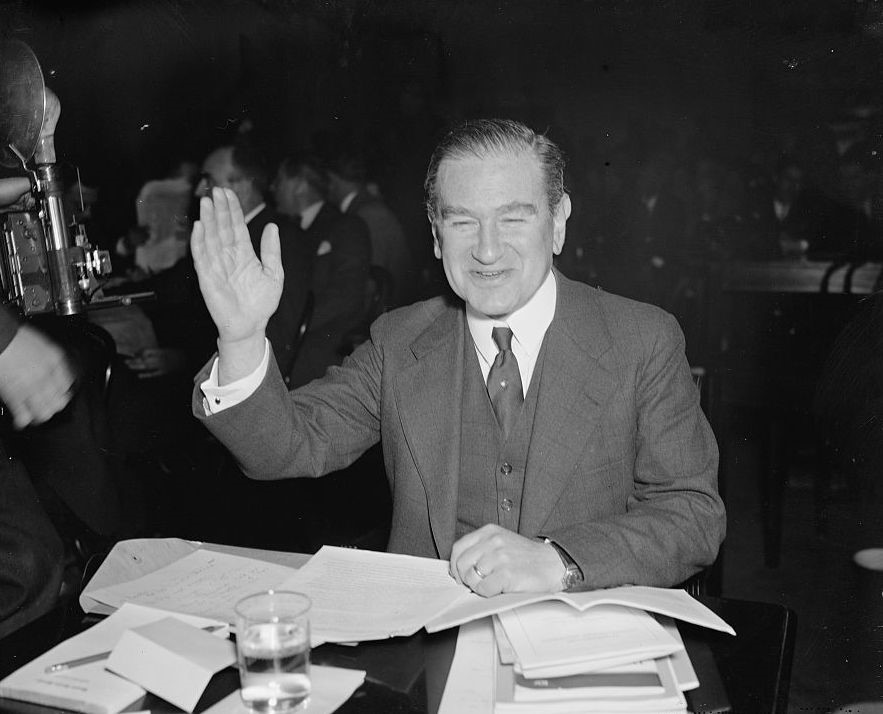
Edwin Borchard before the Senate Judiciary Committee 1937[6]

The reviews also mentioned the KWI as the publications’ editor, although the Kaiser-Wilhelm-Society was not mentioned. Abraham Howard Feller of Harvard University, who had also worked at the KWI and was part of the editorial team of the Fontes Juris Gentium, expressed his hope that the KWI would play an “increasingly large part in international legal life”.[7] Edwin Borchard, a Law Professor at Yale University, wrote the most enthusiastic and extensive review about the KWI and its publications in the American Journal of International Law. Therein, Borchard praised the foundation of the KWI as “an epoch-making event”, and portrayed the KWI as an example for other future research institutes and imagined a cooperation amongst them.[8] His praise may not have been without self-interest, though. Borchard himself contributed to the first edition of the Journal with an article entitled “The Kellogg Treaties Sanction War”.[9] As one of the first American law professors, Borchard lectured at Berlin University in 1925 and he was a close friend of Viktor Bruns. Borchard also belonged to a group of American intellectuals who favoured American non-intervention in the First and Second World Wars.[10]

Traditions of Legal Institutions

The foundation of the KWI also has to be seen in the broader context of the foundation of other national and regional institutions of international law prior to and during the First World War. All institutions served the scientific community as well as governments in building understanding of the role of international law in international politics and ways in which states could use international law as an instrument to serve national interests while simultaneously fitting into an increasingly internationalised world. For instance, the American Institute of International Law, founded in 1912, aimed to understand the role of international law in the formation of an international society in the Americas. The hemispheric approach aimed to develop international law, which more specifically served the needs of the Americas.[11] In fact, the Institute particularly served US imperial policy in Latin and South America.[12]

The First World War led to a temporary suspension of the work of international law organisations, such as the Institut de Droit International (IDI) and the International Law Association, whose aim was to advance the codification of international law by collecting and analysing various national laws and practices, and to find a common ground for international norms.[13] But with the suspension of these organisations, the closely-knit networks of international lawyers saw the creation of new national organisations. In 1915, the Grotius Society was founded in Great Britain with the aim of studying the developments of international law during the war. In its wartime publication Problems of the War, academics and law practitioners discussed pressing themes, which emerged from the war, such as neutrality, blockade, reprisals, prisoners of war, and enemy merchantmen. Membership was confined to British citizens (although some exceptions could be made) and the majority of articles reflected allied perspectives.[14] The Society’s Vice-President, Henry Goudy, who held one of the most prestigious academic positions as Regius Professor of Civil Law at the University of Oxford, wrote that it was a “purely British Society”.[15] Goudy eagerly emphasised that the Society’s goal was to “treat all international questions in an absolutely independent spirit”, yet followed this claim by a long list of Germany’s violations of international law.[16]

Politics and International Law

The example of the Grotius Society signalled the broader question that concerned the international law community in both war and peace time: the relationship between politics and international law. In 1873, the founding members of the IDI intensely debated how they should position themselves as an academic society between politics and international law. The IDI’s statutes initially stated that active members were not allowed to execute political mandates.[17] Yet, this clause was soon dropped when the members of the IDI realised that international norms could only be developed with the involvement of national parliaments and governments.[18] It showed, crucially, that national and international legal norms were constituted at the same time.

Viktor Bruns, 1937[19]

The end of the First World War, too, demonstrated that politics and international law were closely intertwined.[20] The Versailles Treaty system created an international post-war order with the League of Nations and the Permanent Court of International Justice (PCIJ) at its heart.[21] The foundation of the KWI reflected the need of the German government to develop expertise and knowledge in the field of international law which would enable it to effectively defend Germany’s interests in the Versailles Treaty system. Thus, it is not surprising that the KWI primarily focused on reparations and occupation.[22] In fact, with Germany’s admission to the League of Nations in 1926, active participation in the new international order was desirable for Germany. And yet, German politicians and the German public were sceptical of the League’s ability to respond to German interests, as were many lawyers.[23] Despite that, the director of the KWI, Viktor Bruns, earned his reputation as a German representative at the PCIJ and as a judge in several mixed arbitration commissions during the interwar period.[24]

The KWI as an “epoch-making event”?

The KWI was part of a broader trend, which was happening at the same time in the Anglo-American research community, regarding the foundation of international law institutions to understand the international order by examining international law from national and regional perspectives. The institutions pursued similar aims, scope, and methods to examine and comment on an increasingly internationalised world, which strengthened, but also limited, the sovereignty of states.[25] The oscillation between the international and national sphere characterised the interwar period and, more often than not, the two complemented rather than opposed each other.[26] Lively discussions took place in the international law community on wartime developments of international law, the post-war order, the Versailles Treaty, the relationship of states and the League of Nations as well as the PCIJ.[27] The foundation of the KWI was not only an epoch-making event, it was also a response to the challenges of the interwar period, which redefined the relationship between states and the international sphere, and, moreover, the role of international law in politics.

[1] Institut für Ausländisches Öffentliches Recht und Völkerrecht, AJIL20 (1926), 357.

[2] Manley O. Hudson, Review: Fontes Juris Gentium by Viktor Bruns, Ernst Schmitz, A.H. Feller and B. Schenk Graf von Stauffenberg, AJIL 25 (1931), 795-796.

[3] Philip C. Jessup, Review: Fontes Juris Gentium. Series A. Sectio 1. Tomus 1 and 2. Sectio 2, Tomus 1, edited by Viktor Bruns, Political Science Quarterly 47 (1932), 296-299 (97, 99).

[4] Charles G. Fentwick, Review: Fontes Juris Gentium, ed. by Viktor Bruns, The University of Pennsylvania Law Review 81 (1932), 238-239.

[5] James L. Brierly, Review: Fontes Juris Gentium, ed. by Viktor Bruns, British Year Book of International Law 13 (1932), 199-201 (200); For a more sympathetic review, see: Wyndham A. Bewes, Review: Fontes Juris Gentium, ed. by Viktor Bruns, International Affairs 12 (1933), 397.

[6] Public Domain.

[7] Abraham H. Feller, Review: Zeitschrift für ausländisches öffentliches Recht und Völkerrecht, edited by Viktor Bruns and others, Harvard Law Review 43 (1930), 851.

[8] Edwin M. Borchard, Institut für Ausländisches Öffentliches Recht und Völkerrecht, AJIL 24 (1930), 587-591.

[9] Edwin M. Borchard, “The Kellogg Treaties Sanction War,” HJIL 1 (1929), 126-131.

[10] Hatsue Shinohara, US International Lawyers in the Interwar Years. A Forgotten Crusade, Cambridge: Cambridge University Press 2012, 17-24, 124-131.

[11] Constitution of the American Institute of International Law, in: James Brown Scott (ed.): American Institute of International Law: Its Declaration of the Rights and Duties of Nations, Washington, D.C.: The American Institute of International Law 1916, 107-116, Article II: 107-108.

[12]Juan Pablo Scarfi, The Hidden History of International Law in the Americas. Empire and Legal Networks, Oxford: Oxford University Press 2017, 33, 37-38.

[13] Gabriela A. Frei, The Institut de Droit International and the Making of Law for Peace, 1899-1917, in: Remi Fabre (ed.), Les défenseurs de la paix (1899-1917), Rennes: Presses Universitaires de Rennes 2018, 133.

[14] The Grotius Society. Founded 1915. Rules, Problems of the War 1 (1915), vii-ix.

[15] Henry Goudy, Introduction, Problems of the War 1 (1915), 1-7 (1).

[16] Goudy (fn. 15), 2.

[17] Statuts votés par la Conférence Juridique internationale de Gand, le 10 Septembre 1873, Annuaire de l’institut de droit international 1 (1877), 1-4.

[18] Revision des statuts – Règlements nouveaux, Annuaire de l’institut de droit international 9 (1887-88), 357.

[19] AMPG, Berlin.

[20] Marcus M. Payk, Frieden durch Recht? Der Aufstieg des modernen Völkerrechts und der Friedensschluss nach dem Ersten Weltkrieg, Oldenbourg: De Gruyter 2018, 495-653.

[21] Dan Gorman, Cooperation, Conflict, and International Order: Lessons from the Post-WW1 Settlement, in: Seth Center/Emma Bates, After Disruption: Historical Perspectives on the Future of International Order, Washington D.C.: Center for Strategic and International Studies 2020, 24-59 (25-27).

[22] Felix Lange, Between Systematization and Expertise for Foreign Policy: The Practice-Oriented Approach in Germany’s International Legal Scholarship (1920-1980), EJIL 28 (2017), 538-540 (543-544).

[23] Christoph M. Kimmich, Germany and the League of Nations, Chicago: University of Chicago Press 1976, 94-105; Martti Koskenniemi, The Gentle Civilizer of Nations. The Rise and Fall of International Law 1870-1960, Cambridge: Cambridge University Press 2001, 236-238.

[24] Viktor Bruns, La Cour Permanente de Justice Internationale. Son Organisation et sa Compétence, in: Hague Academy of International Law (ed.), Recueil des cours – Collected Courses of the Hague Academy of International Law, vol. 62, Leiden: Brill 1937, 549-670; Heinrich Triepel, Nachruf Viktor Bruns, HJIL 11 (1942/43): 324a-324d.

[25] Leonard V. Smith, Sovereignty at the Paris Peace Conference of 1919, Oxford: Oxford University Press 2018, 260-262.

[26] Glenda Sluga, Internationalism in the Age of Nationalism, Philadelphia: University of Pennsylvania Press 2013; Glenda Sluga/Patricia Clavin, Rethinking the History of Internationalism, in: Glenda Sluga/Patricia Clavin,  Internationalisms. A Twentieth-Century History, Cambridge: Cambridge University Press 2017, 3-13.

[27] Geoffrey Butler, Sovereignty and the League of Nations, British Year Book of International Law 1 (1920/21), 35-44; Arthur Baumgarten, Souveränität und Völkerrecht, HJIL 2 (1929), 305-334; Jesse S. Reeves, International Society and International Law, AJIL 15 (1921), 361-374.

Suggested Citation:

Gabriela Frei, “An epoch-making event”? The Foundation of the Kaiser-Wilhelm-Institute and the Anglo-American Research Community, 1912-1933, MPIL100.de, DOI: 10.17176/20240403-174131-0.

Lizenz: CC BY-NC-SA 4.0 DEED


Hermann Heller, der Außenseiter. Kritiker und Verteidiger des Rechtsstaates in einer Krisenzeit

Hermann Heller, the Outsider. Critic and Defender of the Constitutional State in a Time of Crisis

Deutsch

Nur zwei Jahre, von 1926 bis 1928, war der sozialdemokratische Staatsrechtler Hermann Heller (1891-1933) am Kaiser‑Wilhelm‑Institut für ausländisches öffentliches Recht und Völkerrecht (KWI) tätig. Diese Tätigkeit wird in Beiträgen über Hermann Heller, wenn überhaupt, nur beiläufig erwähnt. Das mag nicht zuletzt daran liegen, dass Heller in vielerlei Hinsicht ein Außenseiter war, der nicht so recht ins Bild passte – auch in der Retrospektive. Sich mit Heller zu befassen, heißt somit auch, sich die teilweise vergessene, mitunter auch verdrängte, Pluralität der Akteure und Akteurinnen des Instituts in den 1920er Jahren in Erinnerung zu rufen.

Ein Außenseiter am KWI

Hermann Heller (undated, © Universitätsarchiv Frankfurt, 854/552)

Als Sozialdemokrat und engagierter Verteidiger der Weimarer Republik entsprach Heller nicht dem typischen konservativen Profil des  rechtswissenschaftlichen Establishments der Weimarer Republik, das der jungen Demokratie meist distanziert gegenüberstand.[1] Mit seinen Angriffen auf das studentische Korporationswesen entsprach sein Habitus auch nicht dem tradierten Bild des deutschen Hochschullehrers. Heller kam nicht zuletzt zum KWI, weil er sechs Jahre nach dem Erhalt der venia legendi für Rechtsphilosophie, Staatslehre und Staatsrecht an der Universität Kiel noch immer keine Professur bekommen hatte. 1922 war er nach Leipzig gegangen, wo er die Leitung des neugeschaffenen Volksbildungsamts übernahm und sich, wie bereits in Kiel mit einem anderen sozialdemokratisch engagierten Rechtswissenschaftler, Gustav Radbruch, aktiv in der Volkshochschulbewegung engagierte.[2] Dass der Bildungsminister der vom Sozialdemokraten Otto Braun geführten preußischen Regierung, Carl Heinrich Becker, bei seiner Einstellung am KWI eine Vermittlerrolle spielte, ist nicht auszuschließen – zwei Jahre später ernannte Becker Heller zum außerordentlichen Professor an der Universität Leipzig.

Auch innerhalb der Sozialdemokratie war Heller eine umstrittene Figur, schreckte er doch nicht davor zurück, etablierte marxistische Dogmen offen anzufechten. So stellte er die Auffassung des Staates als bloßes Herrschaftsinstrument der besitzenden Klasse, der im Zuge der proletarischen Revolution und der Überwindung der kapitalistischen Ordnung zwangsweise „absterben“ müsse, in Frage und forderte von den Sozialdemokraten eine positive Einstellung zum Staat und zur Nation. Für viele seiner Parteigenossen mussten Aussagen wie „Sozialismus ist nicht Aufhebung, sondern Veredelung des Staats“[3] wie eine Provokation klingen.

Trotz seiner unorthodoxen Laufbahn und seiner unkonventionellen Ansichten avancierte Heller während seiner Zeit am KWI zu einer wichtigen Figur der Weimarer Debatten um Staat, Recht und Demokratie. Am Institut konnte er sich wieder verstärkt der wissenschaftlichen Arbeit widmen. Davon zeugt seine Schrift Die Souveränität, die 1927 in der Institutsreihe Beiträge zum ausländischen öffentlichen Recht und Völkerrecht erschien und Viktor Bruns gewidmet war.[4] Die Arbeit war wohl wegen ihrer zugleich antipositivistischen Ausrichtung und der Aufwertung des Staats- und Souveränitätsbegriffs für das KWI anschlussfähig. Als Kritiker Hans Kelsens und des Positivismus im Allgemeinen wurde Heller in dieser Zeit neben Heinrich Triepel, Erich Kaufmann, Rudolf Smend und Carl Schmitt zu einem führenden Protagonisten des „Weimarer Methodenstreits“ in der Staatsrechtslehre, der damals seinen Höhepunkt erreichte.

Ab 1928 rückte die Auseinandersetzung mit der Krise der parlamentarischen Demokratie und dem Faschismus in den Mittelpunkt von Hellers Werk. Er veröffentlichte in einer Schriftenreihe der Deutschen Hochschule für Politik, wo er parallel zu seiner Referententätigkeit am KWI lehrte, den Aufsatz Politische Demokratie und soziale Homogenität, in dem er unter anderem kritisch auf Carl Schmitts Parlamentarismuskritik einging. Im selben Jahr unternahm Heller eine sechsmonatige Reise nach Italien. Diese bildete die Grundlage für seine Schrift  Europa und der Fascismus, deren erste Ausgabe 1929 erschien. Heller analysierte die Entstehung, die Ideologie und das Programm des italienischen Faschismus als Antwort auf die politische Krise des europäischen Staats und betonte in der Schlussfolgerung die „große Bedeutung“ der faschistischen Diktatur als „abschreckendes Beispiel“ [5] für die europäischen Demokratien.

Indem Heller eine Krise der Rechts- und Staatsordnung diagnostizierte, unterschied er sich kaum von der Mehrheit seiner zeitgenössischen Kollegen. Im Gegensatz zu vielen entwarf er allerdings einen Lösungsansatz, der nicht auf die Beseitigung des demokratischen Rechtsstaats hinauslief. Die Kombination aus Hellers Kritik des Rechtsstaats und seinem gleichzeitigen Eintreten für dessen Erneuerung in Form des „sozialen Rechtsstaats“ verdient es deshalb etwas näher dargelegt zu werden.

Kritiker des liberalen Rechtsstaates – oder dessen, was aus ihm geworden war

Hellers Kritik des Rechtsstaats in den 1920er Jahren lässt sich etwas vereinfachend in zwei Thesen zusammenfassen. Erste These: Die herrschende individualistisch-liberale Rechts‑ und Staatsauffassung und ihre Staatsform, die parlamentarische Demokratie, gehen von isolierten, freien und gleichen Individuen aus und abstrahieren somit von den gesellschaftlichen Bedingungen und tatsächlich bestehenden Ungleichheiten. Auf sozial ungleiche Lagen angewandt, kritisierte Heller, werde die formale Rechtsgleichheit zu materiell ungleichem Recht.[6] So habe eine formalistische Rechtsauffassung in der Klassengesellschaft zu einem immer schärferen Widerspruch zwischen Rechtsform und Rechtswirklichkeit geführt, „zur radikalsten Ungleichheit“ und zur „Diktatur der herrschenden Klasse“.[7]

Zweite These: Dieser Zustand sei das Produkt einer allmählichen Entleerung beziehungsweise „Degeneration“ der Rechtsstaatsidee.[8] Nach dem Scheitern der 1848er Revolution sei diese allmählich von ihrem materiellen Gerechtigkeitsideal entkoppelt und auf bloße Gesetzesmäßigkeit – bloßen Rechtsformalismus – reduziert worden. Damit habe die Rechtsstaatlichkeit ihre emanzipatorische Funktion verloren, die sie im Vormärz für das Bürgertum hatte. Heller gab zwei Erklärungen für diese Entwicklung: Erstens sei das Bürgertum nach dem Kampf gegen den Absolutismus saturiert gewesen und habe sich mit dem bereits Errungenen zufriedengegeben; zweitens habe es angesichts der Aneignung der liberalen Forderungen durch das Proletariat Angst vor einem radikalen gesellschaftlichen Umsturz bekommen.

Diese hier sehr knapp skizzierten ideengeschichtlich-politischen Betrachtungen waren eng mit Hellers methodologischen Positionen verknüpft. Er betrachtete nämlich den Rechtspositivismus und insbesondere Hans Kelsens Reine Rechtslehre als Produkt eines Degenerationsprozesses des liberalen Rechtsstaats. Mit dem Rechtspositivismus sei nur das Recht als bloße Form für jeden beliebigen Inhalt, unabhängig von Wert und Wirklichkeit, übriggeblieben. Für Heller gingen also die Krise der parlamentarischen Demokratie als Staatsform des liberalen Rechtsstaats und die Krise der Staatsrechtslehre miteinander einher.

Verteidiger des Rechtsstaats in der Krise

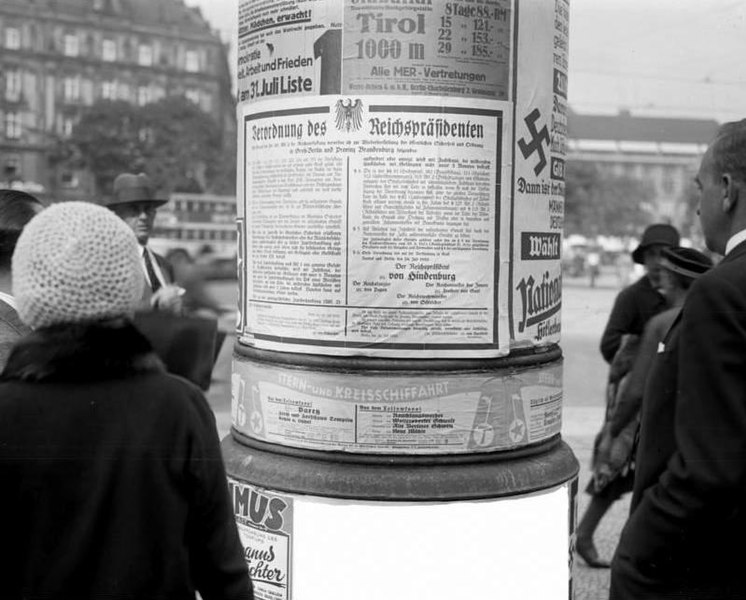
Notverordnung des Reichspräsidenten (Berlin im Juli 1932) [9]

Wie bereits angedeutet, stand Heller mit seiner Krisendiagnose keineswegs allein da. Antiliberale und antipositivistische Kritik waren in allen politischen Lagern weit verbreitet. Antidemokratisch angelegte Lösungsansätze wies Heller allerdings entschieden zurück. So setzte er sich kritisch mit Carl Schmitts Thesen über den Parlamentarismus und insbesondere über einen grundsätzlichen Gegensatz zwischen Parlamentarismus und Demokratie auseinander.[10] In Europa und der Fascismus machte Heller keinen Hehl daraus, was er von Schmitts Thesen hielt: „Dass Carl Schmitt und Mussolini sich höchst persönliche Begriffe von Demokratie bilden“, schrieb er, „kann vielleicht der Diktatur, bestimmt aber nicht der Wissenschaft förderlich sein“[11]. Heller lehnte ebenso die in Weimar weit verbreitete Auffassung des Staates als eines über und unabhängig von den Individuen bestehenden Wesens. Aus seiner Sicht war ein solches Staatsverständnis schlicht ungeeignet, den Staat als Einheit in der Vielheit zu erfassen, die durch Willensakte von realen Personen gebildet wird und nicht ohne sie existiert. Hellers pluralistisches Staatsverständnis blieb in der damaligen Staatslehre eine Ausnahme. Hellers Kritik galt auch dem Faschismus: Dieser habe zwar die Mängel des  Zustandes von Staat und Gesellschaft in vielen Punkten sehr scharf gesehen; er sei aber nicht imstande, die Grundprobleme der Zeit zu lösen – nämlich die Klassenfrage und das Fehlen einer Wert- und Willensgemeinschaft – , welche die Krise der parlamentarischen Demokratie herbeigeführt hätten.[12]

Heller ging es also nicht darum, den liberalen Rechtsstaat zu beseitigen, sondern ihn „umzubauen“.[13] Wie aber stellte er sich das vor? Bis 1928 verwendete er den Begriff der „sozialen Demokratie“. Diese „soziale Demokratie“ setzte einen Paradigmenwechsel im Rechtsdenken voraus, nämlich die Absage an das individualistisch-abstrakte Menschenbild des Liberalismus und die „Ausdehnung des materiellen Rechtsstaatsgedankens auf die Arbeits- und Güterordnung“[14], um Hellers bekannte Formulierung aus Rechtsstaat oder Diktatur aufzugreifen. Mit anderen Worten: Das Recht sollte endlich die konkreten Lebenslagen der Menschen und die gesellschaftlichen Ungleichheiten und Machtverhältnisse berücksichtigen. Hier ist zu betonen, dass sich Heller den Wandel zur „sozialen Demokratie“ immer als geordneten staatlich-juridischen Prozess im Rahmen der demokratischen Verfassungsordnung vorgestellt hat. Aus seiner Sicht enthielt nämlich die Weimarer Verfassung die notwendigen „verfassungsrechtlichen Hebel“[15] um diesen Wandel zu vollziehen. Er dachte dabei vor allem an die Bestimmungen der Artikel 151 („Die Ordnung des Wirtschaftslebens muß den Grundsätzen der Gerechtigkeit mit dem Ziele der Gewährleistung eines menschenwürdigen Daseins für alle entsprechen. In diesen Grenzen ist die wirtschaftliche Freiheit des einzelnen zu sichern“) und 153 („Eigentum verpflichtet. Sein Gebrauch soll zugleich Dienst sein für das Gemeine Beste“) und an den sogenannten „Räteartikel“, den Artikel 165 (Mitwirkungsrechte der Arbeiter und Angestellten durch Tarifverträge und die Einrichtung von Betriebs- und Bezirksarbeiterräten). Mit einem solchen Paradigmenwechsel sollte es möglich sein, das Recht in seiner emanzipatorischen Funktion wiederherzustellen.

Der Begriff „sozialer Rechtsstaat“ taucht bei Heller erst 1929/30 im Aufsatz Rechtsstaat oder Diktatur auf. Der darin erkennbare Begriffswechsel hatte wohl weniger mit einem inhaltlichen Wandel von Hellers Denken zu tun als mit der damaligen Zuspitzung der Kritik an der parlamentarischen Demokratie und der eminent politischen Bedeutung dieser Debatte. Der Optimismus von 1924, die Hoffnung, dass die Weimarer Verfassung eine Veränderung der Rechts- und Wirtschaftsordnung ermöglichen würde, war verflogen. Die Deutschen, erklärte Heller, standen vor einer politischen – und existentiellen – Entscheidung: der „Entscheidung zwischen fascistischer Diktatur und sozialem Rechtsstaat“[16]. Es war wohl kein Zufall, dass Heller sich gerade in der Krisenphase der Republik begrifflich mit aller Deutlichkeit in die Tradition des Rechtsstaats stellte: Er wollte das Bürgertum auffordern, sein eigenes politisch-juristisches Erbe zu verteidigen, statt „Selbstmord“[17] zu begehen.

Der Weg aus der Krise des Rechtsstaats und seiner Staatsform, der parlamentarischen Demokratie, führte also für Heller nicht über deren Zerstörung: Sie sollten vielmehr mit neuem Inhalt gefüllt werden. Hellers Lösungsansatz wies zweifellos Schwächen und Ambivalenzen auf: Seine scharfe Kritik am Rechtspositivismus Kelsens, der selbst ein überzeugter Demokrat war, schoss wohl teilweise über das Ziel hinaus. Hellers Konzept vom Übergang zum sozialen Rechtsstaat mochte auch zu staatszentriert sein und zu abstrakt bleiben. Dass er aber entschieden an der Kontinuität zwischen liberaler und sozialer Rechts- und Staatsordnung und an der emanzipatorischen Funktion des Rechts festhielt, war im damaligen theoretischen und politischen Kontext bemerkenswert.

Nachspiel: Hermann Heller und die Carls

Im Oktober 1928 wurde Heller zum außerordentlichen Professor an der Universität Leipzig ernannt und verließ das KWI. Im Frühjahr 1932 erhielt er eine ordentliche Professur an der Universität Frankfurt. Diese späte Anerkennung seiner wissenschaftlichen Leistung war jedoch ein trügerisches Zeichen: Aufgrund seines politischen Engagements hatte sich eine Mehrheit der Fakultätsangehörigen zunächst gegen Heller ausgesprochen und statt seiner Carl Schmitt vorgeschlagen.[18] Im Oktober 1932 standen sich dann Hermann Heller und Carl Schmitt – neben Carl Bilfinger, dem späteren Nachfolger Viktor Bruns‘ am KWI und Leiter des neugegründeten Max-Planck-Instituts für ausländisches öffentliches Recht und Völkerrecht– vor dem Staatsgerichtshof im „Preußenschlag“-Prozess gegenüber: Schmitt als (erfolgreicher) Verteidiger der Reichsregierung, Heller als (erfolgloser) Prozessvertreter der im Juli abgesetzten preußischen Regierung und damit der Weimarer Verfassungsordnung. Dabei konnte er auf seine Arbeit am KWI zurückgreifen, denn als früherer Referent der Abteilung Schweiz war er mit Fragen der Bundesexekution in föderativen Verfassungen vertraut.[19] Letztendlich illustrierten der Prozess und dessen Ausgang, was Heller im selben Jahr in seinem Aufsatz Bürger und Bourgeois feststellte: Der Rechtsstaat, die staatliche Lebensform des Bürgertums, wurde paradoxerweise quasi nur noch von der Sozialdemokratie verteidigt. Das Bürgertum – und viele Juristen – hatte ihn schon aufgegeben. Ein paar Monate später wurde Heller selbst zum Opfer des Untergangs dieses Rechtsstaats, als er als Hochschullehrer jüdischer Herkunft im April 1933 aufgrund des „Gesetzes zur Wiederherstellung des Berufsbeamtentums“ von den Nationalsozialisten aus dem Staatsdienst entfernt wurde. Sein Lehrstuhl wurde vom Verfechter des „totalen Staats“ Ernst Forsthoff übernommen, während dessen Mentor Carl Schmitt, zu dem Heller zu Beginn seiner Berliner Zeit ein gutes Verhältnis gepflegt hatte, die Legitimität des Führers als obersten Gerichtsherren bekräftigte.[20] Heller war schon vor seiner Entlassung nach Spanien gegangen, wo er im November 1933 an den Folgen eines Herzanfalls starb.

Er konnte also die Wiederherstellung des demokratischen Rechtsstaats nach 1945 nicht erleben. Neben Hellers Stellung als unorthodoxer Außenseiter, der in keine staatsrechtliche „Schublade“ passt, mag dies eine andere Erklärung dafür sein, dass er in der Staatsrechtslehre der frühen Bundesrepublik insgesamt weniger als die anderen führenden Weimarer Staatsrechtler Smend, Schmitt und Kelsen rezipiert wurde und erst über die Schriften Ernst-Wolfgang Böckenfördes wieder expliziten Einfluss gewann. Ein anderer ehemaliger Mitarbeiter des KWI, der zwischen 1927 und 1928 mit Heller zusammengearbeitet hatte und ihn und sein Engagement für die Republik bewunderte, war dagegen schon unmittelbar nach dem Kriegsende entscheidend an den westdeutschen Verfassungsdebatten beteiligt: der Sozialdemokrat Carlo Schmid (der am KWI noch als „Karl“ firmiert hatte). Unter anderem ihm ist zu verdanken, dass der Gedanke des „sozialen Rechtsstaats“ Eingang in das Grundgesetz fand. Hellers Tätigkeit am KWI hat also schließlich doch, wenn auch auf Umwegen, zu seinem Nachruhm beigetragen. Und den deutschen Rechtsstaat geprägt.

[1] Als andere prominente Ausnahmen kann man auch Hans Kelsen, Hugo Sinzheimer und Ernst Fraenkel sowie die jüngeren Franz Neumann und Otto Kirchheimer nennen.

[2] Für biografische Details siehe: Klaus Meyer, Hermann Heller: Eine Biographische Skizze, Politische Vierteljahresschrift 8 (1967), 93–313; Das Engagement in der Volkshochschulbewegung war in der Weimarer Zeit geradezu typisch für sozialdemokratische Rechtswissenschaftlicher – man könnte hier auch auf Hugo Sinzheimer oder Franz Neumann verweisen.

[3] Hermann Heller, Sozialismus und Nation, 2. Aufl. 1931, in: Christoph Müller (Hrsg.), Hermann Heller, Gesammelte Schriften, Bd. I, Leiden: Sitjhoff 1971, 437-526 (496). Die erste Auflage erschien 1923.

[4] Hermann Heller, Die Souveränität – Ein Beitrag zur Theorie des Staats- und Völkerrechts, Beiträge zum ausländischen öffentlichen Recht und Völkerrecht Bd. 4, Berlin: De Gruyter 1927.

[5] Hermann Heller, Europa und der Fascismus, 2. Aufl. 1931, in: Gesammelte Schriften (Fn. 3), Bd. II, 465-610 (609).

[6] Hermann Heller, Die politischen Ideenkreise der Gegenwart, in: Gesammelte Schriften (Fn. 3), Bd. I, 267-412 (396).

[7] Hermann Heller, Politische Demokratie und soziale Homogenität, in: Gesammelte Schriften (Fn. 3), Bd. II, 421-434 (430).

[8] Hermann Heller, Rechtsstaat oder Diktatur?, in: Gesammelte Schriften (Fn. 3), Bd. II, 443-462 (449-450); Hermann Heller, Bürger und Bourgeois, in: Gesammelte Schriften (Fn. 3), Bd. II, 625-642 (632).

[9] BArch, Bild 102-13680 / Pahl, Georg.

[10] Den Schmitt insbesondere in der zweiten Auflage seiner Schrift Die geistesgeschichtliche Lage des Parlamentarismus theorisiert hatte: Carl Schmitt, Die geistesgeschichtliche Lage des Parlamentarismus, 2. Aufl., München: Duncker und Humblot 1926.

[11] Heller, Fascismus (Fn. 5), 541.

[12] Siehe: Heller, Fascismus (Fn. 5), 604 ff.

[13] „Für uns kann es sich nur darum handeln, […] den liberalen in einen sozialistischen Rechtsstaat umzubauen“: Hermann Heller, Ziele und Grenzen einer Verfassungsreform, in: Gesammelte Schriften (Fn. 3), Bd. II. 411-417 (416).

[14] Heller, Rechtsstaat (Fn. 8), 451.

[15] Hermann Heller, Grundrechte und Grundpflichten, in: Gesammelte Schriften (Fn. 3), Bd. II, 281-317 (312).

[16] Heller, Rechtsstaat (Fn. 8), 462.

[17] Heller, Rechtsstaat (Fn. 8), 460.

[18] Dazu: Meyer (Fn. 2), 309.

[19] Meyer (Fn. 2), 310.

[20] Siehe: Carl Schmitt, Der Führer schützt das Recht, DJZ 15 (1934), 945-950.

English

Constitutional law expert and social democrat Hermann Heller (1891-1933) worked at the Kaiser Wilhelm Institute for Comparative Public Law and International Law (KWI) for just two years, from 1926 to 1928. In contributions on Hermann Heller, this employment is usually only mentioned in passing, if at all. This may not least be due to the fact that he was in many respects an outsider who did not really fit in – even in retrospect. Dealing with Heller therefore also means recalling the partially forgotten, sometimes even suppressed, plurality of protagonists at the institute in the 1920s.

An Outsider at the KWI

Hermann Heller (undated, © Universitätsarchiv Frankfurt, 854/552)

As a social democrat and committed defender of the Weimar Republic, Heller did not match the generally conservative profile of the jurisprudential establishment of the Weimar Republic, which in large part distanced itself from the young democracy.[1] With his attacks on the culture of Studentenverbindungen (fraternity-like structures strongly associated with conservatism and German nationalism), his habitus did not correspond to the traditional image of the German university lecturer either. Heller came to the KWI not least because, six years after receiving the venia legendi for philosophy of law, constitutional theory (Staatslehre) and constitutional law at the University of Kiel, he still had not been offered a professorship. In 1922, he had moved to Leipzig, where he took over the management of the newly-established People’s Education Office (Volksbildungsamt) and, as in Kiel, was together with another social democratically committed jurist, Gustav Radbruch, actively involved in the Adult Education Movement (Volkshochschulbewegung)[2] It cannot be ruled out that the Minister of Education Carl Heinrich Becker of the Prussian government, led by social democrat Otto Braun, played a mediating role in Heller’s appointment at the KWI – two years later, Becker appointed him as an associate professor at the University of Leipzig.

Heller was also a controversial figure within social democracy, as he did not shy away from openly challenging well-established Marxist dogma. For example, he rejected the view that the state constitutes a mere instrument of power of the propertied class and will eventually have to “die off” in the course of the proletarian revolution and the overcoming of the capitalist order. Instead, Heller demanded from the social democrats a positive attitude towards the state and the nation. To many of his party comrades, statements such as “socialism is not the abolition but the ennoblement of the state”[3] must have sounded provocative.

Despite his unorthodox career and his unconventional views, during his time at the KWI, Heller became an important figure in the debates on state, law and democracy in the Weimar Republic. At the institute, he was able to devote more time to academic work again. This is evidenced by his book Die Souveränität (“On Sovereignty”), which was published in the Institute’s series “Contributions on Comparative Public Law and International Law” and was dedicated to Viktor Bruns.[4] The work was likely well‑received within the KWI because of its anti-positivist orientation and its valorisation of the concept of state and sovereignty. As a critic of Hans Kelsen and legal positivism more broadly, Heller became a leading protagonist – alongside Heinrich Triepel, Erich Kaufmann, Rudolf Smend, and Carl Schmitt – of the controversy on methodology in constitutional law in the Weimar Republic (Weimarer Methodenstreit), which reached its peak at the time.

From 1928 onwards, the focus of Heller’s work shifted towards the crisis of parliamentary democracy and fascism. He published the essay Politische Demokratie und soziale Homogenität (“Political Democracy and Social Homogeneity”) in a publication series by the Deutschen Hochschule für Politik (“German College of Policy”), where he taught alongside his work at the KWI. There, inter alia, he critically addressed Carl Schmitt’s critique of parliamentarism. In the same year, Heller went on a six month long trip to Italy, which laid the foundation for his work Europa und der Fascismus (“Europe and Fascism”), the first edition of which was published in 1929. Heller analyzed the emergence, ideology, and the political program of Italian fascism as a reaction to the political crisis of the European state. In his conclusion he underlined the “great significance” of the fascist dictatorship as a “cautionary example”[5] for European democracies.

In diagnosing a crisis of the legal system and state order, Heller did not distinguish himself from the majority of his contemporary colleagues. In contrast to many others, however, he developed a solution that did not amount to the elimination of the democratic constitutional state. The consolidation of Heller’s criticism of the constitutional state and his simultaneous advocacy for its renewal in the form of a “social constitutional state” (sozialer Rechtsstaat) therefore deserves to be explained in more detail.

Critic of the Liberal Constitutional State – or What had Become of it

Heller’s critique of the constitutional state in the 1920s can be summarised somewhat simplistically in two theses. First thesis: the predominant liberal and individualistic conception of law and state, and its corresponding form of government, the parliamentary democracy, rely on the assumption of isolated, free and equal individuals and thus an abstraction from social conditions and real-world inequalities. When applied to socially unequal situations, however, Heller argued formal legal equality produces a substantively unequal legal order.[6] Therefore, under the conditions of a class society, a formalistic conception of law had led to an ever-sharper contradiction between legal order and legal reality, “to the most radical inequality” and to the “dictatorship of the ruling class”.[7]

Second thesis: this state of affairs is the product of a gradual erosion or “degeneration” of the idea of the rule of law.[8] After the failure of the 1848 revolution, it was gradually decoupled from an ideal of material justice and reduced to mere lawfulness – mere legal formalism, according to Heller. As a result, the rule of law lost the emancipatory function it had had for the bourgeoisie in the Vormärz. Heller gave two explanations for this development: firstly, the bourgeoisie had become saturated after the struggle against absolutism and was content with what had already been achieved. Secondly, due to the appropriation of liberal demands by the proletariat, the bourgeois class had become afraid of a radical social upheaval.

These historical-political considerations, outlined very briefly here, were closely linked to Heller’s methodological positions. He considered legal positivism and, in particular, Hans Kelsen’s Reine Rechtslehre (“Pure Theory of Law”) the product of a process of degeneration of the liberal constitutional state. With legal positivism, the law only remained as a mere form for any content, independent of value and reality. Therefore, for Heller, the crisis of parliamentary democracy as the form of government of the liberal constitutional state and the crisis of constitutional law scholarship went hand in hand.

Defender of the Constitutional State in a Time of Crisis

The emergency decree of the Reich President (Berlin, July 1932) [9]

As already indicated, Heller was hardly alone in his diagnosis of a crisis. Anti‑liberal and anti-positivist criticism was widespread in all political camps. However, Heller firmly rejected anti-democratic solutions. He was critical of Carl Schmitt’s theories on parliamentarism and in particular of his thesis of a fundamental conflict between parliamentarism and democracy.[10] In Europa und der Fascismus, Heller made no secret of what he thought of Schmitt’s theses: “the fact that Carl Schmitt and Mussolini form highly personal concepts of democracy”, he wrote, “may perhaps be conducive to dictatorship, but certainly not to science”[11]. Heller also rejected the doctrine of the state as a being existing beyond and independent of individuals. To him, such a view was simply unsuitable for grasping the state as a unity in multiplicity, which is constituted by voluntary acts of real persons and does not exist without them. His pluralistic understanding of the state remained an exception in the constitutional theory of the time. Heller also criticised fascism: although he admitted that it had seen the shortcomings of the state and society very clearly in many respects, he maintained it was unable to solve the fundamental problems of the time – namely the class question and the lack of a community of values and will – which had brought about the crisis of parliamentary democracy.[12]

Heller’s aim was therefore not to eliminate the liberal constitutional state, but to “transform” it.[13]  How did he envision this? Until 1928, he used the term “soziale Demokratie” (“socially-oriented democracy”). This “soziale Demokratie” presupposed a paradigm shift in legal thinking, namely the rejection of liberalism’s individualistic and abstract conception of man and the “extension of the substantive concept of the rule of law to the order of labour and property”[14], to pick up on Heller’s well-known quote from Rechtsstaat oder Diktatur (“Constitutional State or Dictatorship”). In other words, the law should finally take into account people’s concrete life situations, social inequalities and power relations. Here, it must be emphasised that Heller envisioned the transformation towards a “socially-oriented democracy” as an orderly political-legal process within the framework of the democratic constitutional order. In his view, the Weimar Constitution contained the necessary “constitutional levers”[15] to bring about this change. He was thinking primarily of the provisions of Article 151 (“The organization of economic life must accord with the principles of justice and aim at securing for all conditions of existence worthy of human beings. Within these limits the individual is to be secured the enjoyment of economic freedom.”), Article 153 (“Property entails obligations. Its use shall also serve the public good.”)[16] and to the so-called “council article”, Article 165 (participation rights of workers through wage agreements and the establishment of workers’ councils). With such a paradigm shift, Heller thought it possible to restore the law in its emancipatory function.

The term “social constitutional state” does not appear in Heller’s work until 1929/30 in the essay Rechtsstaat oder Diktatur. The change in terminology recognisable in this essay probably had less to do with a change in Heller’s thinking than with the intensification of criticism of parliamentary democracy at the time and the eminent political significance of this debate. The optimism of 1924, the hope that the Weimar constitution would enable a change in the legal and economic order, had evaporated. German society, Heller stated, was facing a political – and existential – decision: the “choice between fascist dictatorship and a social constitutional state”.[17] It was probably no coincidence that, in the crisis phase of the republic, with his choice of words, Heller placed himself very clearly in the tradition of the constitutional state: he wanted to call on the bourgeoisie to defend their own political and legal heritage instead of committing “suicide”[18] .

For Heller, the way out of the crisis of the constitutional state and its form of government, parliamentary democracy, was not to destroy them, but rather to give them new substance. Heller’s approach undoubtedly had weaknesses and ambivalences: his harsh criticism of the legal positivism of Hans Kelsen, who was himself a convinced democrat, arguably partly overshot the mark. His concept of the transition to a social constitutional state may also be too state-centred and remain too abstract. However, the fact that he resolutely adhered to the continuity between a liberal and a socially-oriented legal system and state order as well as to the emancipatory function of the law was remarkable in the theoretical and political context of the time.

Aftermath: Hermann Heller and the Carls

In October 1928, Heller was appointed associate professor at the University of Leipzig and left the KWI. In spring 1932, he received a full professorship at the University of Frankfurt. However, this late recognition of his academic achievements was deceptive: due to his political activities, a majority of faculty members had initially spoken out against Heller and proposed Carl Schmitt instead.[19] In October 1932, Hermann Heller and Carl Schmitt – alongside Carl Bilfinger, later Viktor Bruns’ successor at the KWI and director of the newly founded Max Planck Institute for Comparative Public Law and International Law – faced each other in the “Preußenschlag” trial before the State Court: Schmitt as the (successful) attorney of the Reich government, Heller as the (unsuccessful) counsel of the Prussian government, which had been removed in July, and, thus, of the Weimar constitutional order. In this function, he was able to draw on his work at the KWI, because as a former research fellow in the Swiss department he was familiar with questions of federal executive power within the framework of federal constitutions.[20] Ultimately, the trial and its outcome illustrated what Heller had stated in the same year in his essay Bürger und Bourgeois (“Citizen and Bourgeois”): virtually the only remaining defender of the constitutional state, the political habitat of the bourgeoisie, was, paradoxically, social democracy. The bourgeoisie – and many lawyers – had already given up on it. A few months later, Heller himself fell victim to the downfall of the constitutional state, when he was removed from his professorship by the National Socialists in April 1933 due to his Jewish origin, on the basis of the “Gesetzes zur Wiederherstellung des Berufsbeamtentums” (“Law for the Restoration of the Civil Service”). His chair was taken over by the advocate of the “total state” Ernst Forsthoff, while Carl Schmitt, mentor of the latter, with whom Heller had cultivated a good relationship in the beginning of his time in Berlin, reaffirmed the legitimacy of the Führer as the supreme legal authority.[21] Heller had already emigrated to Spain before his dismissal, where he died in November 1933 from the consequences of a heart attack.

He was therefore unable to witness the restoration of the democratic constitutional state after 1945. In addition to Heller’s role as an unorthodox outsider who did not fit into any “box” of constitutional law scholarship, this may be another explanation for the fact that he was received less than other leading Weimar constitutional law scholars like Smend, Schmitt and Kelsen in the constitutional law scholarship of the early Federal Republic of Germany and only regained explicit influence through the writings of Ernst‑Wolfgang Böckenförde. Another former KWI employee, who had worked with Heller between 1927 and 1928 and admired him and his commitment to the Republic, was decisively involved in the West German constitutional debates immediately after the end of the war: the social democrat Carlo Schmid (who still went by the name “Karl” during his time at the KWI). It is partly thanks to him that the idea of the “social constitutional state” found its way into the new German constitution. Heller’s work at the KWI, therefore, although by a circuitous route, ultimately did contribute to his posthumous fame. And it shaped the German constitutional state.

Translation from the German original: Sarah Gebel

[1] Other prominent exceptions include Hans Kelsen, Hugo Sinzheimer, Ernst Fraenkel and Gustav Radbruch as well as the younger Franz Neumann and Otto Kirchheimer.

[2] For biographical details, see: Klaus Meyer, Hermann Heller: Eine Biographische Skizze, Politische Vierteljahresschrift 8 (1967), 93–313; his engagement in the Volkshochschulbewegung was typical for social-democratic legal scholars in the Weimar Republic, one could also point to Hugo Sinzheimer or Franz Neumann.

[3] Hermann Heller, Sozialismus und Nation, 2. edn. 1931, in: Christoph Müller (ed.): Hermann Heller, Gesammelte Schriften, vol. I, Leiden: Sitjhoff 1971, 437-526 (496, translated by the editor). The first edition was published in 1923.

[4] Hermann Heller, Die Souveränität – Ein Beitrag zur Theorie des Staats- und Völkerrechts, Contributions on Comparative Public Law and International Law vol. 4, Berlin: De Gruyter 1927.

[5] Hermann Heller, Europa und der Fascismus, 2nd edition 1931, in: Gesammelte Schriften (fn. 3), vol. II, 465-610 (609, translated by the editor).

[6] Hermann Heller, Die politischen Ideenkreise der Gegenwart, in: Gesammelte Schriften (fn. 3), vol. I, 267-412 (396).

[7] Hermann Heller, Politische Demokratie und soziale Homogenität, in: Gesammelte Schriften (fn. 3), vol. II, 421-434 (430, translated by the editor).

[8] Hermann Heller, Rechtsstaat oder Diktatur?, in: Gesammelte Schriften (fn. 3), vol. II, 443-462 (449-450); Hermann Heller, Bürger und Bourgeois, in: Gesammelte Schriften (fn. 3), vol. II, 625-642 (632).

[9] BArch, Bild 102-13680 / Pahl, Georg.

[10] Schmitt had theorised this particularly in the second edition of his work Die geistesgeschichtliche Lage des Parlamentarismus (“The Crisis of Parliamentary Democracy”): Carl Schmitt, Die geistesgeschichtliche Lage des Parlamentarismus, 2. edn., München: Duncker und Humblot 1926.

[11]Heller, Fascismus (fn. 5), 541 (translated by the editor).

[12] See: Heller, Fascismus (fn. 5), 604 ff.

[13] “For us, it can only be a matter of […] transforming the liberal constitutional state into a socialist constitutional state” (translated by the editor): Hermann Heller, Ziele und Grenzen einer Verfassungsreform, in: Gesammelte Schriften (fn. 3), vol. II. 411-417 (416).

[14] Heller, Rechtsstaat (fn. 8), 451 (translated by the editor).

[15] Hermann Heller, Grundrechte und Grundpflichten, in: Gesammelte Schriften (fn. 3), vol. II, 281-317 (312, translated by the editor).

[16] Translation following: Heinrich Oppenheimer, The Constitution of the German Republic, London: Stevens and Sons 1923, Appendix: The constitution of the German Federation of August 11, 1919, 219-260.

[17] Heller, Rechtsstaat (fn. 8), 462 (translated by the editor).

[18] Heller, Rechtsstaat (fn. 8), 460 (translated by the editor).

[19] See: Meyer (fn. 2), 309.

[20] Meyer (fn. 2), 310.

[21] See: Carl Schmitt, Der Führer schützt das Recht, DJZ 15 (1934), 945-950.

“Asylum Compromise” Revisited

In the early 1990s, Andreas Zimmermann – then a PhD candidate at the Max Planck Institute for Comparative Public Law and International Law (MPIL) in Heidelberg – comprehensively addressed the question of the conformity of so-called “safe third country” (STC) practices in the field of refugee protection with international law. In 1992, in the run-up to the reform of the German asylum system, he wrote an expert opinion together with the institute’s director at the time, Jochen A. Frowein, for the German Federal Ministry of Justice titled “Der völkerrechtliche Rahmen für die Reform des deutschen Asylrechts” (“The International LawFramework for the Reform of German Asylum Law”)[1]. Following the adoption of Article 16a of the Basic Law – the German constitution –  in 1993, he wrote his PhD thesis titled “Das neue Grundrecht auf Asyl – Verfassungs- und völkerrechtliche Grenzen und Voraussetzungen” (“The New Fundamental Right to Asylum – Constitutional and International Law Limits and Requirements”).[2] The work was published in 1994 as part of the Heidelberg Max Planck Law book series “Contributions on Comparative Public Law and International Law”. It analyses in detail the legality of Article 16a of the Basic Law at the constitutional, European, and international level. Furthermore, in 1993, he also wrote an article on “Asylum Law in the Federal Republic of Germany in the Context of International Law”, which was published in the Heidelberg Journal on Comparative Public Law and International Law (HJIL).[3] In light of the current discourse surrounding the proposals for a reform of the Common European Asylum System (CEAS), it is worthwhile revisiting these works.

The “Asylum Compromise” of 1993

In 1993, the concept of STC was introduced to the German constitution in an effort to deal with the high influx of war refugees from the former Yugoslavia. Germany thereby followed an emerging practice that originated in Switzerland to ensure a sharing of responsibility for asylum seekers  among members of the international community. States most impacted by refugee influx could reject an application for asylum as inadmissible and could subsequently send asylum seekers to another state on the condition that the receiving state could offer them adequate protection in accordance with accepted international standards.

Through the so-called “asylum compromise”, the right to asylum was severely restricted by means of changing Article 16 of the Basic Law. The previous version, formerly enshrined in Article 16(2) of the Basic Law read:

“Persons persecuted on political grounds shall have the right of asylum.”

Paragraph (2) of Article 16a of the Basic Law (introduced in 1993) stipulates:

“Paragraph (1) [the right to asylum] of this Article may not be invoked by a person who enters the federal territory from a member state of the European Communities or from another third state in which application of the Convention Relating to the Status of Refugees and of the Convention for the Protection of Human Rights and Fundamental Freedoms is assured. […]”[4]

Safe Third Country Practices and International Law

Regarding the compliance of the STC concept enshrined in Paragraph (2) of Article 16a of the Basic Law with international law, Zimmermann’s main conclusions,[5] in 1993, are as follows:

Under customary international law, states are not subject to a duty to readmit persons other than their own nationals. Hence, sending an asylum seeker to a third state is only possible if that state has declared its willingness to readmit asylum seekers and provide them with the option to request refugee status in a legally binding agreement with the sending state.

Under the 1951 Geneva Refugee Convention (thereinafter: Refugee Convention), states are generally not precluded from returning asylum seekers to third states. In any given case, however, it must be assured that the principle of non-refoulement, enshrined in Article 33 of the Refugee Convention, is abided by. This means that asylum seekers must be protected from persecution in the third state as well as from deportation by the third state to the presumed country of persecution (protection from chain deportations).

While STC can be determined in a generalized manner, it is necessary that the states in question are themselves bound by the Refugee Convention without geographical reservations and that their procedure of asylum application is in line with the procedural minimum standard under international law. However, even if the procedural guarantees of the Refugee Convention are generally complied with, the returning state is obliged to examine whether the receiving state fulfils its obligations under Article 33 of the Refugee Convention bona fide. In case of concrete indications that the respective third country is, in practice, not complying with the prohibition of refoulement stipulated in Article 33 of the Refugee Convention despite its formal commitment to the Convention, the returning state is obliged to review whether a country may remain on the list of STC.

Furthermore, before being sent back to a STC, a refugee must be granted an opportunity to claim that, in his or her individual case, the third state in question would not be safe.

Under the Refugee Convention, an asylum-seeker needs to be sufficiently connected to the third country in question for his or her transfer there to be legal. For example, a state has no right to return a person to a country through the airport of which he or she has passed for purposes of transit only.

Whereas the returning state must ensure that the third state abides by Article 33 of the Refugee Convention, it is not responsible for ensuring that allprovisions of the Refugee Convention are complied with in the third country.[6] Nevertheless, the third state must guarantee the refugee some kind of minimum living standard.

Under the European Convention on Human Rights (ECHR), there are further special restrictions, e.g., with regard to the protection of family life (Article 8 ECHR) and the prohibition (under Article 3 ECHR) to create a situation where a person is permanently sent from one state to another and thus becomes a “refugee in orbit”.

Most of these findings about the legal safeguards still apply to today’s changed legal environment and have been further developed by scholarship and jurisprudence over the years. Some questions, however, remain disputed to this day: this includes whether the third state needs to be a party to the Refugee Convention and to what extent the sending state must ensure that provisions of the Refugee Convention are complied with in the third country.[7]

The Safe Third Country Concept in EU Asylum Law

In 2005, the concept of STC was incorporated at the EU-level in the 2005 Asylum Procedures Directive, which was later replaced by the 2013 Asylum Procedures Directive (rAPD). Article 38(1) rAPD stipulates that a member state may apply the STC concept only when the competent authorities are satisfied that a person seeking international protection will be treated in accordance with the following principles in the third country:

„(a) life and liberty are not threatened on account of race, religion, nationality, membership of a particular social group or political opinion;

(b) there is no risk of serious harm as defined in Directive 2011/95/EU;

(c) the principle of non-refoulement in accordance with the Geneva Convention is respected;

(d) the prohibition of removal, in violation of the right to freedom from torture and cruel, inhuman or degrading treatment as laid down in international law, is respected; and

(e) the possibility exists to request refugee status and, if found to be a refugee, to receive protection in accordance with the Geneva Convention.”

Furthermore, according to Article 38(2)(a) rAPD, the applicant needs to be sufficiently connected to the STC, so that his or her return and seeking refuge there may be considered reasonable. If the conditions of Article 38 rAPD are met, a member state may consider an application for international protection to be inadmissible (Article 33(2)(c) rAPD).

Increasingly, restrictive immigration policies are aimed at deterring irregular arrivals and responsibility-shifting rather than responsibility-sharing. States are seeking to outsource migration management and international protection responsibility to third countries – mostly transit countries – already impacted by large refugee flows. These policies come with diminished safeguards, as demonstrated by the 2016 EU‑Turkey statement or the 2022 UK‑Rwanda agreement, the latter of which was recently declared unlawful by the UK Supreme Court on the basis that Rwanda was not a STC as asylum seekers would be at risk of refoulement.

While Article 16a of the Basic Law has lost its significance in German asylum law practice since the main regulations are now contained in international treaty law and EU law, the underlying question of the conformity of STC practices with international law remains a topical one. In June 2023, the European Council agreed on a negotiation position on the new Asylum Procedures Regulation. Under the latest[8] amended proposal for an Asylum Procedure Regulation (draft APR), the use of STC procedures shall be expanded by watering down and settling the legal safeguards of the concept on a low standard:

Article 43a(2) of the draft APR states that STC  need only provide “effective protection” to refugees but they are not obligated to grant them legal status, ensure full access to healthcare, or guarantee family unity. Furthermore, the concept of “de facto-protection”, on which Article 43a(2) draft APR is based, does not comply with international refugee law. However, whether the STC must be a party to the Refugee Convention (without geographical limitation) remains, as mentioned, controversial.[9] For instance, a STC could refer to a definition of refugee different than the one laid down in the Refugee Convention, as Zimmermann argues in his dissertation. Furthermore, as a non‐contracting state, a STC could claim to not be legally bound by the principle of non‐refoulement. Lastly, there would be no possibility for the UNHCR to intervene in cases of obvious breaches of the principle of non‑refoulement. Accordingly, at least in Zimmermann’s opinion, the STC must be a party to the Refugee Convention (as well as to other human rights treaties relevant to asylum).[10] With the concept of non-refoulement becoming customary in international law and, arguably, jus cogens, the argument Zimmermann makes may have lost some of its traction. However, an expansion of the circle of STC in the sense that it is no longer required for a third country to respect the principle of non-refoulement “in accordance with the Geneva Convention”[11] would be contradictory to Article 78(1) TFEU and Article 18 of the EU-Charter which require, respectively, that the EU’s asylum policy be “in accordance” with the Refugee Convention and that “the right to asylum shall be guaranteed with due respect for the rules of the Geneva Convention”.

According to Article 45(1)(a) of the draft APR, the safety of a country is to be assessed with reference to “non-nationals”. STC could therefore include countries persecuting their own citizens and producing refugees themselves. Additionally, a third country may be categorized as a STC “with the exception of certain parts of its territory or clearly identifiable groups of persons”, Article 45(1a) draft APR. This could lead to the relocation of asylum seekers to an unstable third state, where a protection zone equivalent to the size of a refugee camp is effectively managed and asylum seekers are held there with their subsistence ensured. This raises unresolved questions regarding the EU’s responsibility for ensuring adequate living standards in third countries as well as the inclusion of asylum seekers in line with the Refugee Convention (cf. Zimmermann’s findings above).

Fortunately, the “reasonable connection requirement” is to be upheld and its definition is subject to rules under national law. This prevents EU member states from concluding a UK‑Rwanda‑like agreement and sending refugees to faraway countries with which they lack any connection. Under Article 45(2b)(b), Recital 37 of the draft APR, a reasonable connection may be established when the applicant has settled or stayed in the third country. Proposals that included references to “transit” as conclusive evidence of a connection were unsuccessful. This is in line with the case law of the Court of Justice of the European Union (CJEU).[12] The examples provided of “settlement” and “stay” nonetheless give member states some room for interpretation in this direction. Having said that, the “reasonable connection requirement” as laid out by Zimmermann in 1994 should inform these interpretations.

Member states may presume the safety of a third country on the mere basis of an agreement between the EU and said third country as well as general assurances by that country that readmitted migrants will be “protected in accordance with the relevant international standards”, Article 45(3) draft APR. The EU-Turkey deal, however, is living proof that the mere existence of an agreement does not guarantee its safety in practice. This is why the 2007 Michigan Guidelines on Protection Elsewhere require, for permitting the referral of an asylum seeker to “protection elsewhere”, a “good faith empirical assessment”[13] by the sending state that refugees will enjoy Refugee Convention rights in the receiving state.[14] The burden of proof in this respect therefore does not lie with the asylum seeker but with the country where the asylum application was lodged, as it retains the responsibility for any action in violation of its obligations under international law, particularly the principle of non-refoulement (cf. Zimmermann’s findings above).

Conclusion and Outlook

After three years of negotiations, the European Parliament and the Council reached a political agreement on the key proposals of the Pact on 20 December 2023, including the Asylum Procedures Directive. This opened the door for further negotiations regarding technical details with a formal adoption expected before the European Parliament elections in June 2024.

The latest proposal for the APR is an example of an attempt at lowering standards with regard to the concept of STC and contradicts the EU’s endorsement of a positive contribution to the protection and promotion of human rights.[15] Once it is formally adopted (changes by means of the political agreement reached in December 2023 and further political discussions notwithstanding), refugee protection in the EU will largely depend on how member states interpret and enforce the regulation. It will be important for member states to consider the real circumstances in the third countries in question. Furthermore, due consideration should be taken of the principles of international cooperation and responsibility-sharing as expressions of international solidarity, a concept which is enshrined in the preamble of the Refugee Convention. Member states should conduct negotiations with all third countries along the migration routes and the EU should make more attractive offers of cooperation with regard to migration policy towards the relevant third countries. To this end, it should also utilize development policy instruments, for example supporting these countries in strengthening their asylum and migration policy capacities.

30 years after the German “asylum compromise”, migration remains at the forefront of the political debate. Concomitant with this is the desire of states to send asylum seekers and, by extension, responsibility to third countries. The debate about international human rights and refugee protection standards in this regard must likewise continue and it is worth bringing to attention some “old” arguments such as those put forward by Andreas Zimmermann and Jochen Frowein at the MPIL.

[1] Jochen A. Frowein, Andreas Zimmermann, Der völkerrechtliche Rahmen für die Reform des deutschen Asylrechts: Gutachten im Auftrag des Bundesministeriums der Justiz erstattet vom Max-Planck-Institut für ausländisches öffentliches Recht und Völkerrecht, Heidelberg, Bundesanzeiger 45 (1993).

[2] Andreas Zimmermann, Das neue Grundrecht auf Asyl – Verfassungs- und völkerrechtliche Grenzen und Voraussetzungen, Contributions on Comparative Public Law and International Law vol. 115, Heidelberg: Springer 1994.

[3] Andreas Zimmermann, ‘Asylum Law in the Federal Republic of Germany in the Context of International Law’, HJIL 53 (1993), 49-87.

[4] Translation: Christian Tomuschat et al., in cooperation with the Language Service of the German Bundestag, Basic Law for the Federal Republic of Germany in the revised version published in the Federal Law Gazette Part III, classification number 100-1, as last amended by the Act of 19 December 2022 (Federal Law Gazette I p. 2478).

[5] Compare: Zimmermann (fn. 2), 400-401.

[6] This is to be read against the background that, in Andreas Zimmermann’s opinion, it is required under international law that a STC is a party to the Refugee Convention.

[7] Rainer Hofmann and Tillmann Löhr, ‘Introduction to Chapter V: Requirements for Refugee Determination Procedures’ in: Andreas Zimmermann, Felix Machts and Jonas Dörschner (eds), The 1951 Convention Relating to the Status of Refugees and its 1967 Protocol: A Commentary, Oxford: Oxford University Press 2011, 1112-1113.

[8] Any changes that were agreed upon as part of the political agreement reached in December 2023 are not expected to be available on paper until February 2014.

[9] Hofmann and Löhr (fn. 7), 1112, para 79.

[10] Compare: Zimmermann (fn. 2), 174f.

[11] Article 38(1)(c) rAPD.

[12] See CJEU, LH v. Bevándorlási és Menekültügyi Hivatal, judgement of 19 March 2020, case no. C-564/18, ECLI:EU:C:2020:218; CJEU, FMS, FNZ, SA, SA junior v. Országos Idegenrendészeti Főigazgatóság Dél-alföldi Regionális Igazgatóság, Országos Idegenrendészeti Főigazgatóság, judgement of 14 May 2020 in joint cases no. C-924/19 PPU and C-925/19 PPU, ECLI:EU:C:2020:367; CJEU, European Commission v. Hungary, judgement of 16 November 2021, case no. C-821/19, ECLI:EU:C:2021:930.

[13] Emphasis added.

[14] See also: UN High Commissioner for Refugees (UNHCR), Guidance Note on bilateral and/or multilateral transfer arrangements of asylum-seekers, May 2013, available at: <https://www.refworld.org/docid/51af82794.html>  (last accessed: 18 January 2024), para 3(iii).

Suggested Citation:

Laura Kraft: “Asylum Compromise” Revisited, MPIL100.de, DOI: 10.17176/20240219-184505-0

Lizenz: CC BY-NC-SA 4.0 DEED


Fontes Juris Gentium. Ein völkerrechtliches Editionsprojekt

Fontes Iuris Gentium. An editorial project on international law

Deutsch

Einleitung. Zur Schaffung eines „Sinnsystems“

Vor etwa 100 Jahren war es wohl allenfalls Utopisten vorstellbar, dass riesige Quellen- und Textsammlungen digital verfügbar sein könnten. Zu jener Zeit waren Textsammlungen dessen, was man als Völkerrecht kannte, äußerst rar und ihre Anpassung an Rechtsentwicklungen allein schon aus technischen Gründen zeit- und natürlich auch kostenaufwendig. Die bedeutendste Sammlung völkerrechtlicher Quellen war seinerzeit der von Martens herausgegebene Recueil völkerrechtlicher Verträge, dessen erster Band bereits 1791 erschien.[1] Diese Publikation wird zurecht als die bedeutendste Grundlage des Völkerrechts und Martens daher als „Vater des positiven Völkerrechts“ angesehen.  Vor diesem Hintergrund war die Idee, weitere völkerrechtliche Quellen zu sammeln und zu publizieren, folgerichtig und es war naheliegend, dass dabei der Blick auf die völkerrechtliche Praxis gelenkt wurde. Die verlässlichste Aussagekraft über diese bot die internationale Gerichtsbarkeit, was zu dem Projekt führte, den völkerrechtlichen Gehalt aus Entscheidungen internationaler Rechtsprechungsorgane kontinuierlich zusammenzustellen und zu veröffentlichen. Der Urheber des Projekts, Viktor Bruns, Direktor des Kaiser-Wilhelm-Instituts für ausländisches öffentliches Recht und Völkerrecht (später Max-Planck-Institut, MPIL), umschrieb die Grundidee folgendermaßen:

„Es ist … Aufgabe der Wissenschaft, die Grundlagen und Grundprinzipien des Völkerrechts als einer Rechtsordnung zu ermitteln und ein System aufzustellen, das aus der Beobachtung der internationalen Praxis gewonnen ist und das ein Sinnsystem ist, das dem Charakter einer Rechtsordnung und im speziellen dem einer Ordnung für das Zusammenleben und den Verkehr der Staaten entspricht. So muß die Theorie des Völkerrechts aus der Erfahrung in der Praxis gewonnen, und so muß die Praxis an den so gewonnenen Erkenntnissen geprüft werden. Das ist nur möglich auf Grund eines umfassenden Überblicks über die internationale Praxis. Diesen Überblick zu verschaffen, ist Zweck der Herausgabe der Fontes Juris Gentium.“[2]

Da bekanntlich Völkerrecht nicht nur Grundlage der Entscheidungen vor internationalen Gerichten ist, sondern auch nationale Gerichte bei ihrer Rechtsfindung Völkerrecht anzuwenden haben, war das Projekt Fontes Iuris Gentium nicht nur darauf angelegt, die Rechtsprechung internationaler Gerichte zu bearbeiten, sondern auch die Positionen nationaler Gerichte zu völkerrechtlichen Fragen aufzuarbeiten. Entsprechend wurden in der Serie der Fontes zur   Gerichtsbarkeit (Series A) zwei Abteilungen vorgesehen: die erste Abteilung (Fontes Iuris Gentium, Series A, Sectio 1) war der internationalen Gerichtsbarkeit gewidmet, das heißt dem Ständigen Schiedshof und dem Ständigen Internationalen Gerichtshof (StIGH) und dessen Nachfolger, dem Internationalen Gerichtshof (IGH). Die zweite Abteilung dieser ersten Serie (Fontes Iuris Gentium, Series A, Sectio 2) galt der Erörterung völkerrechtlicher Fragen in den Entscheidungen der obersten Gerichte der wichtigsten Staaten. Zusätzlich zur Serie über die internationale Gerichtsbarkeit wurde eine zweite Serie angelegt, die die politischen und rechtlichen Grundsätze aus dem Notenwechsel der wichtigsten Staaten enthalten sollte (Series B). Geplant, aber niemals ausgeführt wurden zudem eine dritte Serie zu Gutachten und Entscheidungen internationaler Organe, die nicht den Charakter internationaler Gerichte haben (Series C), und schließlich eine vierte Serie (Series D), in der die Vertragsklauseln der wichtigsten, seit Beginn des 19. Jahrhunderts abgeschlossenen Verträge enthalten sein sollten.[3] Dass dieses höchst ehrgeizige Vorhaben nur in langfristiger Zusammenarbeit mehrerer Wissenschaftler durchgeführt werden konnte, war offensichtlich. Daher war es ohne Frage bei einer Forschungseinrichtung wie dem MPILin den richtigen Händen und wohl auch nur hier zu bewältigen.

System und Aufbau der Fontes  

Meine persönliche Erfahrung mit der Arbeit an den Fontes betrifft nur die Serie A, Sectio 1, also die Bearbeitung der Entscheidungen des IGH, beginnend mit der Publikation von Band 6, der die Entscheidungen von 1959-1975 enthält, bis zur Beendigung des Projekts im Jahr 2005.

Als ich 1970 als wissenschaftliche Referentin am MPIL angestellt wurde, war dies in zweierlei Hinsicht etwas Besonderes, was mir allerdings erst später bewusst wurde. Zum einen war damals schon die Tatsache, dass Frauen im wissenschaftlichen Bereich eingestellt wurden, außergewöhnlich und kann als „Pilotprojekt“ für die dann später zunehmende Einstellung von Kolleginnen angesehen werden. Zum anderen, und wesentlich bedeutender, war die Tatsache, dass meine vita nicht den Lebensläufen bisheriger Mitarbeiter entsprach. Ich hatte nämlich in einem ersten Studium den Weg als Diplomdolmetscherin eingeschlagen und dann bei der EWG mit seinerzeit noch nur sechs Mitgliedstaaten als Simultandolmetscherin gearbeitet. Aber diese wenig kreative Tätigkeit erschien mir auf Dauer nicht befriedigend und so studierte ich dann Rechtswissenschaften an der Universität Heidelberg. Die Kombination aus Sprachkompetenz und erfolgreichem Jurastudium war dann offensichtlich ausschlaggebend für meine Einstellung –insbesondere mit Blick auf das Projekt Fontes, das aufgrund der zunehmenden Zahl von Fällen, die vor den IGH gebracht wurden, intensiveren Einsatz forderte. Erfreulicherweise blieb jedoch trotzdem noch Raum für die Fertigstellung einer Dissertation.[4] Neben den üblichen Aufgaben als wissenschaftlicher Referent am Institut blieb ich bis zur Einstellung 2005 „die Konstante“ des Fontes‑Teams, dessen Leitung ich 1985 übernommen hatte, mit Beginn der Fortführung des  Projekts in der von Professor Rudolf Bernhardt initiierten Form des World Court Digest. Die weiteren drei bis vier Mitglieder der Arbeitsgruppe waren jeweils nur vorübergehend eingebunden.

Wie schon erwähnt, begann meine Tätigkeit an den Fontes mit den beiden Teilbänden von Band 6 der Fontes Series A, Sectio 1. Diese waren (zusammen mit Band 7, der die Dekade von 1976 bis 1985 abdeckt) die letzten Bände, die noch unter dem ursprünglichen Titel und in der ursprünglichen Form der Fontes Iuris Gentium erschienen. Die Dokumentation der späteren Rechtsprechung des IGH wurde dann unter dem Titel World Court Digest fortgeführt, allerdings mit einigen wesentlichen Änderungen.

Aber zunächst einmal zum grundlegenden System der Fontes-Serie. Wie der Titel bereits sagt, handelt es sich um ein Quellenwerk. Das heißt, dass nur Exzerpte aus den Originaltexten der Entscheidungen des Gerichts wiedergegeben wurden. Das schließt natürlich auch Gutachten ein. Da die Entscheidungen jeweils in Englisch und Französisch abgefasst sind, wurden jeweils beide Sprachfassungen aufgenommen, auf der linken Buchseite die französische Fassung, auf der rechten die englische. Exzerpte des authentischen Texts der Entscheidung wurden mit einem Stern (*) gekennzeichnet. Auch Erklärungen und Sondervoten, die den Entscheidungen angefügt sind, wurden ausgewertet und zunächst in kleinerem Druck einbezogen, auch hier wurde jeweils die authentische Sprache kenntlich gemacht. Später, bei der Umstellung auf den World Court Digest, wurde allerdings die Einbeziehung der Sondervoten und Erklärungen zunächst grundsätzlich in Frage gestellt. Die Aufnahme dieser Texte wurde aber dann – glücklicherweise – doch beibehalten, da sie zum Diskussionsstand im Gericht und insbesondere auch zur Entwicklung der Rechtsauffassung des Gerichts außerordentlich informativ sind.

[pdf-embedder url=”https://mpil100.de/wp-content/uploads/2024/01/jpg2pdf.pdf”]

Die Systematik aller Bände folgt einem einheitlichen Aufbau: Der erste Teil der jeweiligen Bände gilt dem materiellen Recht, das in gleichbleibender Struktur von den Grundlagen und Grundfragen des Völkerrechts über spezielle Rechtsgebiete wie Vertragsrecht, Staatshaftungsrecht, und internationale Organe bis hin zu Krieg und Neutralität reicht. Gerade in diesem Teil hat sich natürlich die Bandbreite der Sachgebiete über die Jahre ganz wesentlich erweitert, da das Völkerrecht immer mehr Bereiche abdeckt, wie zum Beispiel Seerecht, Luft- und Weltraumrecht, Menschenrechte, internationales Wirtschaftsrecht, internationales Umweltrecht, internationales Strafrecht, um nur einige der neueren Aspekte zu nennen. Der zweite Teil eines Bandes gilt jeweils der Struktur der internationalen Gerichtsbarkeit, also dem StIGH und dem KaIGH und hat sich sachlich nicht erweitert. Er behandelt neben den Grundlagen der internationalen Gerichtsbarkeit die Bereiche Zuständigkeit, Verfahren, Urteile und Gutachten.

Wie bereits betont, trug die Publikation ursprünglich den Titel Fontes Iuris Gentium und den Untertitel Handbuch der Entscheidungen des (Ständigen) Internationalen Gerichtshofs. Dieser präzisierende Zusatz war durchaus sinnvoll, denn die Entscheidungen internationaler Gerichte sind als solche nicht „Quellen“ des Völkerrechts, da Gerichte bekanntlich nicht Recht setzen, sondern Recht sprechen. Allerdings sind die Grenzen hier oft fließend, und gerade im Völkerrecht gab es vor 100 Jahren nicht nur „weniger Recht“, sondern vor allem: weniger geschriebenes, kodifiziertes Recht. Aufgabe und Wert der Fontes lag insbesondere darin, genau herauszuarbeiten und zu dokumentieren, was das internationale Gericht als Teil des positiven Völkerrechts festgestellt hatte. Diese Zielsetzung musste bei der konkreten Arbeit immer wieder in Erinnerung gerufen werden, denn bisweilen war es schon sehr verlockend, ein Exzerpt kurz zu halten und damit die Aussage des Gerichts konkreter und definitiver zu fassen, als sie tatsächlich sein sollte. Doch der wissenschaftliche Geist und die Verantwortung des Teams und seines langjährigen Leiters Rudolf Bernhardt führten – wie wir fanden – immer dazu, die „Quelle“ nicht anzutasten und Aussagen so umfänglich wie erforderlich zu reproduzieren, um ihren tatsächlichen Gehalt getreu widerzuspiegeln. Dieses Bestreben führte auch dazu, dass beim Übergang zum World Court Digest längere Exzerpte aufgenommen wurden, um Ausgangspunkt, Parteivorbringen und Bewertung des Gerichts genauer abzubilden. Angesichts der Tatsache, dass die Zahl der Fälle und der Umfang der Entscheidungen im Laufe der Zeit stark zugenommen hatten – was eine erfreuliche Akzeptanz der internationalen Gerichtsbarkeit dokumentiert – wurden damit jedoch auch Einschnitte an anderer Stelle erforderlich. Konkret hatte dies zur Folge, dass die Zweisprachigkeit aufgegeben wurde und nur noch die englischen Texte der Entscheidungen ausgewertet und wiedergegeben wurden – unabhängig davon, ob sie die authentische Textfassung waren.  Neu eingeführt wurde eine Zusammenfassung der Fälle in englischer Sprache, was bei den oft recht komplizierten Grundlagen der Streitigkeiten und auch Gutachtenfragen sehr hilfreich war. Zudem wurde auch eine Liste der Richter und ad hoc Richter des behandelten Zeitraums erstellt, so dass die bearbeitete Periode im Gesamtüberblick leicht zu überschauen war.

Editorische Arbeit im vordigitalen Zeitalter: Mit Schere, Papier und Klebstoff

Wie Viktor Bruns schon im Vorwort zum 1. Band der Serie A, Sectio 1, erwähnt hatte, konnte nur ein Team von Wissenschaftlern, in der Regel vier bis fünf Kollegen, die Arbeit an den Fontes leisten. Das erforderte zunächst einmal vor allem die intensive Lektüre der Entscheidungen und dann, in nicht minder intensiven Diskussionen, die Entscheidung darüber, welche Passagen an welcher Stelle der Systematik wiedergegeben werden sollten. Hierbei war eine gewisse Kontinuität zumindest eines Teils des Teams hilfreich, so dass Erfahrung mit der Kultur der Fontes und neuer Input durch neue Mitarbeiter gleichermaßen permanent gesichert waren. Für neue Teamkollegen, vor allem jüngere Mitarbeiter, bot dies Gelegenheit, sich intensiv mit den Entscheidungen des „Weltgerichtshofs“ zu befassen, die bis heute ein wesentlicher Spiegel des Standes des Völkerrechts und seiner Entwicklung sind. Kritische Auseinandersetzung mit dem Völkerrecht konnte auf diese Weise hervorragend vermittelt und eingeübt werden.

Dorothee Bender (1970er) (Foto MPIL)

Neben dem „wissenschaftlichen Team“, dem die Auswahl der Exzerpte und ihrer Position in der Systematik oblag, hing die Herstellung der einzelnen Bände natürlich ganz wesentlich von dem „technischen Team“ ab, das in der Regel aus nur zwei oder drei Personen bestand. Die Herstellung des Manuskripts im „vordigitalen Zeitalter“ mag heute geradezu abenteuerlich erscheinen. Sie verdient an dieser Stelle ausdrückliche Würdigung, denn ohne die akribische Mitarbeit der Sekretariate wäre wohl kaum je ein Band erschienen. Natürlich können hier nicht alle einzelnen Mitarbeiterinnen genannt werden, die sich da höchst verdienstvoll betätigt haben, aber stellvertretend soll zumindest Dorothee Bender namentlich erwähnt werden, die über Jahrzehnte der nicht-digitalen Welt diese Arbeit in der ihr eigenen Perfektion hauptverantwortlich bewältigt hat. Und das lief folgendermaßen ab: Wenn das Team sich auf ein Exzerpt und dessen Einordnung in die Systematik geeinigt hatte, wurde dies im Text der Entscheidung kenntlich gemacht und seine Zuordnung vermerkt. Händisch musste dann dieses Exzerpt mit einer Schere aus dem Text ausgeschnitten und auf ein Blatt Papier geklebt werden; die entsprechende Rubrik des Exzerpts sowie die Angabe der Seiten im Urtext waren dann manuell und gut leserlich einzufügen. War ein Exzerpt für mehrere Rubriken vorgesehen, so musste es mehrfach abgetippt werden und den gleichen Weg gehen. Die Entscheidungen des Gerichts sahen nach diesem Prozedere sehr löchrig aus.  Und das Endmanuskript der Fontes bestand schließlich aus den gesammelten Seiten mit den aufgeklebten Exzerpten. Für die beiden Teile von Band 6 zum Beispiel – insgesamt über 830 Seiten – war das ein eindrucksvolles Konvolut, das natürlich noch ungebunden war und daher sorgfältig gehütet werden musste, damit kein einziges Blatt verloren ging oder falsch einsortiert wurde. Dieser zugegeben aufwendigen, aber verlässlichen Art der Manuskriptherstellung haben wir schmerzlich nachgetrauert, als das erste im Institut am Computer verfasste Manuskript, der World Court Digest 1986-1990, plötzlich auf mysteriöse Weise „verschwunden“ war, kurz bevor es zum Verlag gehen sollte –  und auch nur teilweise wieder hergestellt werden konnte. Allerdings blieb dieses Missgeschick einmalig – und die Herstellungsweise konnte insgesamt den technischen Fortschritten angepasst werden, die es bald auch ermöglichten, eine digitale Online-Version zur Verfügung zu stellen.[5]

Schlussbemerkung

Der durch die digitale Entwicklung erleichterte Zugriff auf die Originaltexte der Entscheidungen des IGH ist fraglos sehr zu begrüßen, kann meines Erachtens aber die Fontes Iuris Gentium bzw. den World Court Digest nicht völlig ersetzen. Denn diese Publikationen machten es möglich, die Entwicklungen des Völkerrechts zu bestimmten Sachbereichen, so wie sie in den Entscheidungen des IGH zum Ausdruck kamen, kontinuierlich über Jahrzehnte zu verfolgen. Gerade in den neueren Bereichen des Völkerrechts ist ein solcher „historischer“ Überblick außerordentlich lohnend und hilfreich. Und nebenbei sei bemerkt, dass die Bearbeiter dabei vielfach feststellen konnten, dass ihre Versuchung, Exzerpte kürzer zu fassen, und damit die völkerrechtliche Aussage kategorischer erscheinen zu lassen, als sie seinerzeit wirklich war, der tatsächlichen Entwicklung des Rechts oft nur vorgegriffen hätte. Die mit den Fontes eröffnete Möglichkeit, die Entwicklung des Völkerrechts in einzelnen Bereichen minutiös nachzuverfolgen, reicht nur bis 2005. Danach wurde das gesamte Projekt eingestellt, was, wie alle derartigen Entscheidungen, zwar nachvollziehbar ist, aber eben auch bedauerliche Nebenwirkungen hat.

[1] Georg Friedrich von Martens, Recueil des principaux traités d’alliance, de paix, de trêve, de neutralité, de commerce, de limites, d’échange etc. conclus par les puissances de l’Europe tant d’entre elles qu’avec du monde depuis 1761 jusqu’à présent, Bd. 1, Göttingen: Jean Chretien Dieterich 1791; Ab1819 wurde das Werk von unterschiedlichen Herausgebern bis 1944 fortgeführt unter dem Titel „Recueil Martens“.

[2] Viktor Bruns, Vorwort zu Band 1, Series A, Sectio 1, S. XI.

[3] Erschienen sind in Serie A, Sectio 1 Band 1 (1931), 3 (1935) und 4 (1964) zum Ständigen Internationalen Gerichtshof; Band 2 (1931) zum Ständigen Schiedshof und zum Internationalen Gerichtshof; die Bände 5 (1961), 6 (1978) und 7 (1990) in der „alten“ Fassung unter dem Titel Fontes Iuris Gentium und beginnend mit der Rechtsprechung ab 1986 unter dem Titel World Court Digest die Bände 1-4, die die Rechtsprechung bis einschließlich 2005 umfassen. In der Serie A, Sectio 2, sind in Band 1 (1931) die Entscheidungen des Deutschen Reichsgerichts von 1879 – 1929 bearbeitet worden; in Band 2 (1960) die Entscheidungen  des Reichsgerichts unter Einbeziehung der Staatsgerichtshofs für das Deutsche Reich, 1929-1945; Band 3 bis Band 9 betreffen dann die deutsche höchstrichterliche Rechtsprechung in völkerrechtlichen Fragen bis einschließlich 1985. Die Serie B Sectio 1 umfasst in Band 1 die diplomatische Korrespondenz von 1856 ‑1878 und in Band 2 die diplomatische Korrespondenz von 1871‑1878.

[4] Karin Oellers-Frahm, Die einstweilige Anordnung in der internationalen Gerichtsbarkeit, Beiträge zum ausländischen öffentlichen Recht und Völkerrecht Bd. 66, Berlin: Springer 1975.

[5] Diese ist zu finden auf: <www.mpil.de/de/pub/publikationen/archiv/world-court-digest.cfm>.

English

Introduction. On the establishment of a “material system”

Some 100 years ago, only utopians could have imagined that huge collections of legal sources and texts would become available digitally. At that time, collections of texts on what was known as international law were extremely rare and their adaptation to legal developments was – for technical reasons, to begin with – time-consuming and, of course, costly. The most important collection of international law sources at the time was the Recueil of international treaties edited by von Martens, the first volume of which was published as early as 1791.[1]  This publication is rightly regarded as the most important basis of international law and Martens is therefore considered the “father of positive international law”. Against this background, the idea of collecting and publishing further sources of international law was logical, and it was only natural that the focus was to be put on the practice of international law. Here, international jurisdiction offered the most reliable information, which led to the project of continuously compiling and publishing excerpts relevant to the determination of international law from the decisions of international judicial bodies. The initiator of the project, Viktor Bruns, Director of the Kaiser Wilhelm Institute for Comparative Public Law and International Law (later to become the Max Planck Institute for Comparative Public Law and International Law, MPIL), described the main concept as follows:

“It is […] the task of science to ascertain the bases and basic principles of international law as a legal order and to draw up a system, informed by the observation of international practice and which is a material system, corresponding to the character of a legal order, specifically an order for the coexistence and interaction of states. Thus, the theory of international law must be extracted from experience in its practice and thus practice must be evaluated on the basis of the findings made in this manner. This is only possible based on a comprehensive overview of international practice. To create this overview is the purpose of the publication of the Fontes Juris Gentium.[2]

As international law is not only the legal basis of decisions of international courts, but national courts also have to apply international law, the Fontes Iuris Gentium project was designed not only to analyse the case law of international courts, but also to examine the positions taken by national courts on questions concerning international law. Accordingly, the Fontes series on jurisdiction (Series A) was divided into two sections: the first section (Fontes Iuris Gentium, Series A, Sectio 1) was devoted to international jurisdiction, i.e. the Permanent Court of Arbitration (PCA) and the Permanent Court of International Justice (PCIJ) as well as its successor, the International Court of Justice (ICJ). The second section of this first series (Fontes Iuris Gentium, Series A, Sectio 2) dealt with questions of international law in decisions of the highest courts of the most important states. In addition to the series on international jurisdiction, a second series was created, containing the political and legal principles derived from the exchange of diplomatic notes between the most important states (Series B). Planned, but never realised, were a third series on opinions and decisions of international bodies that do not have the character of international courts (Series C), and a fourth series (Series D), which was to contain the treaty clauses of the most important treaties concluded since the beginning of the 19th century.[3]  That this highly ambitious project could only be realised through the long‑term collaboration of several scholars was obvious. It was therefore evidently in the right hands at a research institution such as the MPIL and could arguably only be accomplished here.

System and structure of the Fontes 

My personal experience with the work on the Fontes only relates to Series A, Sectio 1, i.e. the processing of the decisions of the ICJ, starting with the publication of Volume 6, which contains the decisions from 1959-1975, until the termination of the project in 2005.

When I came to the MPIL as a research fellow in 1970, it was a special situation in two regards, although I only realised that later. Firstly, the employment of women in the scientific field as such was unusual at the time and can be seen as a “pilot project” for the later increase in the recruitment of female colleagues. Secondly, and much more importantly, my curriculum vitae differed from that of other research fellows. After my first degree I had initially chosen the career of a certified interpreter and had worked as a simultaneous translator at the EEC, which at the time had only six member states. This rather uncreative occupation did not strike me as satisfying in the long term, however, and so I went on to study law at the University of Heidelberg. The combination of language skills and a law degree was obviously the decisive factor in my recruitment – especially with regard to the Fontes project, which, due to the increasing number of cases brought before the ICJ, required more intensive work. Fortunately, however, there was still time to complete a doctoral thesis.[4]  In addition to my regular duties as a research fellow at the Institute, I remained “the constant” of the Fontes team, the leadership of which I took over in 1985, when, on initiative of Rudolf Bernhardt, the project was continued in the form of the World Court Digest. The other three to four members of the working group were each only involved on a temporary basis.

As already mentioned, my work on the Fontes began with the two parts of volume 6 of the Fontes Series A, Sectio 1, which (together with Volume 7, covering the ten-year period from 1976 to 1985) were the last volumes to appear under the original title and in the original form of the Fontes Iuris Gentium. The documentation of the ICJ’s later case law was then continued under the title World Court Digest, albeit with some substantial changes.

But, first of all, to the general structure of the Fontes series: As the title suggests, it is a collection of sources. This means that only excerpts from the original texts of the court’s decisions have been reproduced. This of course also includes advisory opinions. As the decisions are each formulated in English and French, both language versions were included, the French version on the left side of the book and the English version on the right side. Excerpts from the authentic text of the decisions were marked with an asterisk (*). Declarations as well as separate and dissenting opinions attached to the decisions were also analysed and initially included in smaller print; here, too, the authentic language was indicated. Later, during the transition to the World Court Digest, the inclusion of the separate opinions and declarations was called into question fundamentally. Fortunately, however, it was decided to continue with this practice after all, as these texts are extremely informative with regard to the state of the legal debate within the Court and, in particular, the development of the Court’s legal opinion.

[pdf-embedder url=”https://mpil100.de/wp-content/uploads/2024/01/jpg2pdf.pdf”]

The composition of all volumes follows a standardised structure: The first part of each volume is devoted to substantive law, with a uniform structure ranging from the foundations and basic questions of international law to specific areas such as treaty law, the law of state responsibility, international organs and war and neutrality. In this part in particular, the range of subject matters has significantly increased over the years, as international law now covers more and more areas, such as the law of the sea, aviation law, space law, human rights law, international commercial law, international environmental law, and international criminal law, to name just a few of the more recent aspects. The second part of each volume is devoted to the structure of international jurisdiction, i.e. the PCIJ and the ICJ, and has not been expanded in terms of subject matter. It covers the foundations of international jurisdiction as well as the areas of jurisdiction, proceedings, judgements, and advisory opinions.

As previously highlighted, the publication was originally entitled Fontes Iuris Gentium and subtitled Handbuch der Entscheidungen des (Ständigen) Internationalen Gerichtshofs (“Digest of the Decisions of the (Permanent) International Court of Justice”. This clarifying addition was needed, as decisions of international courts are not as such “sources” of international law, since courts do not make, but apply law. However, the boundaries are often blurred, and in international law in particular there was not only “less law” 100 years ago, but above all, there was less positive/written, law. The significance and value of the Fontes lay in particular in precisely identifying and documenting what an international court had found to constitute part of positive international law. This objective had to be kept in mind in the course of the work, as it was sometimes very tempting to keep an excerpt short and thus make the Court’s statement appear more concrete and definitive than it actually was. However, the scientific spirit and responsibility demonstrated by the team and its long-standing head Rudolf Bernhardt always ensured – we believed – the safeguarding of the “sources’” integrity and the reproduction of statements as comprehensively as necessary in order to accurately reflect their true content. This ambition also led to the inclusion of longer excerpts after the transition to the World Court Digest with the aim to reflect the question at stake, the point of view of the parties and the assessment of the Court in more detail.  However, in view of the fact that the number of cases and the volume of decisions had increased significantly over time – which documents a commendable acceptance of international jurisdiction – this made it necessary to make cuts elsewhere in the new edition. Specifically, bilingualism was abandoned and only the English texts of the decisions were now analyzed and reproduced – regardless of whether they were the authentic text version.  A summary of the cases in English was newly introduced, which was very helpful in view of the often quite complicated origins of the contentious cases and advisory opinions. In addition, a list of the judges and ad hoc judges of the period covered was compiled, so that the period dealt with could be easily overseen at a glance.

Editorial work in the pre-digital age: with scissors, paper, and glue

As Viktor Bruns had mentioned in the preface to the first volume of Series A, Sectio 1, only a team of scholars, usually four to five colleagues, could accomplish the work on the Fontes. It required, first of all, an intensive reading of the decisions and then, in no less intense discussions, the making of decisions as to which passages should be reproduced and at which point in the systematic overview. A certain continuity of at least part of the team was helpful here, so that experience with the culture of the Fontes as well as new input from new team members were ensured on a permanent basis. For colleagues, especially younger employees, this provided an opportunity to familiarise themselves intensively with the decisions of the “World Court”, which to this day are an essential reflection of the state of international law and its development. In this way, critical analysis of international law was excellently conveyed and practised.

Dorothee Bender (1970s, photo: MPIL)

In addition to the “scientific team”, which was responsible for the decisions on the selection of excerpts and their position, the production of the individual volumes was of course largely dependent on the “technical team”, which usually consisted of just two or three members. The production of the manuscript in the “pre-digital age” may, from today’s perspective, seem quite adventurous. It deserves to be explicitly recognised here, as without the meticulous cooperation of the secretary’s offices, any volume would hardly ever have been published. Of course, it is not possible to name all the individual members of staff who deserve high appreciation for their efforts, but pars pro toto Dorothee Bender should be mentioned by name here, as she was primarily responsible for this work over decades in the non-digital age and managed it with immanent perfectionism. The process was as follows: Once the team had agreed on an excerpt and its categorisation in the system, this was indicated in the text of the decision and its categorisation was noted. This excerpt then had to be cut out of the text by hand with scissors and glued onto a sheet of paper; the corresponding heading of the excerpt and the page number in the original text then had to be inserted manually and in a clearly legible manner. If an excerpt was intended for several headings, it had to be typed out several times and then followed the same process. The decisions of the court looked very holey after this procedure.  The final manuscript of the Fontes ultimately consisted of the collected pages with the glued‑on excerpts. For the two parts of volume 6, for instance – which totalled over 830 pages ‑ this was an impressive compilation, which was of course still unbound and therefore had to be carefully guarded so that not a single page was lost or misplaced. We mourned the loss of this admittedly time-consuming but reliable way of producing manuscripts when the first manuscript written on a computer at the Institute, the World Court Digest 1986-1990, suddenly and mysteriously “disappeared” shortly before it was due to go to the publisher – and could only be partially restored. However, this mishap remained a one-off – and the overall production method could be modified in line with technological advances, which soon made it possible to provide a digital online version.[5]

Concluding remarks

The facilitation of access to the original texts of the decisions of the ICJ by digital innovations is undoubtedly to be commended, though in my opinion it cannot completely replace the Fontes Iuris Gentium or the World Court Digest. After all, these publications have made it possible to follow developments in international law in certain subject areas, as expressed in the decisions of the ICJ, continuously over decades. Especially in the more novel areas of international law, such a “historical” overview is extremely worthwhile and helpful. And, it may be noted in this context, that the editors have often realised that their temptation to shorten excerpts, and thus to make the statements on international law appear more categorical than they really were at the time, would often have anticipated the actual development of the law in many cases. The opportunity to trace the development of international law in individual areas in minute detail offered by Fontes only lasted until 2005; then, the entire project was discontinued, which, like all such decisions, is understandable but also has some regrettable consequences.

Translation from the German original: Sarah Gebel

[1] Georg Friedrich von Martens, Recueil des principaux traités d’alliance, de paix, de trêve, de neutralité, de commerce, de limites, d’échange etc. conclus par les puissances de l’Europe tant d’entre elles qu’avec du monde depuis 1761 jusqu’à présent, vol. 1, Göttingen: Jean Chretien Dieterich 1791; From 1819 to 1944 the edition was published by various editors under the title “Recueil Martens”.

[2] Viktor Bruns, Preface of vol. 1, Series A, Sectio 1, S. XI.

[3] Published in Series A, Sectio 1 are volumes 1 (1931), 3 (1935) and 4 (1964) on the Permanent Court of International Justice; volume 2 (1931) on the Permanent Court of Arbitration and the International Court of Justice; volumes 5 (1961), 6 (1978) and 7 (1990) in the “old” version under the title Fontes Iuris Gentium and, starting with the case law from 1986, volumes 1-4 under the title World Court Digest, which cover the case law up to and including 2005. In Series A, Sectio 2, Volume 1 (1931) contains the decisions of the German Reichsgericht (supreme criminal and civil court in the German Empire and Weimar Republic) from 1879 to 1929; Volume 2 (1960) contains the decisions of the Reichsgericht under consideration of the Staatsgerichtshof für das Deutsche Reich (constitutional court of the Weimar Republic), 1929-1945; Volumes 3 to 9 then cover case law of the highest German courts concerning international law up to and including 1985. Series B Sectio 1 comprises the diplomatic correspondence from 1856 to 1878 in Volume 1 and the diplomatic correspondence from 1871 to 1878 in Volume 2.

[4] Karin Oellers-Frahm, Die einstweilige Anordnung in der internationalen Gerichtsbarkeit, Contributions on Comparative Public Law and International Law vol. 66, Berlin: Springer 1975.

[5] This can be found at: <www.mpil.de/de/pub/publikationen/archiv/world-court-digest.cfm>.