Alle Artikel von MPIL100

Old Texts, New Constellations

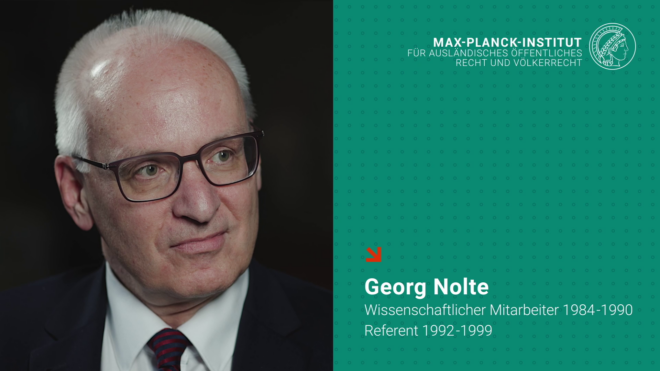
MPIL100 Conversation with Georg Nolte

Watch the video on Youtube

International law does not simply rise or fall, but it takes on new forms, constantly reshaped by shifting historical constellations. That is the conviction running through Georg Nolte’s life in law: from divided Berlin to MPIL’s seminar rooms and, today, the bench of the International Court of Justice.

Tracing his path from a young comparativist at the Max Planck Institute for Comparative Public Law and International Law to a judge at the World Court hearing cases on war and planetary crisis, Nolte revisits Cold War paralysis, the brief euphoric upswing of the 1990s UN, and the contested Kosovo intervention. Encounters and collaboration with mentors like Jochen Frowein and Thomas Franck become professional and personal markers in a shifting landscape where the promise of “constitutionalisation” collides with global power dynamics.

Rather than deploring the “end” of international law amid today’s Security Council deadlock, Nolte recasts the field as a dynamic series of crises and reactivation. Old texts, he argues, can suddenly regain force and credibility when political constellations change.

In dialogue with Jannika Jahn and Alexandra Kemmerer, Nolte turns a personal institutional memory into a broader reflection on international law’s history and present.

This interview was recorded on 8 December 2025 at the Peace Palace in The Hague.

About Georg Nolte

Hier klicken, um den Inhalt von YouTube anzuzeigen.
Erfahren Sie mehr in der Datenschutzerklärung von YouTube.

Georg Nolte is a judge at the International Court of Justice and one of the leading voices in contemporary international law. In his formative years at MPIL, he focused in particular on freedom of expression, military intervention by invitation, and the changing role of the United States within the international legal order. His career as an academic combined professorships in Göttingen, Munich and Humboldt-Universität zu Berlin with service on the Venice Commission of the Council of Europe and membership of the UN International Law Commission, including his mandate as Special Rapporteur on “Subsequent agreements and subsequent practice in relation to interpretation of treaties” and his ILC-chairmanship 2017, before his election to the ICJ.

Cold War Tool, Hot War World: The Heidelberg Method in European International Law.

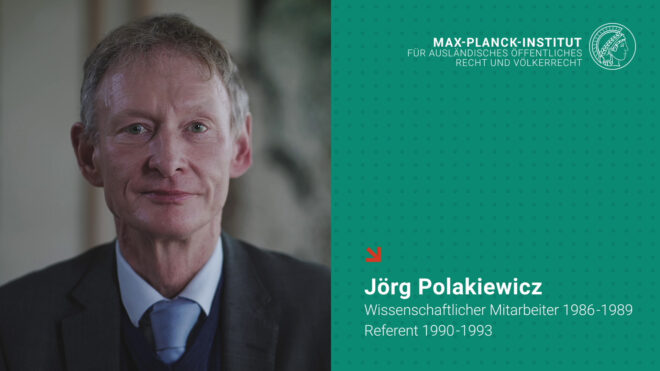
MPIL100 Conversation with Jörg Polakiewicz

How does a scholar trained in the quiet libraries of Heidelberg end up crafting the legal response to a war of aggression? For Jörg Polakiewicz, Director of Legal Advice at the Council of Europe, the answer lies in a specific intellectual DNA: the “Heidelberg Method”—a disciplined fusion of doctrinal rigour and comparative analysis that has proven unexpectedly vital in times of geopolitical fracture. Polakiewicz’s journey begins in the late 1980s, where the Institute served as a calm island amidst the storm of reunification. He recalls the surreal disconnect of November 1989: while the Berlin Wall fell, debates continued in the institute’s seminar rooms as if nothing had happened. He also candidly admits to a “Western bias” that once rendered the East invisible to him. It was only through the Institute’s guests that he encountered the suppressed histories of the Baltic states, sparking a realisation that would define his career: a legal order built only on Western assumptions is fragile. Today, as the Council of Europe confronts Russia’s war against Ukraine, Polakiewicz demonstrates how academic theory transforms into political survival. From the confidential corridors of the 1990s to the transparent, civil-society-driven landscape of today, he traces the evolution of European human rights protection. He argues that the Council’s power lies not in political muscle, but in its technical legal credibility—a credibility forged in the very methodology he absorbed decades ago. In conversation with Alexandra Kemmerer, Head of MPIL’s Berlin Office, Polakiewicz reveals how the networks built in Heidelberg continue to shape the architecture of international law, proving that in an era of crisis, the most durable weapons are often forged in the rigorous, quiet work of the legal scholar. The interview was recorded at the institute on January 11, 2025.

 About Jörg Polakiewicz

Hier klicken, um den Inhalt von YouTube anzuzeigen.
Erfahren Sie mehr in der Datenschutzerklärung von YouTube.


Jörg Polakiewicz is the Director of Legal Advice and Public International Law at the Council of Europe, where he has served in various key capacities since 1993. A former research fellow at the MPIL (1986–1993), he is a leading authority on the interplay between international law and European human rights mechanisms. His work has been instrumental in navigating complex legal challenges, including the EU’s accession to the ECHR and the legal responses to the conflict in Ukraine. He is also an Honorary Professor at the Europa-Institut, the Saarland University International Law School in Saarbrücken.

International Law in the Time of Monsters.

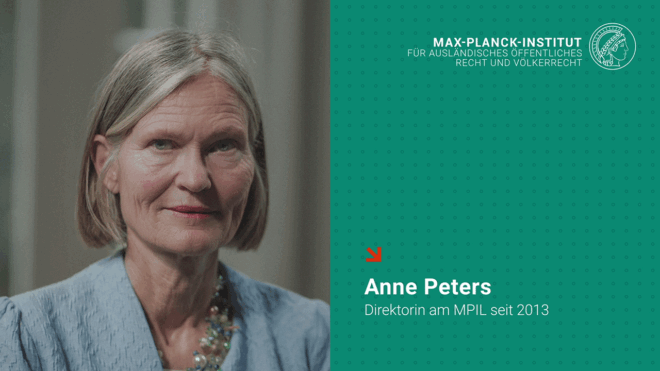
MPIL100 Conversation with Anne Peters

Is international law facing a paradigm shift? When Anne Peters arrived in Heidelberg in 2013, she was the first female director in the Max Planck Institute’s nearly 90-year history. Her appointment lecture, subtitled “Against Epistemic Nationalism,” signalled a clear break from tradition: she wanted to globalise the Institute and end the era of purely “German” international legal scholarship. Today, that global vision is being tested like never before. In a world shaken by the war in Ukraine, the conflict in Gaza, and the return of a U.S. administration that actively negates international norms, Peters sees a “Time of Monsters” where the very language of law is under siege. In this MPIL100 conversation with IL Professor Heike Krieger (Free University Berlin), Peters reflects on leading the Institute through this turbulent decade. She discusses the persistent “closed shop” of German academia that hurdles international scholars, the subtle but real barriers women still face in legal careers, and why she advocates for “scholarly activism” despite populist backlash. From her experiences with censorship in China to internal debates over the Israel-Gaza conflict, Peters argues that while international law may be shifting with global power, scholars cannot afford to stay silent. As she notes, “for if we do not do that, who else is supposed to do it?”

 About Anne Peters

Hier klicken, um den Inhalt von YouTube anzuzeigen.
Erfahren Sie mehr in der Datenschutzerklärung von YouTube.

Anne Peters is a Director at the Max Planck Institute for Comparative Public Law and International Law in Heidelberg and a professor at the universities of Heidelberg, Free University Berlin, and Basel. A leading voice in global animal law and international governance, she has served as a member of the Permanent Court of Arbitration and was the first female President of the German Society of International Law (2019–2023). Her research spans the humanisation of international law, global constitutionalism, and the legal status of non-human animals. She is currently analysing the transformative shifts in the international legal order amidst rising geopolitical tensions.

Turning Enemies Into Constitutional Partners

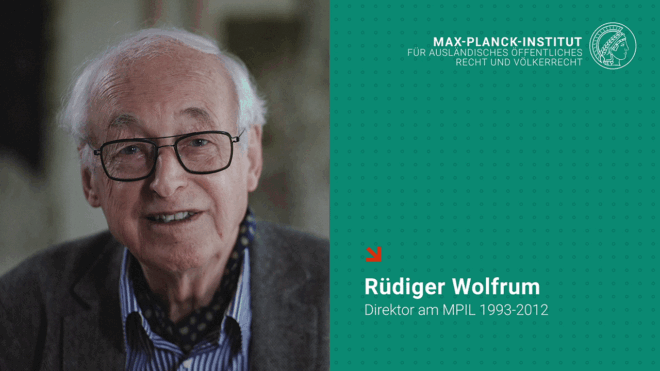
MPIL100 Conversation with Rüdiger Wolfrum

When rival Sudanese delegations arrived in Heidelberg in 2002, they refused even to share a hotel lobby. Three sleepless weeks later they walked out of the Max Planck Institute with a joint bill of rights that became the spine of Sudan’s 2005 Interim Constitution.

At the center was Rüdiger Wolfrum: international judge, peace-broker, and the first “outsider” ever hired to direct the institute. He insists academia should do more than publish; it should settle real disputes. “The Foreign Office never touched our text,” he recalls, proud of a process that mixed 3 a.m. draft sessions with feedback from chiefs, mayors, and imams.

Wolfrum emphasizes that the advisory group at these negotiations included acclaimed experts from both the Global South and North—among them Judge Tafsir Malick Ndiaye (Senegal), Judge Thomas A. Mensah (Ghana), Prince Raad bin Zeid (Jordan), Professor Fred Morrison (USA), and Ambassador Tono Eitel (Germany). Crucially, representatives from both Sudan and South Sudan were able to fully participate and shape the process. As Wolfrum notes, “A constitution that is imposed — or even merely feels imposed — can never achieve the acceptance necessary for its effectiveness.”

In this MPIL100 conversation with Moritz Vinken, Wolfrum explains how academia can host hard political talks, and why young scholars shouldn’t choose between rigor and relevance—they can, and must, deliver both.

About Rüdiger Wolfrum

Hier klicken, um den Inhalt von YouTube anzuzeigen.
Erfahren Sie mehr in der Datenschutzerklärung von YouTube.

As a lawyer, Rüdiger Wolfrum bridged courtroom, classroom, and conflict mediation. As president and long-serving judge of the International Tribunal for the Law of the Sea, he helped shape modern maritime jurisprudence while directing the Max Planck Institute for Comparative Public Law and International Law in Heidelberg. A builder of legal knowledge infrastructures, he spearheaded the Max Planck Encyclopedia of Public International Law (MPEPIL) and the Journal of the History of International Law (JHIL), and advanced ideas like solidarity as a structural principle of international law. Beyond scholarship, he advised peace and constitution-making processes in Sudan, South Sudan, and Lebanon, designing inclusive, locally grounded negotiations. His work—a blend of doctrine and practice—has influenced courts, scholars, and policymakers, and continues through the Max Planck Foundation for International Peace and the Rule of Law.

The Thread Running Through the Institute’s History

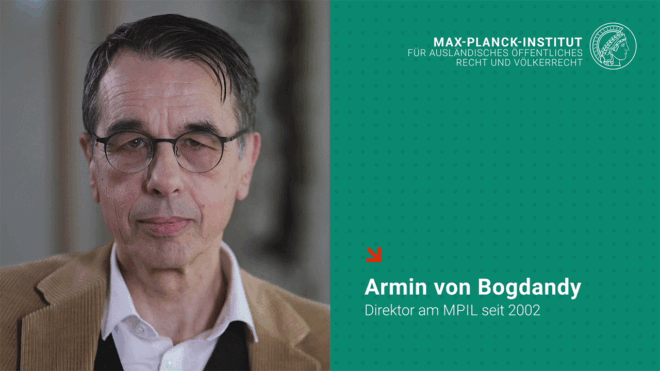
MPIL100 Conversation with Armin von Bogdandy

What connects a century of work at the Max Planck Institute for Comparative Public Law and International Law? For Armin von Bogdandy, one “red thread” runs through its history: Germany’s two lost world wars and the ways legal scholars grappled with their consequences.

Starting from a striking 1989 triptych of the day after the Berlin Wall fell, von Bogdandy traces the Institute’s journey from its 1924 founding in the shadow of Versailles, through the moral compromises of the Nazi period, to post‑war reconstruction and European integration. Debates over German division, Ostpolitik and constitutionalism emerge as different responses to defeat and its ramifications.

As institutional memory fades—over half the staff are under 35—von Bogdandy questions whether an institution can still claim a single identity. Its strength, he argues, lies less in a shared narrative than in productive disagreement about past and future.

In conversation with historian Philipp Glahé, von Bogdandy recasts MPIL’s history as an ongoing dialogue between law, politics and memory—held together by a contested yet inescapable red thread.

About Armin von Bogdandy

Hier klicken, um den Inhalt von YouTube anzuzeigen.
Erfahren Sie mehr in der Datenschutzerklärung von YouTube.

Armin von Bogdandy is director at the Max Planck Institute for Comparative Public Law and International Law in Heidelberg, pairing rigorous theory with engagement in constitutional and rule‑of‑law crises. He helped coin influential frameworks — “international public authority,” analysing how actors like the OECD shape national policy through information, and “transformative constitutionalism,” advancing regional human rights–driven change in Latin America. He has contributed legal analyses and proposals that inform EU debates on democratic backsliding. A recipient of multiple honorary doctorates, he exemplifies the scholar‑practitioner: multilingual, philosophically trained, and comparative in outlook. His work insists that law’s deepest questions transcend borders — and that answering them demands both conceptual ambition and institutional craftsmanship.

Why Translating Law Means Translating Culture

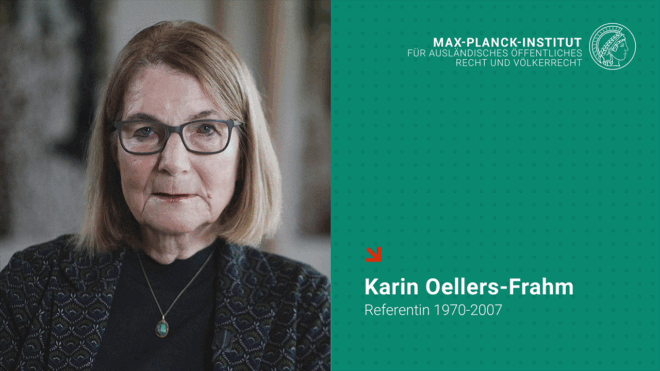
MPIL100 Conversation with Karin Oellers-Frahm

Legal concepts rarely transfer neatly from one system to another. Over five decades at Heidelberg’s Max Planck Institute for Comparative Public Law and International Law, Karin Oellers-Frahm saw how familiar‑looking terms can have very different meanings across jurisdictions. Trained as a French‑Italian interpreter in the 1970s, she soon moved into international law, building a career that combined linguistic skill with deep engagement in comparative and public international law.

From co‑editing a leading commentary on the Statute of the International Court of Justice to witnessing the Institute’s shift from German‑only conferences to an English‑dominated discourse, she learned that true precision rests on cultural fluency as much as on translation. As machine translation advances and English becomes academia’s common language, she reflects with MPIL’s Carolyn Moser and Philipp Glahé on what may be lost — and why future international lawyers must master the legal cultures behind the words.

About Karin Oellers-Frahm

Hier klicken, um den Inhalt von YouTube anzuzeigen.
Erfahren Sie mehr in der Datenschutzerklärung von YouTube.

Karin Oellers-Frahm rose from interpreter training to become one of Germany’s quiet power brokers in international law. After stints translating at the nascent European Community, she joined Heidelberg’s Max Planck Institute for Comparative Public Law and International Law in 1970—an uninvited female newcomer in a world of male jurists. There she helped turn dusty court files into living doctrine: her early thesis that provisional measures of the International Court of Justice must bind states later shaped ICJ jurisprudence. A polyglot with a taste for method, she co-edited the leading commentary on the Court’s Statute, steered the monumental “Fontes” case-law series and mentored generations through Jessup moot courts. Half a century on, alumni still carry the MPI imprint she personifies: rigor, linguistic precision, and an insistence that law’s global dialogue depends on culture as much as codes.

A Librarian’s Voice in the Age of Search and Access

MPIL100 Conversation with Joachim Schwietzke

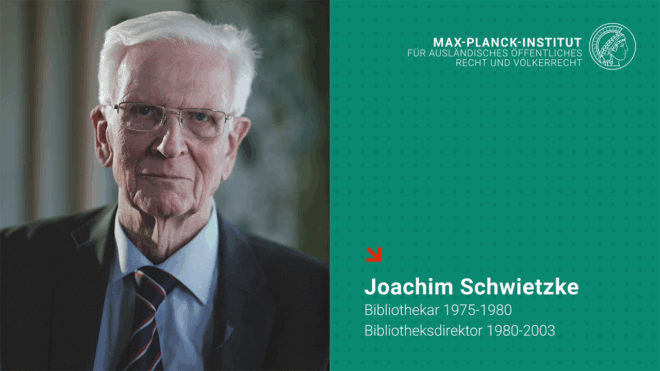
“The library serves the institute”, says Joachim Schwietzke and unfolds a century‑spanning portrait of the MPIL’s collection: from Berlin Palace and a “central room” featuring a paper index, through wartime loss and postwar rescues, to Heidelberg’s systematically arranged library stacks stretching 43 kilometres. He argues that serious international and public law research rests on curated foundations: treaties, statute and case reports, parliamentary records, and the publications of the UN, EU, and League of Nations—framed by a General Section that puts law in dialogue with history, philosophy, sociology, and military and colonial studies. Against keyword search, Schwietzke defends expert selection, multilingual breadth, and on‑site browsing—methods that keep scholarship anchored in sources and context, and keep the institute’s mission at the heart of the library.

About Joachim Schwietzke

Hier klicken, um den Inhalt von YouTube anzuzeigen.
Erfahren Sie mehr in der Datenschutzerklärung von YouTube.


Joachim Schwietzke, a lawyer turned librarian, helped shape one of the world’s preeminent specialist law libraries at the Max Planck Institute for Comparative Public Law and International Law in Heidelberg. Joining the institute in 1975 and later serving as Library Director, he steered its transformation from paper indexes to digital systems while expanding a systematically arranged, closed‑stacks collection spanning international law, comparative public law, legal philosophy, and a striking General Section that embeds law in history, sociology, and military and colonial studies. A longtime leader in the International Association of Law Libraries, he also co‑authored widely used bibliographical compendia on diplomatic conferences and multilateral treaty practice (1641–1924), reference works that bridge archival rigor and scholarly utility.

The Art of Academic Resilience in an Age of Intellectual Fragility

MPIL100 Conversation with Juliane Kokott

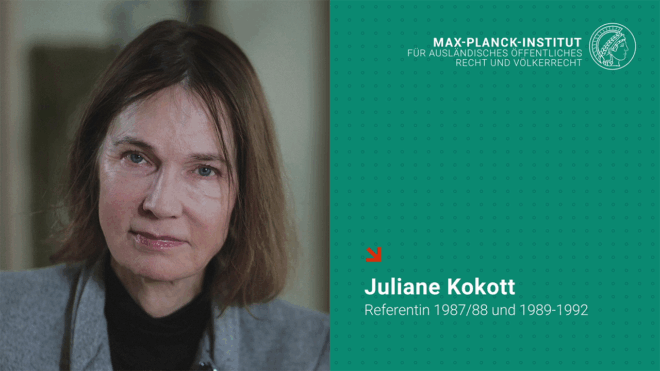
“You don’t always have to be right immediately,” reflects Juliane Kokott—advice that feels radical in today’s academic climate. While today’s emerging scholars often feel compelled to retreat from intellectual risk, Kokott’s path from Max Planck researcher to Europe’s longest-serving Advocate General reveals what intellectual courage actually looks like.

Her story begins in 1980s Heidelberg, where academic debates were “crushing” affairs that could end careers. Yet Kokott learned to separate personal worth from intellectual criticism. “If someone thinks the view is wrong, you just discuss it with the next person,” she explains. Her approach of waiting, reflecting, and returning with stronger arguments contrasts sharply with today’s publish-or-perish anxiety and social media pile-ons, so often felt as oppressive burdens by today’s younger scholars.

From handwritten manuscripts to digital courtrooms, from being one of two women among thirty men to shaping European law through 500-plus judicial opinions, Kokott’s career shows that intellectual resilience isn’t about armor—it’s about staying curious when others quit.

In conversation with MPIL’s Robert Stendel and Philipp Glahé, Kokott reveals precious, seemingly forgotten techniques of academic survival and why the next generation desperately needs to relearn them.

Hier klicken, um den Inhalt von YouTube anzuzeigen.
Erfahren Sie mehr in der Datenschutzerklärung von YouTube.

About Juliane Kokott

Juliane Kokott has carved an uncommon path from Heidelberg lecture halls to the bench of Europe’s highest court. A double-doctorate scholar with credentials from Harvard and Washington, she honed her comparative legal instincts during pivotal years at the Max Planck Institute for International Law, where she navigated country departments spanning Inter-American human rights to European Community law while becoming one of the first women to habilitate there.

She traded ivory-tower contemplation for frontline legal impact in 2003, when she became Advocate General at the Court of Justice of the European Union—only the third woman ever to hold the post and now its longest-serving voice. Her more than 500 influential opinions, spanning competition, tax and fundamental rights, are famed for crisp language and comparative depth rooted in her Max Planck training in empirical, cross-border legal analysis. Kokott balances scholarship—professorial stints across Germany and Switzerland, editorships and global tax projects—with a reputation for principled advocacy for gender equality. Colleagues call her the Court’s “comparative conscience,” a jurist who turns sprawling doctrine into pragmatic guidance for a rapidly integrating Europe.

A Legal-Academic Island During the 1968 Upheaval

MPIL100 Conversation with Konrad Buschbeck

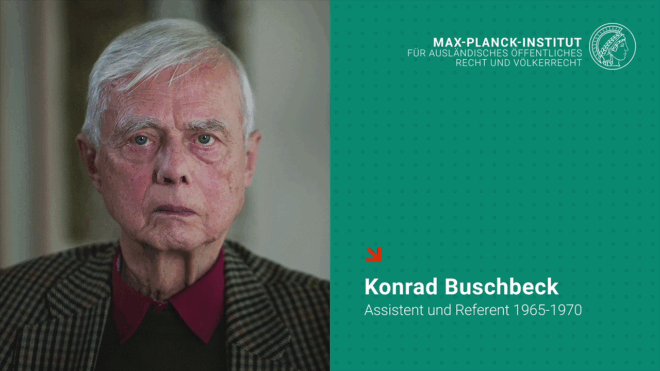
While students rioted in Heidelberg’s streets and police stormed lecture halls, Konrad Buschbeck spent nights on a leather sofa, keeping watch over the Institute’s precious library. “We lived in another world,” he recalls of the legal scholars who remained largely untouched by the 1968 upheaval raging just miles away.

From 1965-1970, Buschbeck inhabited this insulated academic haven—a tight-knit community of “male German jurists” where formal address was standard and soccer games fostered the only informality. The Institute’s researchers heard about protests like “war correspondents,” reporting back from the outside world while their own routines continued undisturbed.

This isolation reflected deeper patterns: a generation’s reluctance to confront the Nazi past of figures like Carl Schmitt, whose “fascinating” intellect Buschbeck had encountered firsthand. While revolution called for accountability, the Institute’s elite networks quietly prepared members for careers in government, diplomacy, and European institutions.

Buschbeck’s reflections reveal how academic privilege can create both opportunity and blind spots. His journey from this protected world to roles including Germany’s first Science Attaché to Poland illustrates the complex legacy of institutions that shaped postwar German elites while remaining largely detached from the social upheavals around them.

About Konrad Buschbeck

Hier klicken, um den Inhalt von YouTube anzuzeigen.
Erfahren Sie mehr in der Datenschutzerklärung von YouTube.

Konrad Buschbeck is a retired German diplomat and legal scholar who bridged law, science policy, and international relations. Born in 1938, he earned his doctorate at the Max Planck Institute for Comparative Public Law and International Law (1965-1970) under Professor Karl Doehring.

His career exemplified the Institute’s “revolving door” function, transitioning from academia to high-level government roles. He served as legal counsel for the German Red Cross on Geneva Convention reforms and held positions in the Federal Ministry for Education and Research, Germany’s EU representation during enlargement.

His capstone role was as Germany’s first Science Attaché to Poland (post-1989), where he orchestrated the first official visit of a Max Planck Society president to Poland, advancing bilateral scientific cooperation during post-Cold War reconciliation. He received the Foundation for Polish Science’s Honorary Distinction for fostering German-Polish ties.

From Terrorism to AI: Legal Scholarship in Changing Times

MPIL100 Conversation with Silja Vöneky

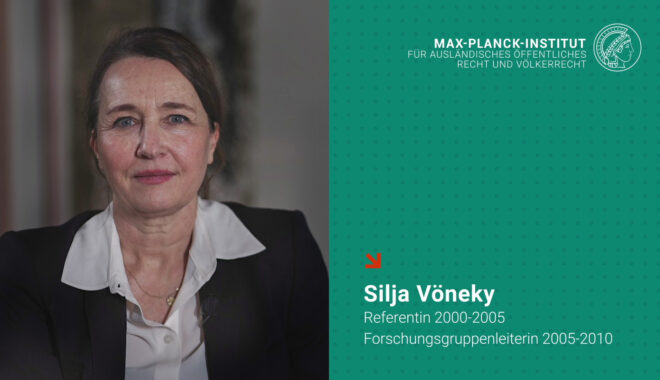
“As a scholar, one is committed to truth,” says Professor Silja Vöneky—a guiding principle throughout her two decades at the intersection of law and ethics. Beginning at Heidelberg’s Max Planck Institute in 1995 with environmental law, Vöneky’s focus pivoted dramatically after 9/11. She controversially argued that the Geneva Conventions might apply to terrorism if state involvement could be proven.

Her career spans international law, bioethics, and most recently, the legal regulation of artificial intelligence—always prioritizing rigorous, principled debate over political convenience. Vöneky’s impact isn’t just academic: she’s brought theory into practice as a peace negotiator in Sudan and expert in Antarctic treaty talks.

In conversation with MPIL’s Silvia Steininger, Vöneky reflects on how academia itself has changed: from hierarchical meetings to more collaborative, interdisciplinary work. Her story illustrates the ongoing challenge for scholars—upholding foundational principles while adapting to a rapidly changing world.

The Interview was conducted in January 2025.

About Silja Vöneky

Hier klicken, um den Inhalt von YouTube anzuzeigen.
Erfahren Sie mehr in der Datenschutzerklärung von YouTube.

Professor Silja Vöneky is one of Germany’s most influential legal scholars at the crossroads of international law, ethics, and technology. As a judge on the Constitutional Court of Baden-Württemberg and Professor at the University of Freiburg, she has shaped thinking on the legal and ethical governance of AI and biotechnology. Vöneky’s career began with environmental law and expanded to global legal responses to terrorism after 9/11, where her rigorous, independent approach advanced the application of humanitarian principles. She has chaired major ethics councils, led interdisciplinary research from German and international platforms, and is known for bridging law, philosophy, and technical innovation. Her commitment to public service, mentorship, and truth has established her as a leading voice on how democracies confront the legal challenges brought about by rapid scientific and technological change.