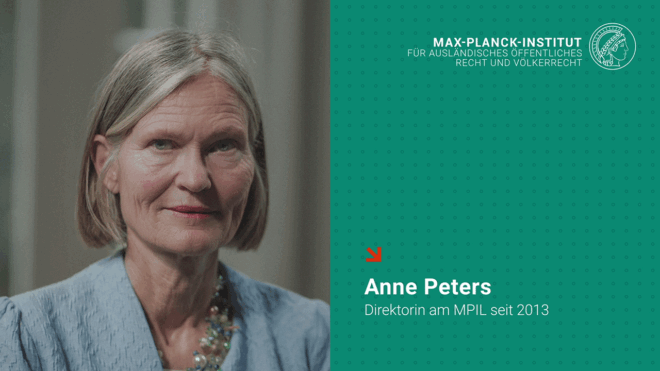
Is international law facing a paradigm shift? When Anne Peters arrived in Heidelberg in 2013, she was the first female director in the Max Planck Institute’s nearly 90-year history. Her appointment lecture, subtitled “Against Epistemic Nationalism,” signalled a clear break from tradition: she wanted to globalise the Institute and end the era of purely “German” international legal scholarship. Today, that global vision is being tested like never before. In a world shaken by the war in Ukraine, the conflict in Gaza, and the return of a U.S. administration that actively negates international norms, Peters sees a “Time of Monsters” where the very language of law is under siege. In this MPIL100 conversation with IL Professor Heike Krieger (Free University Berlin), Peters reflects on leading the Institute through this turbulent decade. She discusses the persistent “closed shop” of German academia that hurdles international scholars, the subtle but real barriers women still face in legal careers, and why she advocates for “scholarly activism” despite populist backlash. From her experiences with censorship in China to internal debates over the Israel-Gaza conflict, Peters argues that while international law may be shifting with global power, scholars cannot afford to stay silent. As she notes, “for if we do not do that, who else is supposed to do it?”
About Anne Peters
Anne Peters is a Director at the Max Planck Institute for Comparative Public Law and International Law in Heidelberg and a professor at the universities of Heidelberg, Free University Berlin, and Basel. A leading voice in global animal law and international governance, she has served as a member of the Permanent Court of Arbitration and was the first female President of the German Society of International Law (2019–2023). Her research spans the humanisation of international law, global constitutionalism, and the legal status of non-human animals. She is currently analysing the transformative shifts in the international legal order amidst rising geopolitical tensions.